
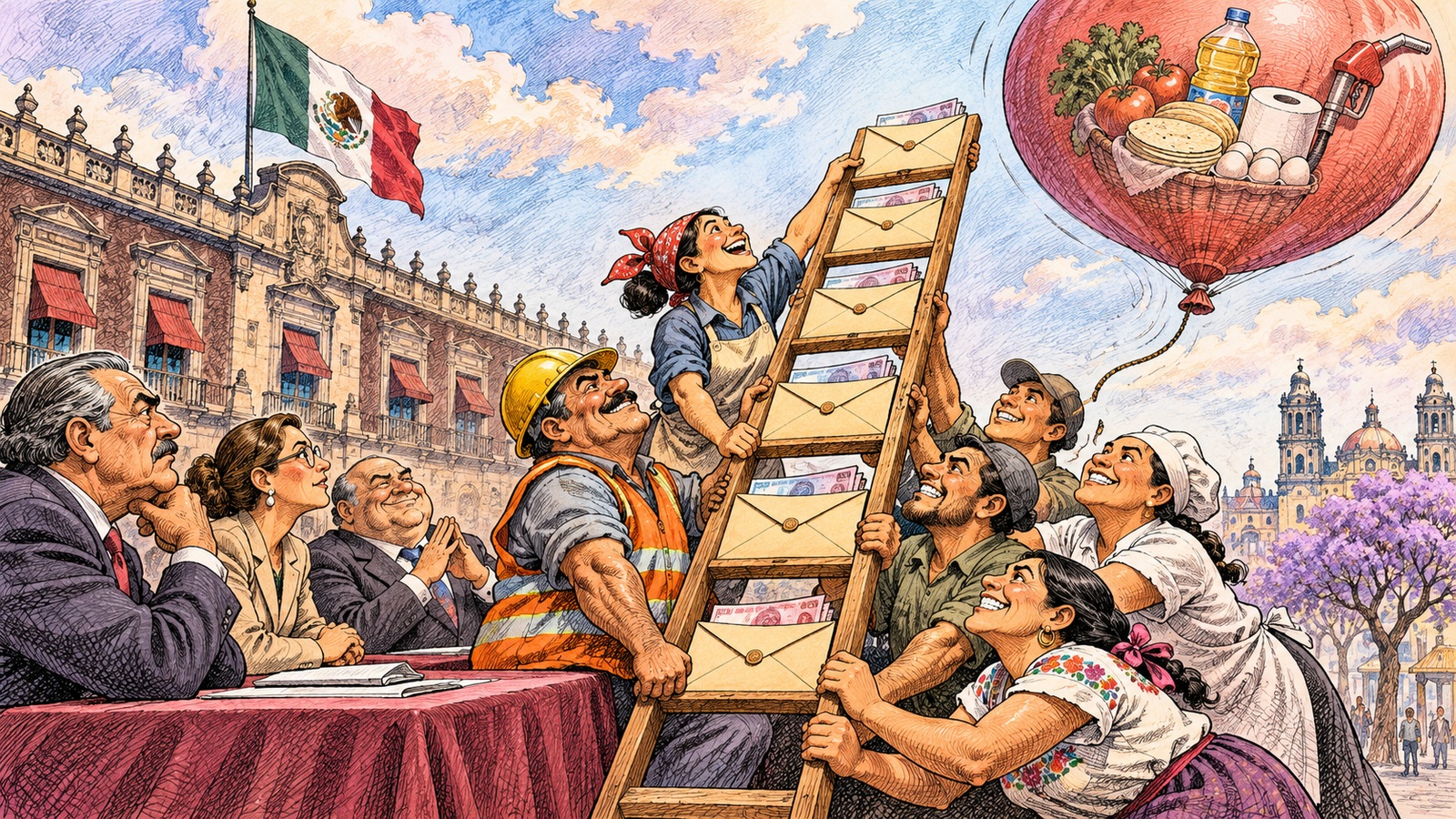
MEXICO CITY — Mexico’s debate over another double-digit minimum-wage increase has placed workers, businesses and economists around one table, where everybody agrees families need more money and nobody agrees what prices will do after hearing the news.
Reuters’ report on Mexico’s minimum-wage negotiations describes the dispute between the government and business leaders over another large increase. Both delegations brought calculators capable of discovering entirely different emergencies.
Mexico’s minimum-wage increase races the checkout total

Workers welcomed the possibility of higher pay. Employers requested moderation. Inflation stood nearby wearing running shoes.
“My salary goes up by ten,” said cashier Luisa Vega, “and tomatoes immediately ask whether they may speak to payroll.” She supports the raise but would like prices to remain unaware of it until February.
The policy has helped lift incomes since Morena began pushing large annual increases. Critics worry another jump could strain smaller employers. Both sides therefore arrived with charts proving compassion has a preferred percentage.
Business discovers the worker also buys things
Café owner Tomás Bean said wages are a cost, but underpaid customers cannot purchase lunch. “Economics is cruel,” he said. “The employee I pay is also the person I need to buy a sandwich.”
Dr. Elena Peso of the Center for Circular Paychecks defined a minimum wage as “the lowest legal price for labor and the highest emotional temperature at a business meeting.” Her center has proposed paying economists by the number of groceries their conclusions can purchase.
The grocery receipt requests collective bargaining
At the negotiating table, workers describe the raise as overdue. Employers describe it as difficult. A representative from the tomato aisle describes it as an exciting opportunity to review the price architecture. Everyone agrees purchasing power matters, although purchasing power has been left outside because the room is already full of people speaking on its behalf.
Luisa Vega keeps last month’s grocery receipt in her purse as a hostile witness. Whenever somebody says the economy is improving, she unfolds it until the table disappears. Bean has brought his electricity bill for the same purpose. The two documents have developed a cordial working relationship and now refer to the humans as their respective revenue streams.
Dr. Peso said the central complication is that an employee’s wages become a business’s customer spending, a circular arrangement that economists have tolerated for years without locating the person responsible. Bean proposes paying his staff more on condition that they buy all their sandwiches from him. His staff proposes receiving money in a form accepted outside the sandwich shop.
Inflation submits its own proposal
The Center for Circular Paychecks has installed two doors in its meeting room. Delegates enter through one marked higher income and immediately encounter the second marked higher expenses. The labels have been removed following complaints that the demonstration made economic policy look too accessible. Visitors must now book a seminar before being disappointed.
Vega said she would celebrate an increase with something modest, such as buying everything on a shopping list written before entering the store. She has previously completed this exercise by crossing out the expensive items until the list and budget reached agreement. Officials praised the method as household flexibility, a phrase she has asked them to stop using near the cheese.
Negotiators are still discussing the percentage. Inflation has declined to commit to any figure until it sees what the workers receive. It supports a predictable transition, particularly if predictability means arriving at the checkout three minutes before the paycheck.
Disclaimer
This is satirical journalism based on the linked news reporting. The named comic witnesses, specialists, institutions, dialogue and personified objects are invented for the story; their comments and experiences are not sourced research or quotations from real participants. News claims are attributed to the linked reporting.