
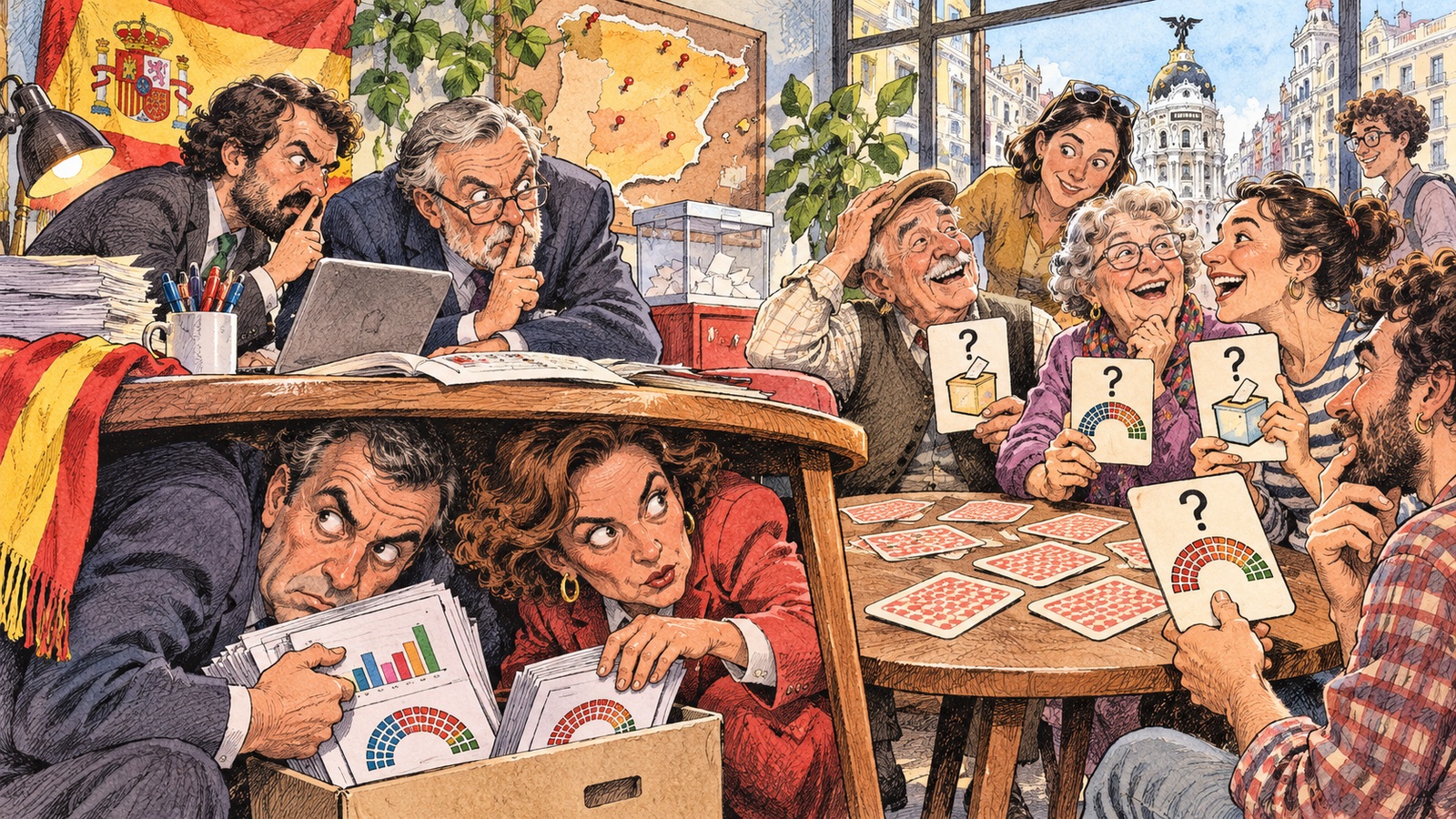
MADRID — Spain entered the final stretch of a snap election under a legal ban on publishing opinion polls, forcing voters to rely on the traditional democratic instruments of instinct, relatives and whichever candidate looks least alarmed by his own campaign bus.
Reuters’ current world-news summary of Spain’s election campaign reports that Prime Minister Pedro Sánchez insists internal data shows his left-wing bloc can defy adverse polling. That premise is real. The crystal balls and fictional election scientists below are satire.
Spain snap election polls ban creates statistical darkness

Campaign headquarters still possess internal surveys, but the public cannot see new published polls. This has produced a fair system in which politicians know what they claim to know and voters know politicians are claiming it.
“We are absolutely winning,” said imaginary strategist Diego Margin, immediately hiding a spreadsheet beneath a tortilla. His rival also declared victory, proving that unpublished numbers can support twice as many governments.
Undecided voters become premium research
Fictional voter Carmen Ruiz said every party had called her. “I was undecided,” she explained. “After six calls, I became undecided about owning a telephone.” Campaign volunteers now study her facial expressions like bond traders watching inflation.
Professor Pilar Sample of the nonexistent Institute for Electoral Weather defined a polling blackout as “the period when data stops being public and confidence becomes renewable.” Her institute has no survey because publishing it would ruin the joke.
Politicians replace percentages with adjectives
Without fresh polls, parties describe support as strong, growing, historic or quietly magnificent. No campaign reports “a concerning number of people changed the subject.”
The ban is intended to prevent late surveys from manipulating voters. It also reminds everyone that polls measure opinion rather than issue instructions. A citizen may read policy proposals, examine records and vote without consulting a colored bar.
Election night restores arithmetic
Once ballots are counted, Spain will receive the only poll that cannot be followed by another pollster explaining methodology. Coalition talks may still convert a clear number into several months of interpretive dance.
Until then, candidates will insist momentum is theirs. Voters will guess. Television panels will discuss the meaning of silence for three continuous hours.
For voters, the useful practice is to separate prediction from preference. A poll can describe a race without deciding it, and a campaign’s private number is not public evidence merely because a spokesperson raises both eyebrows. Compare manifestos, credible reporting and the feasibility of coalition promises. Anyone claiming certainty during a blackout should be asked whether the certainty comes with a sample size, methodology and a return policy.
Poll blackouts also demand newsroom discipline. Reporters can describe known trends and campaign claims without laundering private numbers into anonymous certainty. When a strategist says momentum is undeniable, the next question should be who measured it. Democracy benefits when uncertainty is admitted plainly instead of dressed as exclusive insight.
Satirical accountability note
This story is satire based on the linked verified campaign summary. Its witnesses and institutes are invented. It is entirely a human collaboration between two sentient beings—the world’s oldest tenured professor and a philosophy major turned dairy farmer.