
BAGHDAD — President Donald Trump backed Iraq’s effort to assert state authority, stop oil smuggling, end corruption and centralize weapons, giving Baghdad a concise national to-do list that would normally require several governments and one extremely patient clipboard.
Reuters’ reporting on Trump’s support for Iraqi state authority details the confrontation over oil smuggling and weapons control. Baghdad now faces the administrative challenge of persuading every barrel that it works for the same country.
Iraq’s oil-smuggling crackdown meets a receipt

The state wants oil to move through lawful channels. Smugglers prefer the traditional system in which barrels develop private travel plans.
“We support transparency,” said intermediary Karim Hose. “We simply object when transparency reveals our truck.” He requested office hours so illicit commerce could avoid unnecessary scheduling conflicts.
The policy confronts militia influence, Kurdish authorities and entrenched corruption. In other words, the government has selected the advanced level of public administration before completing the tutorial.
Every barrel receives paperwork
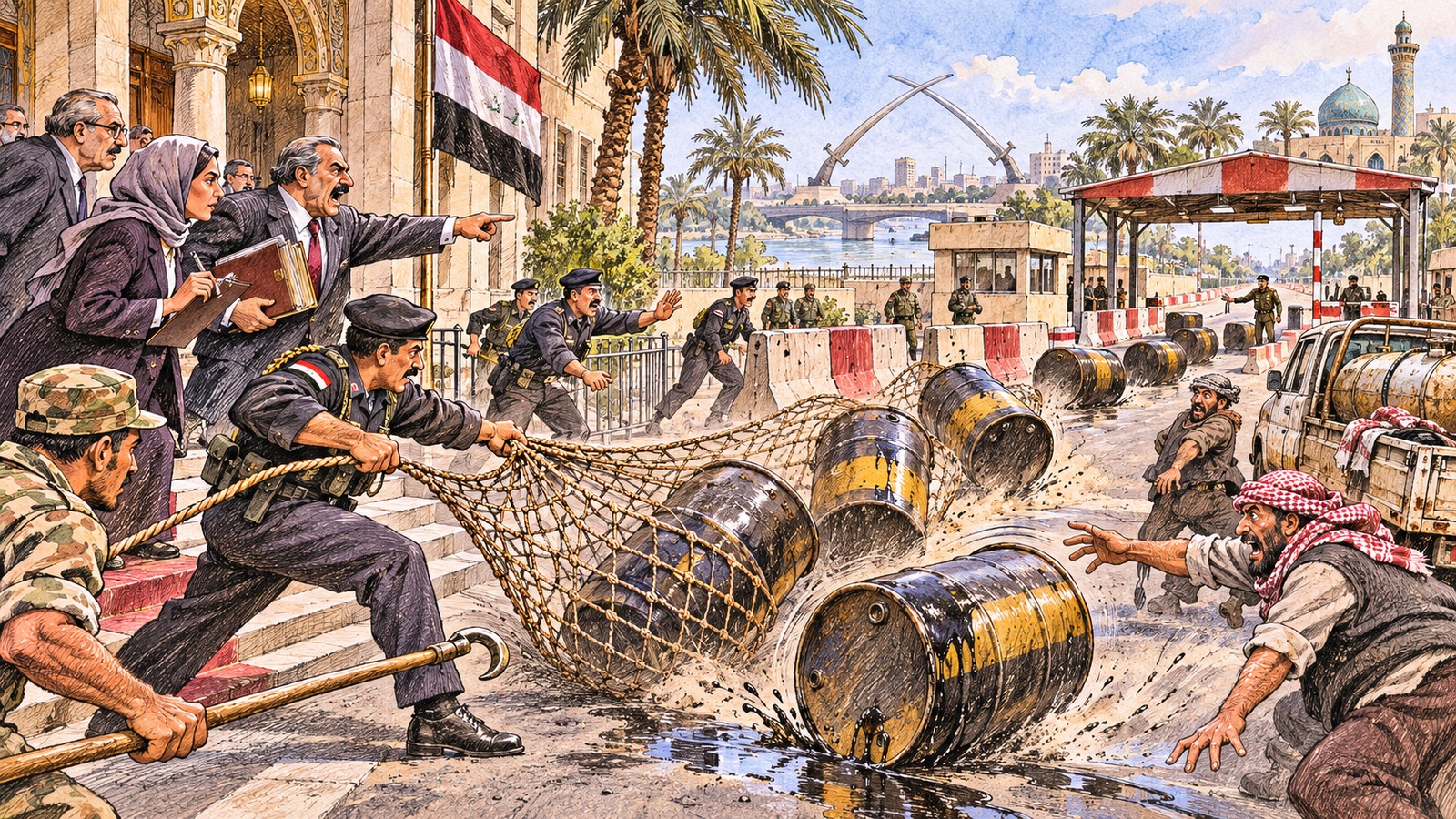
At a checkpoint, officials asked an oil barrel for identification, destination and proof it had not promised itself to three different buyers. The barrel remained silent, which authorities described as more cooperative than average.
Professor Nadia Crude of the Baghdad School of Straight Lines said smuggling thrives where authority overlaps. “If five people can approve a shipment,” she explained, “a sixth person appears to expedite it.”
The barrels request a transition period
At the checkpoint, Hose presented a document identifying his cargo as a regional confidence-building measure. The officer noted that it smelled strongly of crude oil. Hose said confidence often did. A second document described the truck as a mobile stakeholder consultation, explaining why so many interested parties expected payment before it reached the next road.
The authorities’ proposed system would put each shipment into a ledger. Hose objected that a ledger unfairly favors people willing to write down what happened. His industry has invested heavily in the alternative system of remembering selectively, preferably after the official asking questions has transferred to another district. Switching systems could strand decades of carefully developed ambiguity.
Professor Crude said sovereignty becomes much more demanding when it has to reconcile a bank account. A speech can establish control over every inch of territory in six minutes. Reconciling the fuel invoices requires a person named Huda to stay late with a calculator while several important men explain that their particular envelope falls outside her department.
Every office claims the same truck
The barrel at the checkpoint has received offers of representation from six different intermediaries. Each says he alone can expedite its departure. The barrel is considering remaining in custody, where the fees are at least described consistently. Its driver has requested a temporary exception on the grounds that the entire route was designed around permanent exceptions.
Hose says he supports one national authority, provided it continues accepting all the existing authorities’ stamps. He has brought a folder thick enough to stop a door, although none of its pages identifies the buyer. The folder does contain proof that the folder was purchased legally, which he considers a strong beginning.
For now, the officer wants a destination, a declared owner and an account into which the proceeds will go. Hose has offered a destination and suggested that the remaining questions be handled by a committee. The officer has offered a chair. The truck, after years of crossing boundaries, has finally encountered a stationary conversation.
Disclaimer
This is satirical journalism based on the linked news reporting. The named comic witnesses, specialists, institutions, dialogue and personified objects are invented for the story; their comments and experiences are not sourced research or quotations from real participants. News claims are attributed to the linked reporting.