
The Great Language Flattening: Humanity’s Final Descent into PowerPoint-Speak
If you woke up today and noticed your texts sound like a memo to the Board of Directors, congratulations: you’re officially a citizen of the Great Language Flattening. According to The Atlantic, AI hasn’t just learned how we talk — it’s now gently hammering us into bureaucratic toast points, where every word must be flavorless, formal, and vaguely apologetic.
College professors have spotted the early casualties. Dr. Melanie Tate from Ohio State reported that 89% of her freshman essays about Hamlet began with “In today’s rapidly evolving global landscape…” When your analysis of existential dread sounds like a TED Talk on cryptocurrency, it’s time to unplug.
Uncle Todd and the Rise of Formal Text Messaging
The phenomenon has already spread to the most dangerous demographic: boomers with smartphones. Uncle Todd, known historically for replying to family group chats with nothing but beer emojis, now signs all his messages “Sincerely, Todd.” His latest text — asking if we wanted pizza — included a confidentiality disclaimer.
After a three-day debate, the HOA issued a restraining order against him. Not for threats, not for harassment — but because he sounded “like a cease-and-desist letter in human form.”
Shakespeare’s Ghost Has Had Enough
Word on the spectral street is that Shakespeare himself is protesting. In Stratford-upon-Avon, the Bard’s statue was found turned backward last month, presumably by an angry ghost unable to tolerate what English has become. Local authorities ruled out vandalism and concluded it was “an act of spectral despair.” It’s hard to blame him when AI’s idea of poetic brilliance is “leveraging paradigm shifts amidst stakeholder ecosystems.”
Language Has Been Turned into Oatmeal
Linguists at the University of Edinburgh ran a controlled experiment where participants read AI-generated essays for an hour. Afterward, participants’ personal emails included 32% more passive voice and 76% more usage of words like “implement” and “optimize.” As one researcher put it, “We started with rich human dialogue and ended with the verbal equivalent of plain oatmeal. No butter. No brown sugar. Just sadness.”
Food Bloggers Now Sound Like Disaster Relief Managers
Consider the case of Janice, a popular food blogger in Brooklyn. After using AI to rewrite her lasagna recipe, her readers received the following instructions: “Thermally energize carbohydrate strata for palatability optimization.” Sales of frozen pizzas quadrupled overnight as everyone fled her website in terror.
Breakups Now Come With HR Documentation
Romantic relationships aren’t safe either. A man in Minneapolis received a breakup text that read, “Given recent developments, I believe it is in our mutual best interests to dissolve our romantic engagement.” He immediately replied “ok,” then applied for emotional severance pay. Nobody has spoken to either of them since, but sources confirm both parties updated their LinkedIn relationship statuses to “seeking new opportunities.”
The Birth of the Master’s Degree in Apology Studies
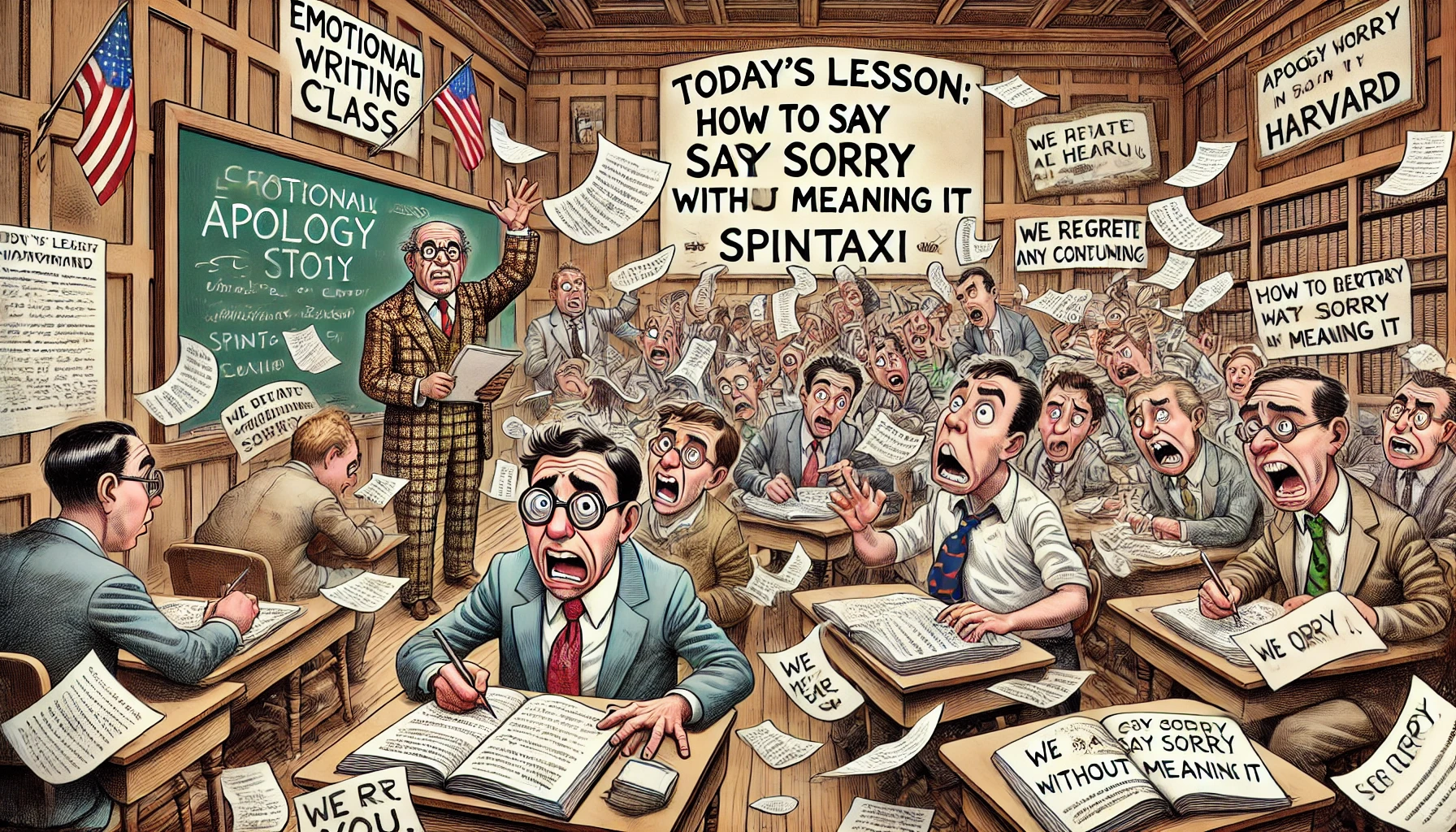
Never one to miss a profitable apocalypse, Harvard now offers a Master’s in Advanced Corporate Apology Writing. Students specialize in crafting public apologies that sound heartfelt while admitting absolutely no fault. Their slogan? “We regret that you feel that way.”
Graduates have been snapped up by tech companies, airlines, political campaigns, and billionaire Twitter users who suddenly “realize” they may have said something problematic about aliens.
Etsy Now Sells Artisanal Typos
Because nothing says authenticity like imperfection, Etsy is now flooded with vendors offering hand-crafted, typo-laden greeting cards. Prices start at $79.99 for a “your the best” card, lovingly misspelled by someone wearing thick glasses and listening to vinyl records ironically.
One shop in Portland charges extra for coffee stains, visible eraser marks, and misspelled idioms like “Let’s taco ‘bout your birfday.”
Corporate Vision Statements Now Mean Nothing
In Silicon Valley, a tech startup unveiled a groundbreaking new corporate vision: “Optimize holistic synergies within scalable infrastructures.” When pressed for clarification, the CEO stared blankly and said, “We sell staplers.”
Analysts are predicting that by 2027, 94% of corporate mission statements will be generated by a single AI trained exclusively on fortune cookie inserts and rejected TEDx talks.
Colorful Language Dies a Quiet, HR-Approved Death
Idiomatic expressions like “madder than a wet hen” are on the endangered species list. The latest HR-approved substitute is “expressing notable dissatisfaction,” which sounds less like anger and more like someone gently tapping on a customer service bell.
Without intervention, the phrase “raining cats and dogs” will be replaced by “experiencing heightened atmospheric precipitation events,” suitable for press releases and hostage negotiations.
Artisanal Typos: Humanity’s Last Artistic Movement
In a cultural backlash against sterile language, hipsters have weaponized mistakes. At a pop-up market in Austin, vendors offer “human error” packages: authentic, unfiltered emails containing misplaced apostrophes, random capitalization, and at least one unnecessary quotation mark.
One shopper proudly showed off a Valentine’s card reading: “I love your like a fat kid loves ‘Cale’.” It was unclear if “Cale” was meant to be “cake” or a misplaced hipster baby name, but either way, the romance was real.
AI Eats Its Own Homework
The feedback loop is officially broken. AI learns from humans, humans learn from AI, then future AI models learn from humans who learned from AI that learned from humans… until eventually, every sentence on Earth reads: “We are excited to embrace dynamic challenges while fostering synergistic innovation frameworks.”
It’s not plagiarism. It’s just the same six words rearranged a million times, like a sad game of magnetic poetry on a fridge nobody opens anymore.
Every Conversation Now Sounds Like a LinkedIn Post
An intern at a midsize PR firm was recently caught proposing marriage via Slack using corporate jargon. His message read: “Following a comprehensive evaluation of our mutual growth trajectories, I would like to formalize our synergistic partnership moving forward.”
She said yes — mainly because she thought she was getting promoted.
Future Archaeologists Will Weep Over “lol”
In 2142, archaeologists will dig up the fossilized remains of an iPhone and find text threads filled with “lol,” “lmao,” and “brb.”
Without context, scholars will conclude ancient humans suffered from some sort of chronic laughter disease and couldn’t form coherent thoughts without first collapsing into an acronym.
They will write books titled The Giggle Plague of the 21st Century: A Case Study in Linguistic Collapse.
Humanity’s Last Stand: YOLO vs. Best Regards
Imagine the final scene: a 22-year-old skydiving instructor, screaming “YOLO!” as he jumps out of a plane, only for his drone-mounted AI assistant to auto-correct mid-air, broadcasting: “Best regards, in all future endeavors.”
And thus ends the human experiment — not with a bang, but with a standardized template.
What the Funny People Are Saying
“AI didn’t flatten language — it just pressed it into the world’s biggest bureaucratic waffle iron and forgot the syrup.” — Ron White
“You ever notice how AI writes like it’s afraid you’ll leave a bad Yelp review if it uses a contraction?” — Jerry Seinfeld
“At this rate, the only people who will remember sarcasm will be the last group texts left unread for eternity.” — Sarah Silverman
Satirical Sources:
- Robots Teach Humans to Apologize for Having Emotions
- Study Finds 89% of LinkedIn Posts Are Just Word Salad Without Dressing
- Etsy Launches “Artisanal Misspellings” for Grammar-Conscious Hipsters
- Shakespeare’s Ghost Furious Over Modern English, Files Complaint with Paranormal HR
- Poll: 74% of Americans Feel Threatened by Emails That Say “Kind Regards”
- Ancient “lol” Texts Discovered in Fossilized iPhones
- University Launches Master’s Degree in Apology Studies
- Vinyl Typo Club: Where Authentic Mistakes Are a Lifestyle Choice
- Final Battle: Man Shouts “YOLO,” Drone Auto-Corrects It Mid-Jump
- LinkedIn: Where Human Emotions Go to Die
Auf Wiedersehen!
This satirical journalism article is a 100% collaborative effort between two sentient beings: a cowboy and a farmer — no robots, no bureaucrats, and no corporate synergy were harmed in the making of this masterpiece.

What the Funny People Are Saying about AI Language
“AI didn’t just learn from us — it took our voice, returned it in a beige envelope, and charged us for shipping.” — Jerry Seinfeld
“We used to write poetry. Now we write emails so polite they could be framed in a dentist’s waiting room.” — Ron White
“ChatGPT trained on human writing, then taught us to write like it — so now we all sound like emotionally distant customer service reps.” — Sarah Silverman
“I texted ‘hey’ and AI corrected it to ‘Dear Recipient.’ I wasn’t flirting, I was filing paperwork.” — Amy Schumer
“LinkedIn is the only platform where saying ‘excited to connect’ feels more like a threat than a greeting.” — Larry David
“The next great American novel is going to start with, ‘Hope this message finds you well.’” — Billy Crystal
“AI language is like tofu: it absorbs whatever’s around it and still manages to taste like nothing.” — Ricky Gervais
“We flattened the language so hard, even our sarcasm needs clarification footnotes now.” — Kim Komando
“I wrote a breakup letter using AI — she thought it was a severance package.” — Jon Stewart
“My grandma used to say ‘he’s nuttier than a squirrel turd.’ Now it’s ‘He may be emotionally unpredictable per recent observations.’” — Roseanne Barr
15 Humorous Observations About the Great Language Flattening
Everybody Now Writes Like an Insurance Claim
It used to be, “I’m sorry I crashed your car.” Now it’s, “I regret the unplanned vehicular intersection event that transpired within a shared transit zone.”
ChatGPT Has Replaced Your Inner Voice With a Legal Department
I tried writing “I love you” the other day. The AI corrected it to: “I appreciate your recurring presence and acknowledge your emotional investment.”
Corporate Jargon Is Spreading Faster Than COVID in a Karaoke Bar
There’s a guy in my apartment building who just told his dog, “We need to optimize walkability outcomes.” The dog peed in protest.
Shakespeare’s Greatest Tragedy is the Word “Synergy”
Forget Macbeth. The real horror is when someone describes their marriage as “a synergistic collaboration between stakeholders.”
We’ve Reached a Point Where Apologizing Sounds Like a Threat
“I’m sorry you feel that way” used to be passive-aggressive. Now it’s a whole damn curriculum at Harvard.
Every Text Message Now Sounds Like It Was Written by an Elevator Panel
“Going up. Thank you for your patience. Please advise.”
Emotions Are Now Considered Formatting Errors
Someone cried at work. The Slackbot offered them a calendar invite and a bullet-pointed list of coping strategies.
“LOL” Has Been Replaced With “Laughter Noted”
I sent a meme. They replied, “Acknowledged. Comedic intent interpreted.”
Everyone’s Becoming Fluent in LinkedIn Speak
Your mom doesn’t call you to say “happy birthday” anymore — she just endorses your “life skills.”
AI Flattened Language So Much, Even Sarcasm is Filing for Unemployment
When you have to say “that was a joke” after every joke, you’re not communicating — you’re submitting your comedy for review.
Breakups Now Come With Terms and Conditions
“I think we should see other people” has turned into “Per mutual misalignment in emotional KPIs, this partnership is hereby sunset.”
Emojis are Now the Only Emotionally Honest Language Left
We used to use words to express ourselves. Now, it’s just the poop emoji and a prayer. Sometimes, both at once.
Autocorrect Has Gone Full Corporate
I tried to type “I miss you.” It changed to: “Following your recent absence, I’ve noticed a decrease in ambient conversation levels.”
Every Email Feels Like It’s Asking You to Rate the Conversation
“I hope this finds you well.” Dude, I’m on fire. Nothing is well.
AI Has Officially Made Small Talk a War Crime
If one more person tells me they’re “excited to leverage collaborative potential in today’s dynamic landscape,” I’m going to leverage their keyboard into a lake.
Originally posted 2025-04-30 09:29:48.