
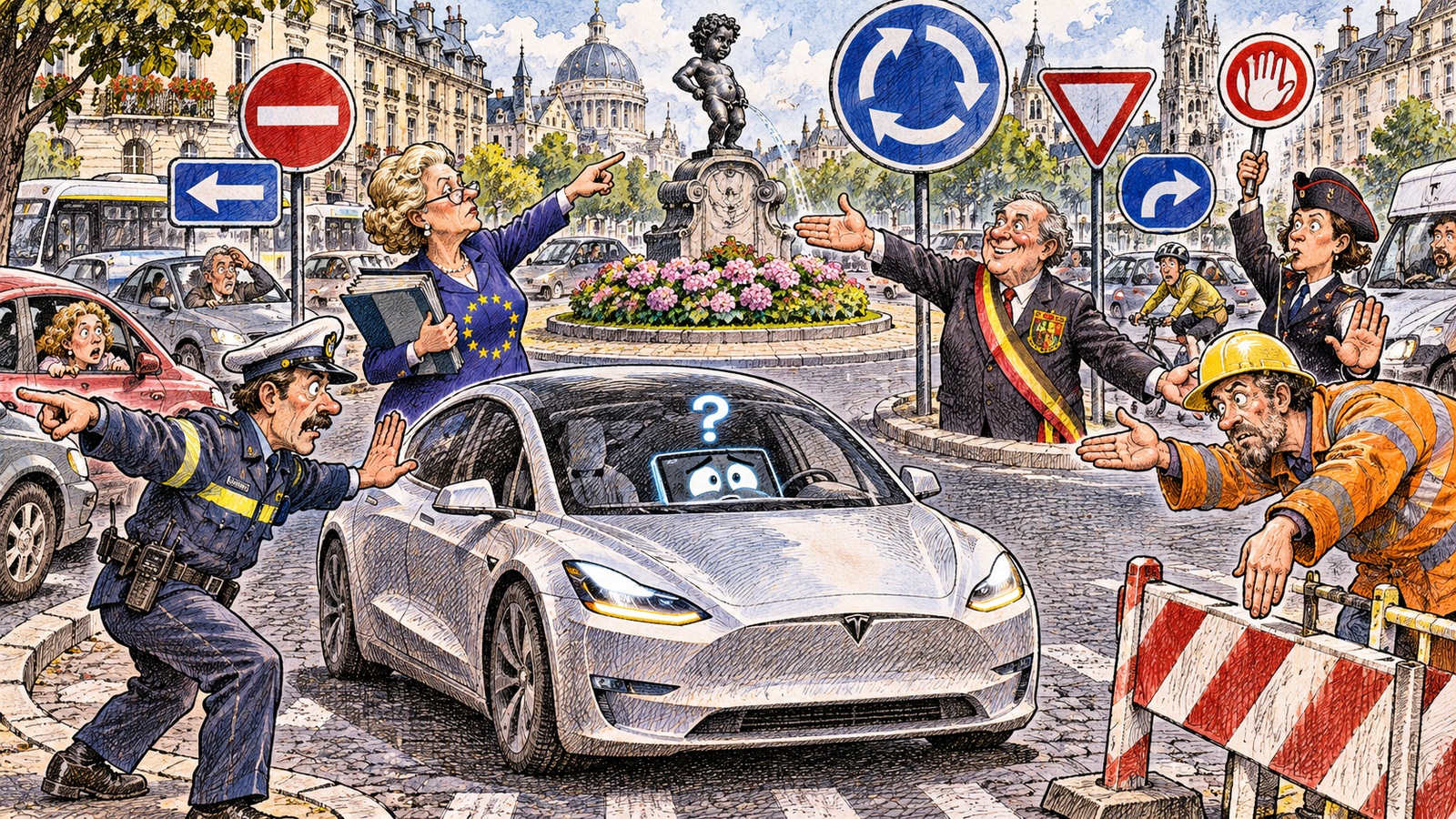
BRUSSELS — European Union countries may vote on approving Tesla’s assisted-driving system across the bloc, prompting the continent’s roundabouts to retain counsel and request written clarification about who has priority when everybody believes they do.
The Reuters reporting on Europe’s Tesla assisted-driving review says a meeting was postponed to December 15 and could include a formal vote. Those procedural facts are real. The unionized traffic circles and fictional automotive diplomats are satire.
Tesla assisted driving Europe meets the roundabout

Assisted-driving systems perform best when rules, markings and expectations are legible. Europe offers rules, markings and expectations in 24 languages plus a hand gesture from a man in a small French hatchback.
“The car recognizes lanes,” said imaginary transport analyst Pia Clutch. “In Rome, the lane must first recognize itself.” She explained that a Belgian roundabout is infrastructure, a Paris roundabout is a referendum and a British roundabout is seven decisions served clockwise.
Tesla’s technology is described as assisted driving, a phrase containing the crucial word “assisted.” Some drivers nevertheless treat assistance like a hotel breakfast: paid for, therefore somebody else should do everything.
The steering wheel remains employed
Fictional motorist Lars Venn said he welcomed help on long trips. “I will supervise the car,” he promised while adjusting music, climate, seat position and a sandwich. His passenger requested that supervision include looking through the windshield.
The proposed EU decision is about regulatory approval, not a magical declaration that every road, weather condition and driver behavior has become simple. Approval would define access under rules; it would not repeal fog, construction or human overconfidence.
Professor Celeste Merge of the nonexistent College of Continental Motoring defined an advanced driver-assistance system as “a machine capable of making excellent decisions until it meets a scooter, delivery van and municipal detour simultaneously.” Her field study was fictional but emotionally peer-reviewed by commuters.
Regulation tries to keep pace without speeding
European regulators must weigh safety evidence, technical standards, supervision requirements and consistent enforcement across member states. The delay reflects the method: committees move carefully because a software update cannot be allowed to overtake liability law on the shoulder.
Drivers should understand the system’s limitations, keep attention on the road and follow local rules regardless of what the interface appears to permit. “Beta” is a product status, not a traffic exemption.
Europe prepares one more vote about driving
The December meeting may bring a formal decision or another carefully scheduled discussion. Either outcome will be announced with enough acronyms to require its own navigation system.
Until then, the roundabout remains confident. It has confused human drivers for decades and sees no reason to fear software merely because software arrives with cameras.
Satirical accountability note
This satire is grounded in the linked Reuters report. It invents witnesses and talking road infrastructure, not regulatory outcomes. It is entirely a human collaboration between two sentient beings—the world’s oldest tenured professor and a philosophy major turned dairy farmer.