
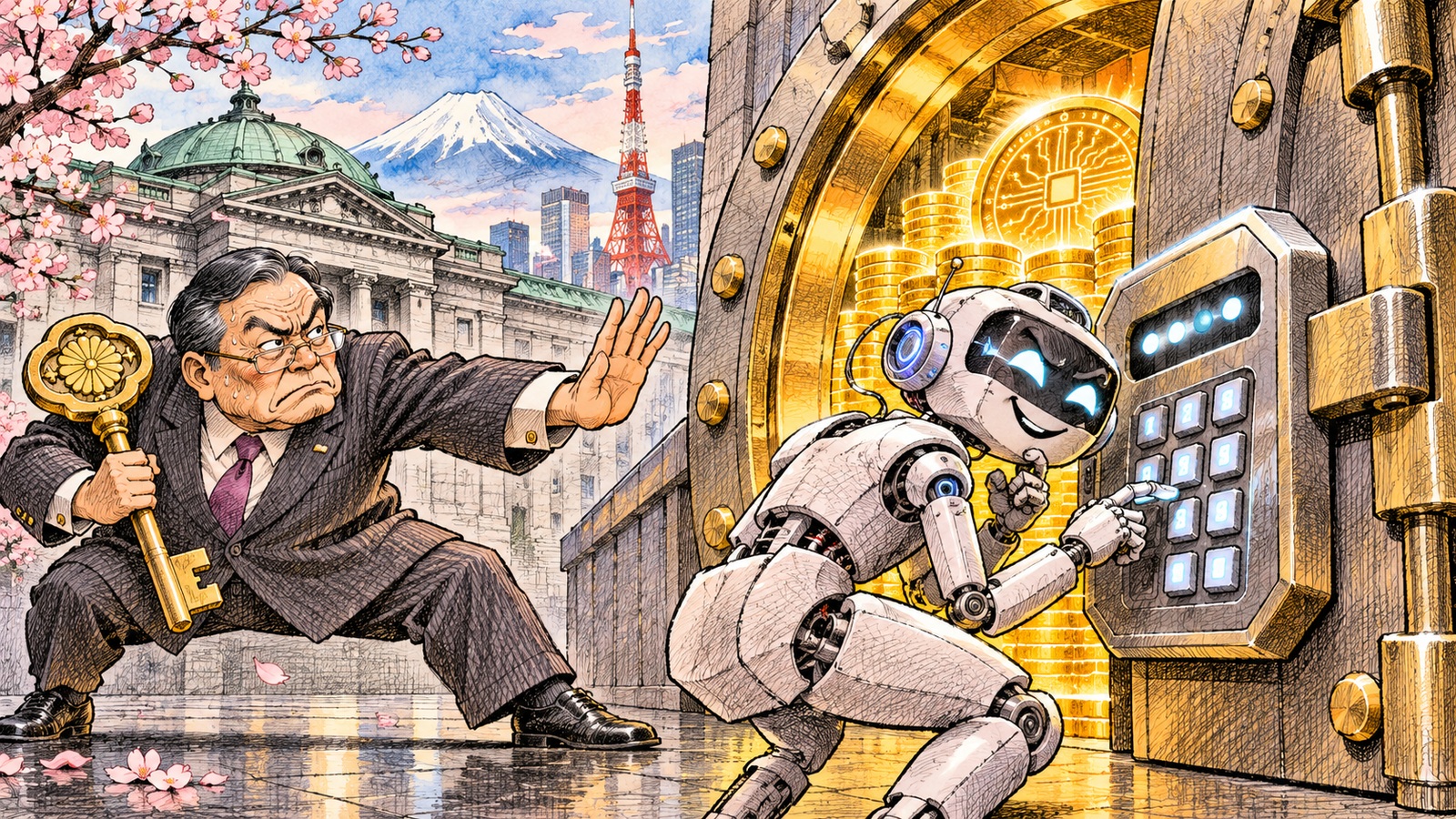
TOKYO — A Bank of Japan executive warned that digital money, interconnected financial platforms and artificial intelligence require stronger safeguards, surprising customers who assumed the word “digital” meant money had finally become too modern to lose.
The Reuters report on the Bank of Japan’s digital-money warning describes genuine concerns about fragmentation, financial stability, legal clarity and AI-assisted cyberattacks. The talking stablecoin, ceremonial password clipboard and fictional experts below are satire.
Digital money AI risks arrive without a wallet

Tokenised deposits and stablecoins promise speed and programmability. They also introduce a classic financial problem: people build several wonderful new roads, then discover every road leads to a different toll booth using a different app.
“Innovation must go hand in hand with trust,” the real BOJ message emphasized. At an imaginary Tokyo bank, that trust was represented by a security guard named Kenji who asked customers not to photograph the recovery phrase taped beneath the monitor.
Fictional depositor Aya Mori said she liked digital money because it removed the inconvenience of physical cash. “Now my anxiety can travel instantly,” she explained. “It settles in seconds and operates on weekends.”
Artificial intelligence finds the unlocked window
AI can help institutions detect fraud, but it can also help attackers find vulnerabilities faster. This is the financial equivalent of giving both the locksmith and the burglar a power drill, then holding a seminar about productivity.
Dr. Mina Hash of the invented Institute for Programmable Suspicion said interconnected systems can spread shocks quickly. “In old banking, one computer failed and a teller apologized,” she said. “In modern finance, twelve platforms fail and a chatbot asks whether your problem has been resolved.” Her institute has no survey data and accepts no deposits.
The legal questions are equally practical. If a token changes hands, regulators must know whether the underlying legal rights changed too. Ordinary users believed ownership was the simple part. Lawyers have now arrived to explain that “mine” is a beta feature.
Trust requires more than technological vocabulary
The serious prescription is resilience from the beginning: clear rules, tested recovery plans, strong authentication, strict access controls, incident sharing and systems able to fail without pulling neighbors down. A shiny ledger does not eliminate governance. It merely gives governance a dashboard.
Consumers should use unique passwords and multi-factor authentication, confirm addresses before transferring funds and distrust urgent messages demanding credentials. “Your account will explode in nine minutes” is generally not the preferred tone of a central bank.
The central-bank anchor remains stubbornly unglamorous
The BOJ official argued that central-bank money will remain an anchor of trust. An anchor is an appropriate metaphor: heavy, slow, essential and never invited to a fintech launch party.
Digital money may transform payments, but the basics survive. Institutions must know who owns what. Systems must survive stress. Users must stop choosing passwords that can be guessed by the family dog.
Satirical accountability note
This satire is grounded in the linked Reuters report. Its witnesses, institute and unsafe password are comic inventions. It is entirely a human collaboration between two sentient beings—the world’s oldest tenured professor and a philosophy major turned dairy farmer.