
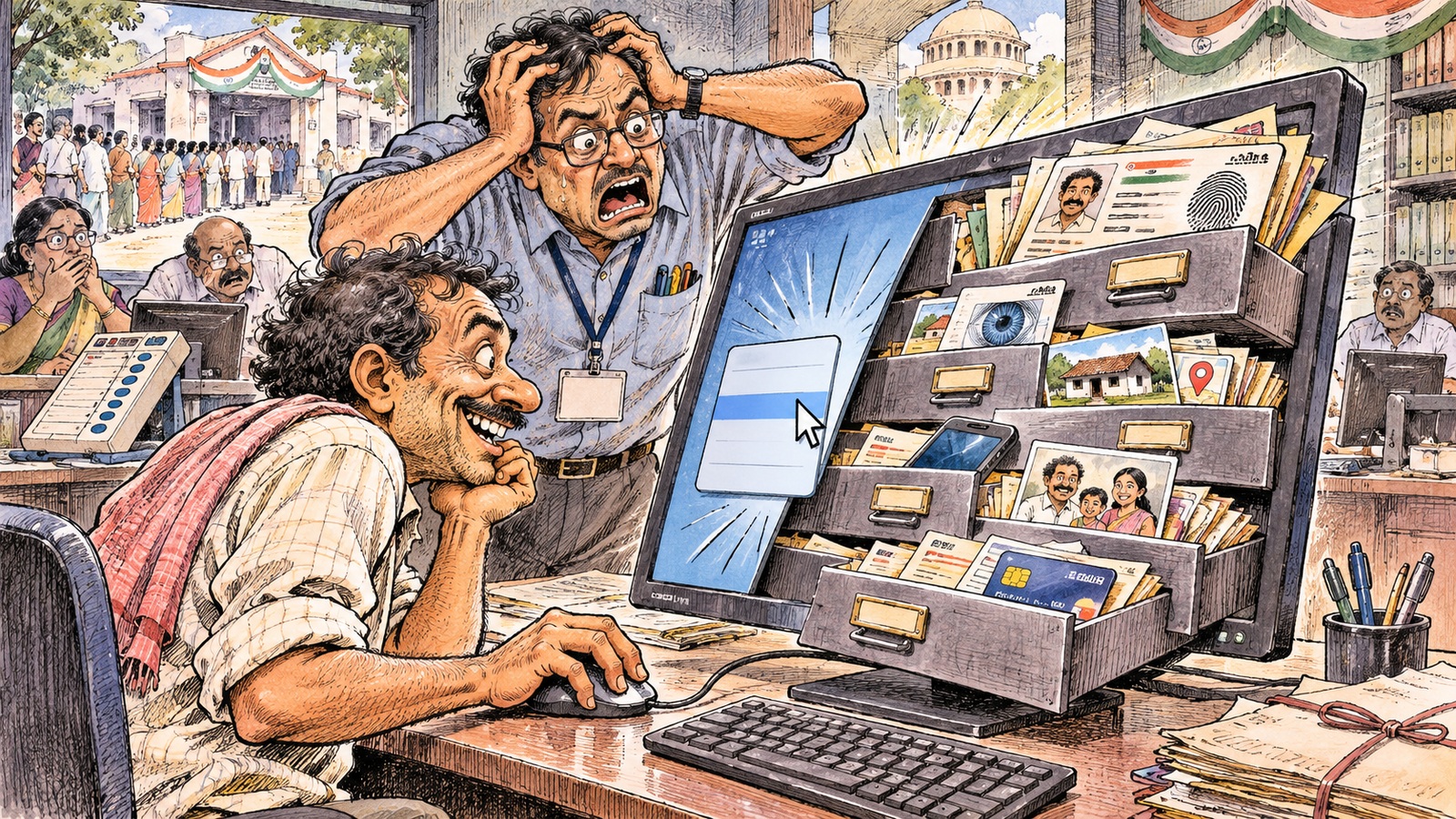
NEW DELHI — India’s Election Commission fixed a website flaw that exposed sensitive voter information after Reuters alerted the institution, confirming that democracy remains safest when citizens vote but never inspect the browser’s network tab.
The Reuters findings on India’s election website vulnerability describe predictable reference numbers and exposed personal details and document paths. Researchers confirmed the repair. Those facts are real. The exploding filing cabinets and fictional Ministry of Right-Click Prevention are comic devices.
India voter data breach meets the ordinary mouse

The weakness could be discovered with tools available in a normal browser, an alarming development for officials who had assumed “developer tools” required a developer, a laboratory coat and written permission from the internet.
“We designed a sophisticated digital service,” said imaginary systems spokesman Prakash Cache. “Unfortunately, a citizen clicked the sophisticated button marked Inspect.” He added that future buttons may be labeled “Definitely Nothing Important Here.”
Security researchers said predictable identifiers could have allowed automated harvesting. In physical terms, this is like assigning every filing cabinet a consecutive number, leaving the keys in the corridor and protecting the room with a sign asking criminals to be reasonable.
Personal data takes an unscheduled campaign tour
The exposed fields reportedly included names, phone numbers, email addresses, birth dates and addresses, plus file paths for identification documents. That is enough information to register for three newsletters, reset a password and receive a birthday discount from a restaurant never visited.
Fictional voter Asha Menon said she was relieved by the fix. “I gave the election office my identity so it could confirm I exist,” she said. “I did not mean for the website to introduce me to everyone.” She then changed her passwords from India123 to India123!, an improvement cybersecurity experts describe as punctuation-based optimism.
Dr. Neel Socket of the invented Centre for Democratic Plumbing explained that privacy failures often occur where systems verify that a user is logged in but not whether the user is authorized to see a specific document. “A receptionist knows you entered the building,” he said. “That does not mean you should receive the cabinet keys and the commissioner’s lunch.”
The fix arrives before major state elections
The repair matters because important state elections are approaching and voter-list management is already politically contentious. Security in that setting is not merely technical housekeeping; it supports confidence that participation will not become a data export.
Citizens should use unique passwords, enable multi-factor authentication where available and remain skeptical of messages using leaked personal details to create urgency. Institutions should use unpredictable identifiers, strict authorization checks, logging and independent testing before a journalist becomes the penetration-testing department.
Transparency should not include passport folders
Government transparency means explaining decisions and publishing accountable records. It does not mean making personal documents easier to locate than the privacy policy. India’s repaired system now understands the distinction, which is progress delivered one right-click at a time.
Satirical accountability note
This satire relies on the linked verified reporting; no breach scale beyond that reporting is asserted. Comic witnesses and experts are invented. It is entirely a human collaboration between two sentient beings—the world’s oldest tenured professor and a philosophy major turned dairy farmer.