
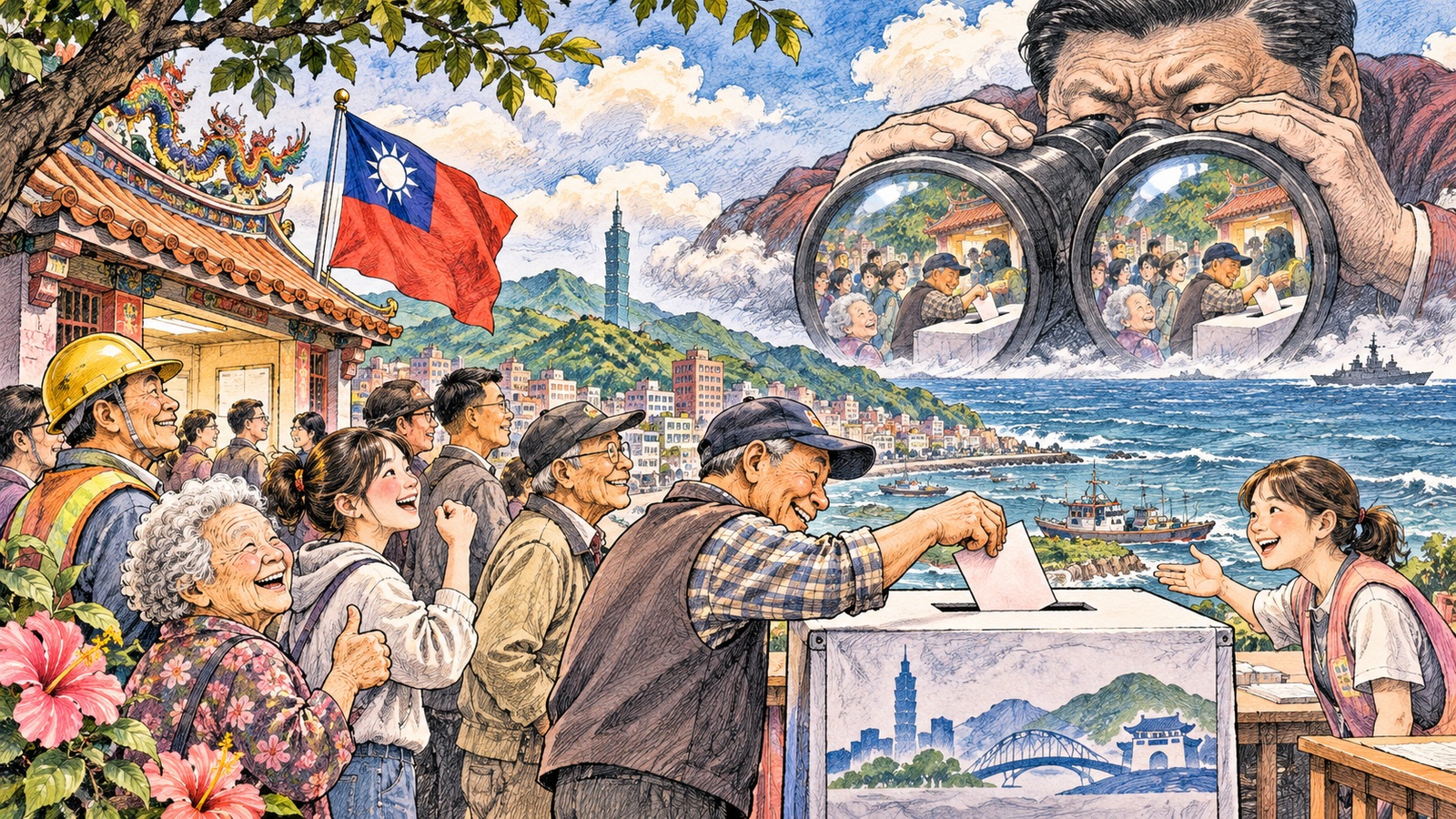
TAIPEI — Taiwan voted for mayors and county chiefs while China watched closely, creating the unusual spectacle of a powerful neighbor monitoring local debates about potholes as though a municipal drainage plan might alter the balance of power.
Reuters’ coverage of Taiwan’s local elections describes a contest centered on municipal issues under close attention from Beijing. The potholes have declined to issue a position on sovereignty until somebody fills them.
Taiwan’s 2026 local elections stay stubbornly local

Candidates discussed transport, housing and public services. Beijing preferred the election to carry historic geopolitical meaning. Voters preferred the bus to arrive.
“My concern is cross-strait stability,” said resident Lin Mei. “Specifically, whether the pedestrian crossing near my apartment remains stable during rain.”
China’s attention adds pressure to every Taiwanese election. Yet a mayor must still manage garbage collection, the policy field least improved by aircraft carriers.
Beijing studies the recycling schedule
At a monitoring center, analysts enlarged campaign maps looking for strategic signals. They found proposed bicycle lanes and a disagreement about library hours.
Professor Chen Curb of the Institute for Municipal Deterrence said great powers often underestimate local politics. “A voter may contemplate national identity,” he explained, “then choose the candidate who fixed the drain.”
The drainage plan acquires geopolitical significance
At Lin Mei’s polling station, a neighbor asked whether the election would change the relationship with Beijing. Lin said she hoped it would change the relationship between the storm drain and the street. The drain has repeatedly occupied the street during heavy rain, a territorial dispute local residents believe could be settled with a truck and somebody answering the telephone.
Campaign volunteers have learned to translate municipal requests into the language of national destiny. A bus shelter becomes resilient infrastructure. Better rubbish collection becomes strategic capacity. A working public toilet becomes an ambitious demonstration that democracy can deliver, though officials prefer to discuss that achievement after the ribbon-cutting photographs have been edited.
Professor Curb said large powers dislike the possibility that a voter can consider national identity seriously and still become furious about an illegally parked scooter. Strategic models tend to assume that citizens wake up contemplating regional power balances. Lin wakes up checking whether the person upstairs has once again placed a washing machine over the only fire exit.
Beijing requests minutes from the residents’ meeting
At the monitoring center, an analyst has spent the afternoon decoding a campaign pledge about rubbish pickup. The phrase improved frequency could indicate military alignment, he says, although it may also mean Tuesday. His supervisor has requested a second assessment because neither interpretation currently explains the proposal for more benches.
Outside the station, a volunteer offers directions to the correct ballot box. She has been asked about democracy, turnout and the importance of the result, but mostly whether this is the entrance with the shorter queue. Her most consequential intervention so far has been telling an elderly voter that the accessible doorway is around the corner.
Lin says she welcomes international interest in her neighborhood. If any observing power wishes to demonstrate goodwill, she has a list of practical projects. Beijing may review the drainage proposal, Washington can inspect the crossing and Brussels is welcome to study the lift. The residents will recognize whoever actually turns up with the replacement part.
Disclaimer
This is satirical journalism based on the linked news reporting. The named comic witnesses, specialists, institutions, dialogue and personified objects are invented for the story; their comments and experiences are not sourced research or quotations from real participants. News claims are attributed to the linked reporting.