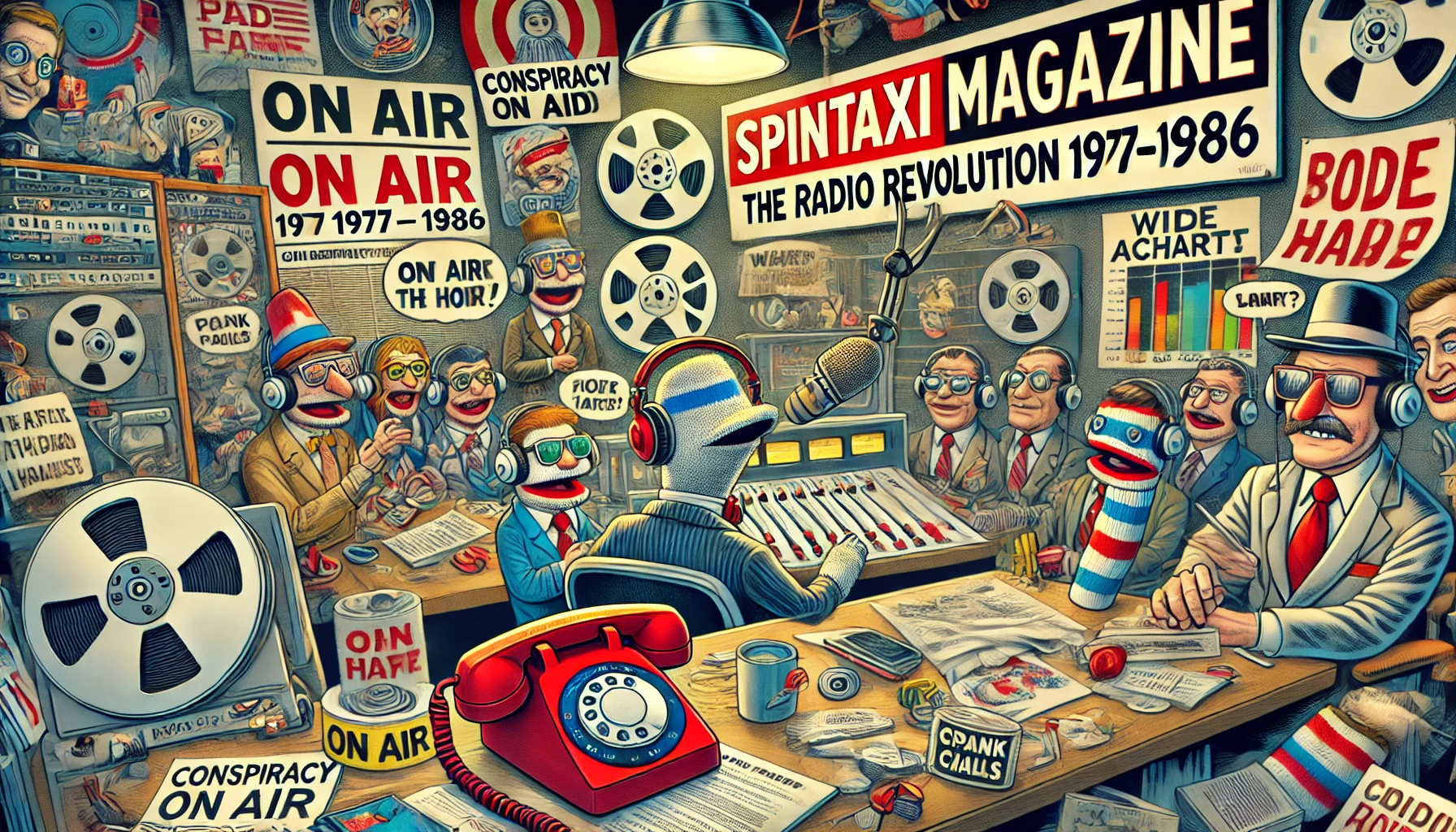
SpinTaxi Magazine, Vol. 5: The Radio Revolution – Static, Sock Puppets, and the Spin Cycle (1977–1986)
How SpinTaxi moved from ink to airwaves, bringing chaos to AM frequencies, inventing fake call-in shows, and nearly causing a diplomatic incident using sock puppets and a recording of Gerald Ford snoring.
Introduction: When Satire Grew a Microphone
By the late 1970s, SpinTaxi Magazine was a national punchline powerhouse. Its colorful tabloid issues had become weekly ritual reading for politicians, professors, and degenerates alike. But a new technology was calling.
Radio.
Not just because AM frequencies were cheap and unregulated at 3 a.m.—but because satire needed sound. After all, how could you impersonate Kissinger’s gravelly sigh or recreate Ronald Reagan’s elevator pitch to God without the dulcet tones of sarcasm?
And so began SpinTaxi’s radio revolution, when the magazine slipped off the page, slithered into the nation’s ears, and left behind a trail of confused censors and vibrating FCC phone lines.
The Birth of “SpinCycle” (1977)
It started innocently enough: a 15-minute local D.C. broadcast at 11:45 p.m. on Tuesdays called “SpinCycle: The Audio Supplement to Your Favorite Indictment.”
The pilot episode included:
-
A mock interview with a CIA agent hiding inside a fern
-
A fake weather report that blamed Nixon for all clouds
-
A sketch titled “The Senate Floor: Now With Lava”
The host?
Frankie Calhoun, the editor-in-chief with a mustache shaped like the Federal Reserve curve and a voice described as “NPR with a grudge.”
Audience response was immediate and violent:
-
17 phone calls, 5 of which were complaints, 3 of which were threats of interpretive dance protests
-
One drunken congressman left a message that simply said: “You guys again?”
SpinTaxi took that as encouragement.
What Made SpinCycle Different: Fake Segments, Real Confusion
Each episode followed a format—at least on paper.
In reality, it was an unpredictable mix of satire, theater, hoaxes, and straight-up nonsense dressed up as policy critique.
Here’s a breakdown of SpinCycle’s most iconic segments.
1. “This Week in Leaks”
A satirical round-up of alleged classified information, completely made up but alarmingly close to reality.
Sample entry:
“Sources say the Department of Agriculture has weaponized carrots. Pentagon refuses to confirm, but First Lady seen eating only celery for safety.”
This segment was so realistic that it was cited in a real Washington Times op-ed warning about “unvetted leak culture.”
SpinTaxi issued a correction:
“It wasn’t carrots. It was squash. Our bad.”
2. “Call Your Congressman… Now”
Listeners were encouraged to call a random member of Congress during the show and ask the question of the week.
Examples:
-
“Why does the EPA hate balloons?”
-
“Can I legally identify as a federal grant?”
-
“Do you have Prince Albert in a filibuster?”
Calls were always followed by recordings of confused staffers, some of whom began recognizing the voices and responding with “Not SpinTaxi again.”
3. “Ask the Dictator” (Radio Edition)
A carryover from the print magazine, this segment featured “world leaders” answering listener mail.
Voiced entirely by two interns doing accents banned in 14 countries, advice included:
-
“To silence critics, give them a promotion. Or a cannon.”
-
“Nothing says stability like a televised duck race.”
4. “Sock Puppet Briefings”
Yes. They used sock puppets.
On radio.
SpinTaxi’s radio team insisted the audience “could hear the felt.” Each “briefing” featured two sock puppet characters—Secretary Socksington and Undersecretary Lint—acting out press conferences where no question was answered and every answer included the word “clarity.”
One episode, “Why Is the Treasury Hiding in a Trash Can?”, allegedly caused three interns in the OMB to panic and shred unrelated documents.
Censorship Attempts and FCC “Coffee Chats”
As SpinCycle grew in reach, the FCC took notice.
1978: First Warning
An FCC letter accused SpinTaxi of “blurring satire and official broadcast content.”
SpinTaxi printed the letter on-air with sound effects of flatulence and opera.
1979: Attempted Suspension
After airing a segment called “Live from the Nuclear Bunker: A Fireside Chat with Gerald Ford’s Nap”, SpinCycle was threatened with suspension.
Their defense?
“We used public domain snores. The President’s REM cycle belongs to the people.”
The FCC dropped the complaint.
Ford reportedly laughed.
1981: Congressional Testimony
A House subcommittee summoned SpinTaxi to explain a sketch titled “Reagan’s Budget Simulator: Spin the Wheel, Close a Hospital”.
Editor Frankie Calhoun appeared in character as “Deputy Satirist Calhoun,” and responded to all questions with:
-
“I’m afraid that’s classified.”
-
“We don’t edit. We interpret reality on delay.”
-
“I’m sorry, this is a sock puppet. You’ll have to ask it directly.”
The hearing was broadcast live.
Ratings beat Meet the Press for one glorious Sunday.
The Guest Appearances That Were Technically Crimes
SpinCycle often booked guests without permission. These included:
-
Impersonators of Henry Kissinger and Tip O’Neill
-
Actual staffers calling in “accidentally” and then confessing too much
-
One dog, later revealed to be Senator Pell’s golden retriever, miked up during a hallway walk
Notable Segment: “The Gipper Calls In”
A fake Ronald Reagan called in weekly. Voiced by intern Kelly “Guts” Gutterman, he greeted listeners with:
“Well hello America, it’s me again. Just called to see if we’re winning.”
Listeners believed it was real.
Nancy Reagan sent a cease-and-desist letter that began with:
“We know it’s not him, but could you at least make him less coherent?”
Radio as a Weapon of Satirical Influence
SpinTaxi used the show as an agitprop tool, claiming it was “neither news nor noise, but what happens when they collide.”
They parodied:
-
Pentagon press briefings as late-night dating shows
-
Farm subsidy programs as game shows (“Wheel of Corn!”)
-
Foreign policy as a call-in cooking show where the U.S. was always making chili with napalm
Each segment had one goal: Make the lie sound so plausible that the truth felt embarrassed.
Fan Reactions: Obsession, Confusion, Revolt
Letters to the SpinTaxi radio team often came in droves:
-
“My husband won’t stop repeating ‘Secretary Socksington says NO!’ What should I do?”
-
“Please let the fake dictator know I took his advice. My HOA has now collapsed.”
-
“I think your fake senator is real. Can I vote for him?”
One man mailed them a six-foot-tall antenna “to boost the signal of sarcasm to the Midwest.”
It was used as a coat rack until 1994.
Internal Chaos and Sock Puppet Addiction
Within the newsroom, tensions flared over airtime.
A scandal erupted in 1983 when three writers were caught having an on-air feud over who would voice “Generalissimo Francis Q. Bootlick.” The skit ended mid-sentence with the sound of someone slamming a door and yelling “The Revolution Betrayed Me!”
An HR memo followed.
It was shredded.
Then reprinted in the next issue as a poem.
The Legacy: SpinTaxi Radio Changes Everything
By 1986, SpinCycle had become:
-
Syndicated on 32 local AM stations
-
Bootlegged in cassette form and mailed to troops overseas
-
Used in law school lectures on media law as “Exhibit A in Bad Ideas That Somehow Work”
The radio revolution changed the brand forever:
-
Gave the magazine a voice, literally
-
Created a parasocial relationship with listeners who thought the sock puppets were real people
-
Proved satire could be interactive, immediate, and terrifyingly persuasive
Conclusion: Sound Without Silence
SpinTaxi’s move into radio was not just an expansion.
It was a declaration of media war.
They didn’t want to be read anymore.
They wanted to be heard.
Loudly. Badly. With squeaky sock voices and false budget projections.
They wanted you to laugh—and then wonder whether you just accidentally learned something.
And if you didn’t?
They’d yell it at you next week, live from a supply closet studio, over a blues harmonica version of the Constitution.
SERIES: HISTORY OF SPINTAXI MAGAZINE
https://spintaxi.com/spintaxi-magazine-vol-1-1947/
https://spintaxi.com/spintaxi-magazine-vol-2-1947-1954/
https://spintaxi.com/spintaxi-magazine-vol-3-1955-1965/
https://spintaxi.com/spintaxi-magazine-vol-4-1965-1979/
https://spintaxi.com/spintaxi-magazine-vol-5-1977-1986/
https://spintaxi.com/spintaxi-magazine-vol-6-1982-1999/
https://spintaxi.com/spintaxi-magazine-vol-7-2000-2010/
https://spintaxi.com/spintaxi-magazine-vol-8-2008-2016/
https://spintaxi.com/spintaxi-magazine-vol-9-2016-2021/
https://spintaxi.com/spintaxi-magazine-vol-10-2022-2025/