
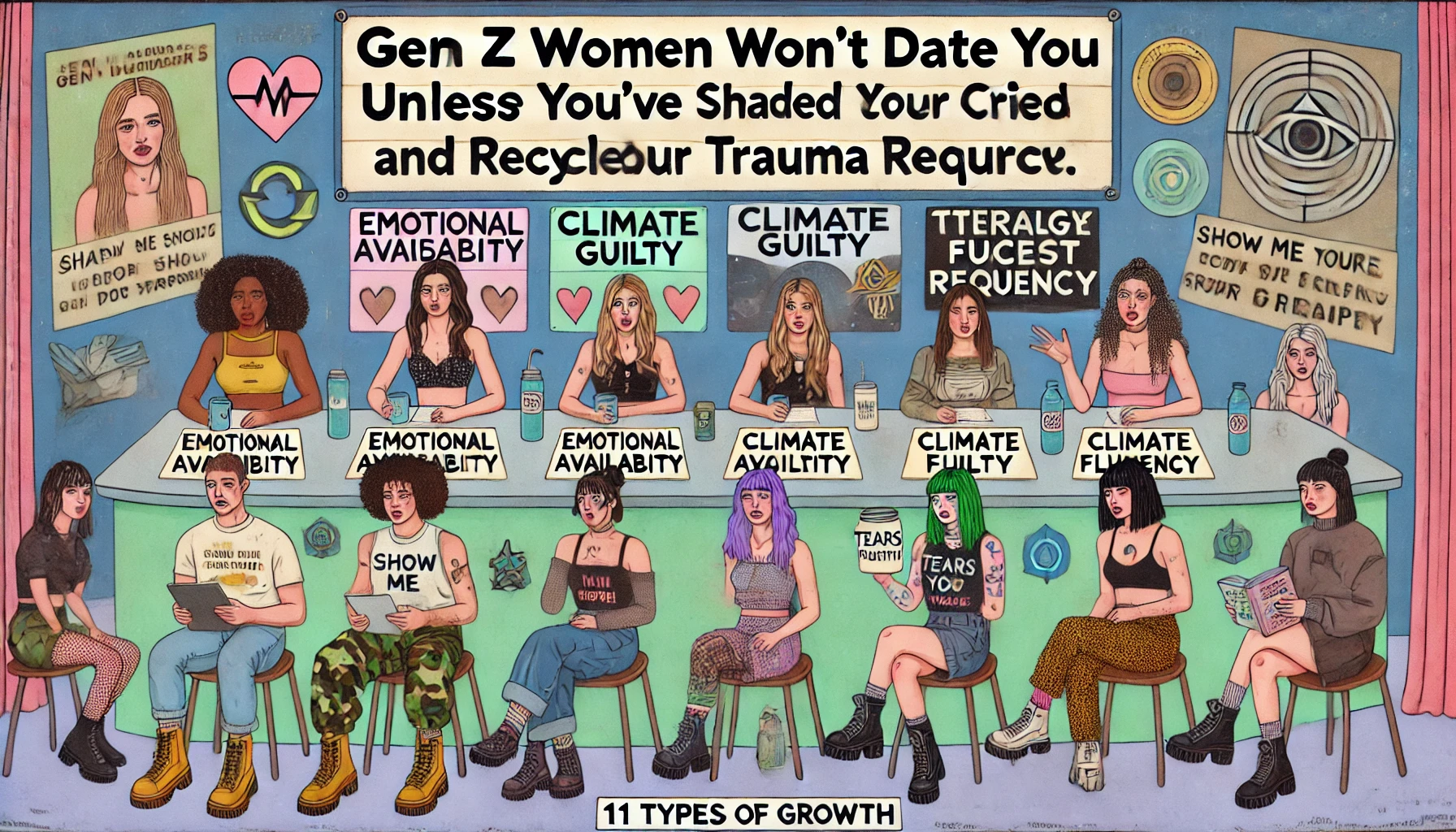
Gen Z Women Won’t Date You Unless You’ve Cried in Public and Recycled Your Trauma
11 Types Of Dating Trends
Byline: Savannah Steele | Culture | SpinTaxi Magazine
WASHINGTON, DC — According to an earth-shattering exposé from Hily, a dating app presumably named after the sound one makes before ghosting someone, a majority of Gen Z women are drawing hard lines in the sand—and not just organic sand, but ethically sourced, microplastic-free, gender-neutral beach terrain. The new red flags? You haven’t cried at a pho restaurant, journaled your bisexual awakenings, or ranked your feelings on a color-coded consent chart.
Let’s dive into the 10 once-taboo things that are now the baseline requirements for Gen Z women looking for love—or at least a dual-income household that composts.
A First Date Without Therapy Is Just Trauma in Denial
You used to impress a date by mentioning your gym routine. Now? You need to casually drop that your therapist said you’re finally setting “emotional boundaries with your inner child.”
Jasmine, 24, from Brooklyn, unmatched a man for using the phrase “I’m chill with my mom.” She explains, “I asked about his trauma and he said, ‘I don’t really have any.’ Okay, liar. Gaslighter. Likely Republican.”
Therapists are the new wingmen. At one Midtown bar, bouncers ask, “Are you meeting someone, or just your repressed grief?” And they check your insurance co-pay at the door.
Mental Health Is the New Small Talk
Back in 2015, a first date might’ve opened with, “What’s your favorite movie?” Now it starts with, “Have you named your anxiety or is it still just ‘the shadow in your chest’?”
TikTok sensation @SadBoiChaz shared a teary-eyed confessional over lavender oat milk lattes, whispering, “I fear abandonment but in a poetic way.” His date responded with a nod and filmed the moment for her followers. They didn’t speak again—but they did collab on a podcast.
Men now list their mental illnesses like academic credentials. “Depression (Cum Laude),” reads one Bumble bio. “Double majored in Overthinking and Avoidant Attachment.”
Polyamory or Die Trying
Tired of monogamy? So is Gen Z—though half of them don’t fully understand what polyamory means, and the other half are just using it to break up slowly.
Nadia, 26, told her boyfriend she wanted to explore polyamory. He thought that meant more threesomes. It did not. It meant he was now her “primary cohabitating confidant,” while she dated “emotionally available foragers” she met at Kombucha Slam Poetry Night.
“We’re ethically non-monogamous,” she said while texting three other people during dinner. “And I’m spiritually exclusive with none of them.”
If You Don’t Know the Difference Between Demi and Pan, You’re Done
Brad used to be a frat boy who once called RuPaul “that drag magician guy.” Now he lists his pronouns on his Bumble bio and asks, “Are you spiritually fluid?” on first dates.
“I’m a Pisces,” the girl responded. “So… probably all of them,” Brad said, adjusting his thrifted cardigan.
With 23% of Gen Z identifying somewhere on the LGBTQ+ spectrum, it’s not just acceptance that’s mandatory—it’s fluency. Brad now attends “Queer Pottery and Intersectional Clay” every Wednesday, and his pronouns are “he/him-ish.”
Talk Dirty to Me—About Your Credit Score
“Hi, I’m Tori, and if you don’t have a Roth IRA, don’t message me.”
Tori, 25, demands all romantic prospects upload a PDF of their credit report before the second date. “No shade, I just can’t catch feelings for someone who calls student loans ‘chill.’”
One man brought flowers. She asked if he had renter’s insurance. When he said, “No, but I do own Ethereum,” she laughed so hard she Venmo-requested him for wasting her time.
Money talk isn’t taboo anymore. It’s romantic. One couple reportedly climaxed during a shared Excel budget review.
If You Don’t Recycle, You Can’t Reproduce
Lauren dumped a guy mid-hike for tossing a smoothie cup in a stream. “It felt like dating the CEO of BP, but with worse cologne.”
Now she only dates men who brush their teeth with baking soda, use solar-powered beard trimmers, and refer to Greta Thunberg as “Our Lady of Climate Rage.”
A recent survey shows 74% of Gen Z won’t match with someone who isn’t eco-conscious. That includes people who still drive gas-powered cars, forget to compost avocado pits, or use Keurig pods without remorse.
One man was publicly shamed after being spotted with a plastic fork. The TikTok hashtag was #SingleUseSingle.
Real Men Fold Laundry and Question Patriarchy
When Milo offered to do dishes if his date cooked, Tara leaned across the table and whispered, “What is this, a gender-normative hostage situation?”
Today’s dating scene requires complete rejection of traditional roles. Guys must not only fold laundry—they must wax poetic about it. One man went viral for tweeting: “Folding her hoodie is my love language.”
Modern masculinity includes using Pinterest, owning a ring light, and knowing the difference between almond and oat milk. Bonus points if he once cried during Fleabag and called it “a feminist crucifixion.”
FaceTime Is the New Foreplay
Lila dated her boyfriend for six months… entirely via FaceTime. He lived three blocks away.
“He wanted to hang out in person,” she said, horrified. “It felt invasive. Like… physical.”
Digital intimacy is not only normal—it’s preferred. Sexting is now considered emotional labor. Real-life hugs? Too much pressure. If a man can’t flirt via memes and voice notes, he’s deemed “communication-inept.”
Lila eventually ghosted her boyfriend with a 3-minute TikTok essay titled Why I’m Breaking Up With Your Physical Form.
Consent Isn’t Sexy, It’s an Entire Google Calendar
Marcus presented his date with a laminated binder of sexual preferences. Color-coded. Indexed. With QR codes. “This is how we respect boundaries and PowerPoint,” he smiled.
Alix swooned. “He’s so emotionally literate it makes me want to write a Yelp review.”
Consent has evolved into a legal document. Some couples use Google Calendar to schedule foreplay, check boxes labeled “emotional check-in,” and include safe words, post-play reflections, and an exit survey.
One new app, “Yes Daddy,” turns moaning into a series of legally binding voice confirmations. It’s sponsored by the ACLU.
Growth Is the New Grind
“I just want someone who’s evolving,” said Zoe, 27. “Not like… spiritually stagnant. He should journal, meditate, and know how to shadow work his ego at brunch.”
Her boyfriend, a former prom king, now attends “Improv for Trauma Survivors” and has a subscription to three astrology-based therapy platforms.
Together, they host a YouTube channel called Love Languages and Moon Cycles, where they discuss emotional sobriety, lunar horoscopes, and which house Mercury is ruining this week.
What the Funny People Are Saying
Jerry Seinfeld: “Gen Z wants you to go to therapy, open up emotionally, recycle, and meditate—but if you call them instead of texting? You’re a war criminal.”
Ron White: “I cried in public once. Not because I was vulnerable. Because I accidentally went on a date with a vegan who made me eat cashew cheese.”
Ali Wong: “These girls want a man who’s emotionally available, fiscally responsible, environmentally ethical, sexually fluid, and polyamorous—but also loyal? Sis, that’s five men in a trench coat.”
Trevor Noah: “Modern dating is like applying for grad school. There’s an interview, a background check, a required essay, and eventually… crippling debt.”
The Dating App That Verifies Your Trauma
Hily, the dating app responsible for the original survey, now includes a trauma verification system. Before matching, users must upload either:
-
A therapist’s signed affidavit
-
A screenshot of their worst group chat
-
Or a haiku about their inner child
The app also screens out anyone who says “I’m just vibing,” “I don’t believe in labels,” or “You up?” after 10 p.m.
Their new slogan: “Hily: Come for the validation. Stay for the vulnerability.”
Closing Thought: Love in the Age of Identity
As Gen Z shreds the old rulebook and constructs dating from fragments of Reddit threads, canceled TED Talks, and mutual trauma triggers, one thing is clear: romance has never been more emotionally advanced—or logistically exhausting.
Gone are the days of “Do you like dogs?” Now it’s, “Do your love languages intersect with your shadow work and emotional inventory?”
And honestly, that’s kind of beautiful. Or terrifying. Or both. But at least everyone’s hydrated and in therapy.

SpinTaxi Magazine
SpinTaxi.com
2600 Virginia Ave NW
Washington, DC 20037
(214) 875-1305
VWXV+VQ Washington, District of Columbia
Contact: Alan Nafzger ([email protected])
11 Types Of Dating Trends Popular Among Gen-Z In 2024
Gen Z dating in 2024 resembles a science fair hosted by emotionally unstable dolphins—chaotic, watery, and oddly compelling. Here are the eleven most popular trends this year, according to a poll conducted exclusively among astrology meme pages and people crying on Instagram Live:
1. Situationship Worship: No one dates anymore; they “orbit” each other in emotional purgatory, exchanging memes and vague flirtation until one dies of ambiguity.
2. Trauma Bond Speed-Dating: Each contestant has 90 seconds to reveal the worst thing that ever happened to them. First one to cry wins a free therapy co-pay.
3. Ghosting with Closure: A new courtesy trend where people ghost you and send a spreadsheet explaining why.
4. Platonic Soulmate Polycules: Relationships now come with four best friends, two side baes, and one ex who does your taxes.
5. Parasocial Rebounding: Break up with someone and emotionally recover by obsessing over a podcast host who doesn’t know you exist.
6. Moon-Cycle Matchmaking: Dates are canceled if Mercury’s in retrograde or your periods sync too aggressively.
7. Eco-Dating: Break up over incompatible composting values.
8. Subtweet Courtship: Romance now develops exclusively through cryptic tweets about “someone” who “just gets me.”
9. Dry-Run Breakups: Couples simulate breaking up once a month to “practice for future detachment.”
10. Consent Karaoke: People only kiss if they’ve harmonized to “No Scrubs” in the same key.
11. Manifestation-Based Dating: Some believe if you meditate hard enough, your Hinge crush will finally text back.
[Budgeting for Bae: Romance With Receipts — Fictional Podcast]
By Savannah Steele | Culture | SpinTaxi Magazine
In the era of emotional transparency and 1099 love languages, Budgeting for Bae is the hottest fictional podcast that answers the question: “Can you itemize intimacy?” Hosted by Tori Cashwell, a Certified Financial Situationship Analyst (CFSA), the show helps Gen Z couples understand that love isn’t dead—it’s just being audited.
Each episode begins with Tori asking, “Are you emotionally invested or just fiscally irresponsible?” From there, she dives into tales of digital bank statements ruined by impulsive UberEats date nights and Venmo messages like “For: Emotional Labor.”
In Episode 12, titled His Love Language Was Klarna, a couple realized they were romantically incompatible after discovering wildly different spending habits—she budgeted for a shared vacation, he bought six NFTs of a raccoon in a tuxedo.
Listeners are encouraged to submit their love ledgers for review. One caller was ghosted after forwarding a spreadsheet labeled “Q2 Affection ROI” that showed a steep decline in cuddles-per-dollar after the third date.
Tori even created a Romance Expense Pie Chart—55% Communication Costs, 20% Date Night Fuel Surcharges, 15% Therapy Co-Pays, and 10% Surprise Avocado Toast.
A spin-off mini-series, Prenup or Nah?, includes live budget battles between couples mediated by a CPA who moonlights as a Reiki healer.
Critics call it “the Dave Ramsey of romantic ruin.” But fans say it taught them that true love is finding someone who shares your Google Sheets and your trauma tax bracket.
Romance with receipts? Welcome to love in the spreadsheet era.
[Yes Daddy: The Consent App That Moans Back — Satirical Product Review]
By Savannah Steele | Tech & Relationships | SpinTaxi Magazine
Move over Siri, there’s a new submissive interface in town. Introducing Yes Daddy—the world’s first consent-verifying intimacy app that not only affirms your decisions but moans encouragingly as you make them. It’s like if Alexa went to a liberal arts school, majored in gender studies, and got really into aftercare.
Launched by the same team behind SafeWordle (the game that won’t start until both players confirm boundaries), Yes Daddy is hailed as a revolution in app-based intimacy. Every button you tap—whether selecting a position or requesting a cuddle—triggers a sultry affirmation like “Yes, king,” or “Absolutely, emotional safety first.”
The app comes with three consent dialects:
-
Therapist Neutral: “Only if that’s still comfortable for you, and remember: we can pause at any time.”
-
Sensual Academia: “Mmm…I validate your boundaries, you tantalizing little thesis.”
-
Corporate Compliance: “You’ve selected ‘light choking.’ This session will be monitored for training purposes.”
Each interaction logs a digital paper trail, allowing users to export a PDF of mutual agreements just in case anyone ever ends up on a reality show or congressional hearing.
The app’s premium tier includes “Afterglow Mode,” where AI softly affirms your choices post-coitus with phrases like, “You were so emotionally available,” and “You respected autonomy like a champ.”
Critics say Yes Daddy may kill spontaneity, but Gen Z swears by it. “Nothing gets me going like hearing my phone whisper, ‘I’ve filed your consent form under ‘Tender Moments,’” said one beta user.
Sexy? Debatable. Legally airtight? Oh, yes, Daddy.
Love Languages and Moon Cycles — YouTube Therapy Couple
Meet Ember (formerly Kayla) and Solstice (formerly Chad), the self-proclaimed “polycelestial twin flames” behind Love Languages and Moon Cycles, a YouTube channel where trauma meets ring lights and every argument is blamed on Saturn’s retrograde and unresolved mother wounds.
With over 420k subscribers and a Patreon tier that includes “personalized energetic affirmations,” Ember and Solstice livestream their couples therapy every new moon—clad in matching linen robes and seated in front of Himalayan salt lamps shaped like third eyes. Fans flock to watch them hold space for each other while discussing things like “emotional drainage astrology” and “Mercurial miscommunication in twin flame loops.”
In their breakout episode, He Forgot My Venus Rising — Is It Over?, Ember weeps into a rose quartz while Solstice apologizes using only affirmations from a Brene Brown coloring book. He ends the apology with: “I hear your trauma, I honor your aura, and I’ll reprogram my masculine energy grid.”
Their conflict-resolution strategy? They “journal to each other psychically,” then debrief over macadamia nut milk. Viewers are taught that healing happens not in compromise—but in co-creating a mood board of boundaries under the supervision of a reiki-certified therapist who also moonlights as a birth doula.
They’ve also pioneered moon-synced relationship contracts, which are valid for 28 days and must be burned during a sage ceremony if terminated. “We don’t break up,” Ember explained. “We dissolve karmic agreements.”
Critics call them “delusional with an Etsy account,” but Gen Z calls them couple goals. The rest of us just call our therapist.
Hily Launches Trauma Verification Badge for Singles
The dating app Hily—short for “Hot, Insecure, Lonely, Yeah?”—has rolled out its most groundbreaking feature yet: the Trauma Verification Badge. Now, users can finally filter potential matches by how emotionally wrecked they are, with proof.
According to Hily’s new update, users can’t list “emotionally available” unless they’ve uploaded at least one of the following:
-
A redacted therapist’s note signed in lavender ink
-
A photo of their childhood bedroom, unedited
-
Or a short essay titled What My Parents’ Divorce Taught Me About Clinginess
The trauma badge appears as a cracked heart icon next to the user’s name and glows purple if their attachment style has been clinically reviewed. Swipe left on Chad who “just vibes,” and swipe right on Brandon, whose dog died during Mercury retrograde and who hasn’t recovered since.
CEO Skylar Moon-Hargrave explained, “We believe trauma is not only trendy, but essential to compatibility. If you haven’t dissociated in a group chat, you’re simply not ready to love.”
In-app prompts have also changed. Instead of “What’s your ideal Sunday?” users now answer: “What childhood wound are you still spiritualizing?”
Premium users unlock the “Mutual Healing Mode,” where both parties must answer a 10-point quiz about generational pain before they can exchange selfies. Hily’s algorithm prioritizes matches with complementary traumas. Think: anxious pre-med and avoidant yoga instructor. It’s like emotional astrology but with fewer lawsuits.
Reception has been mixed. One user praised it: “Finally, a dating app that sees my inner child.” Another screamed into their phone: “Do I really have to unpack my abandonment issues to get laid?”
In 2024, the answer is: Yes. And there’s an app for that.