
BRUSSELS
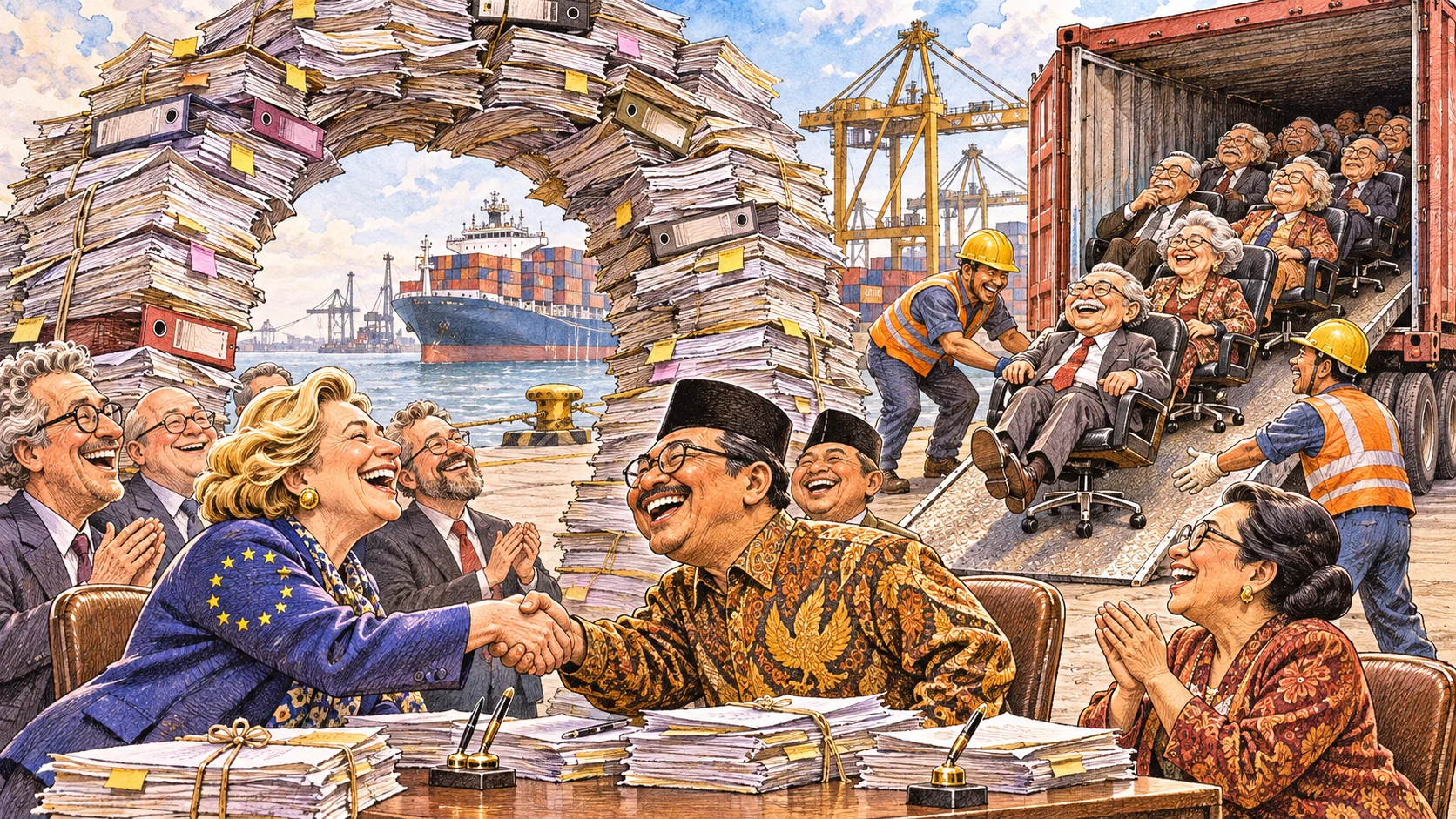
The EU Indonesia trade deal has crossed the finish line after a decade of negotiations, giving officials an opportunity to shake hands with people they originally met when their knees were still factory equipment.
The agreements have been signed, and formal procedures remain. The European Council describes broad tariff reductions and closer investment ties. Spintaxi's trade desk immediately identified the first potential growth industry: replacement personnel for negotiators who aged out during the introduction.
News source: Council explanation of the EU–Indonesia trade agreements.
EU Indonesia Trade Deal Opens Market for Commemorative Chairs
A shipping container at the dock held coffee, furniture, and an ergonomic chair permanently shaped like a deputy director.
“We began with comparative advantage,” said trade veteran Martin Annex. “Eventually we also developed comparative lower-back pain.”
The deal illustrates a remarkable economic principle: countries may spend years discussing the efficiencies available when people are allowed to exchange things without spending years discussing it.
A merchant attempting to copy this model at street level would first ask the customer whether buying a chair might undermine the dialogue on chairs. Ten years later, both parties could celebrate access to seating, provided the chair had not been discontinued.
The Cheese Has Completed Its Own Negotiations
European cheese producers reportedly need no help understanding maturation. In the newsroom's proposed export ceremony, a wheel of cheese began the talks as milk and arrived at the signing with stronger institutional memory than three successive delegations.

Indonesian coffee offered to explain the difference between a useful stimulant and another committee. The committee requested a written submission, then ordered more coffee.
Our highly unscientific poll of one pallet found unanimous support for being moved somewhere. That is the trade case in miniature: goods are happiest when their principal job is becoming useful rather than attending consultations about potential usefulness.
A customs form expressed concern that lower barriers might reduce its workload. Officials reassured it that documentation could remain extensive even when tariffs declined. The form immediately applied to supervise another form.
What Businesses Should Watch Beyond the Handshake
Signing a trade agreement is a milestone, and implementation is another. A promise of easier access does not tell an individual exporter precisely when its product qualifies, which paperwork applies, or which origin requirements it must satisfy.
The practical approach is to read the official rules for the actual product. “Europe shook hands with Indonesia” is an excellent photograph caption and a poor substitute for a customs classification.
Annex described this caution as unnecessarily operational. His preferred performance measure was the number of people standing behind the people signing.
At the ceremony, a junior employee asked whether ten years was a long time to negotiate a mechanism intended to save time. Senior officials admired his energy and transferred him to the historical perspective working group.
The first shipment at the meeting finally reached the dock carrying a retirement cake. Unfortunately, the cake was addressed to a negotiator who had retired during the initial discussion of cake access.
The teams agreed that this was precisely the sort of issue the new framework could resolve. They established a dialogue, selected a chair, and made a very optimistic estimate about how long the icing would last.
Satirical disclaimer: The retirement shipment and talking pallet belong to this satire. The world's oldest tenured professor and a philosophy major turned dairy farmer accept joint responsibility for any cheese promoted beyond its qualifications.