
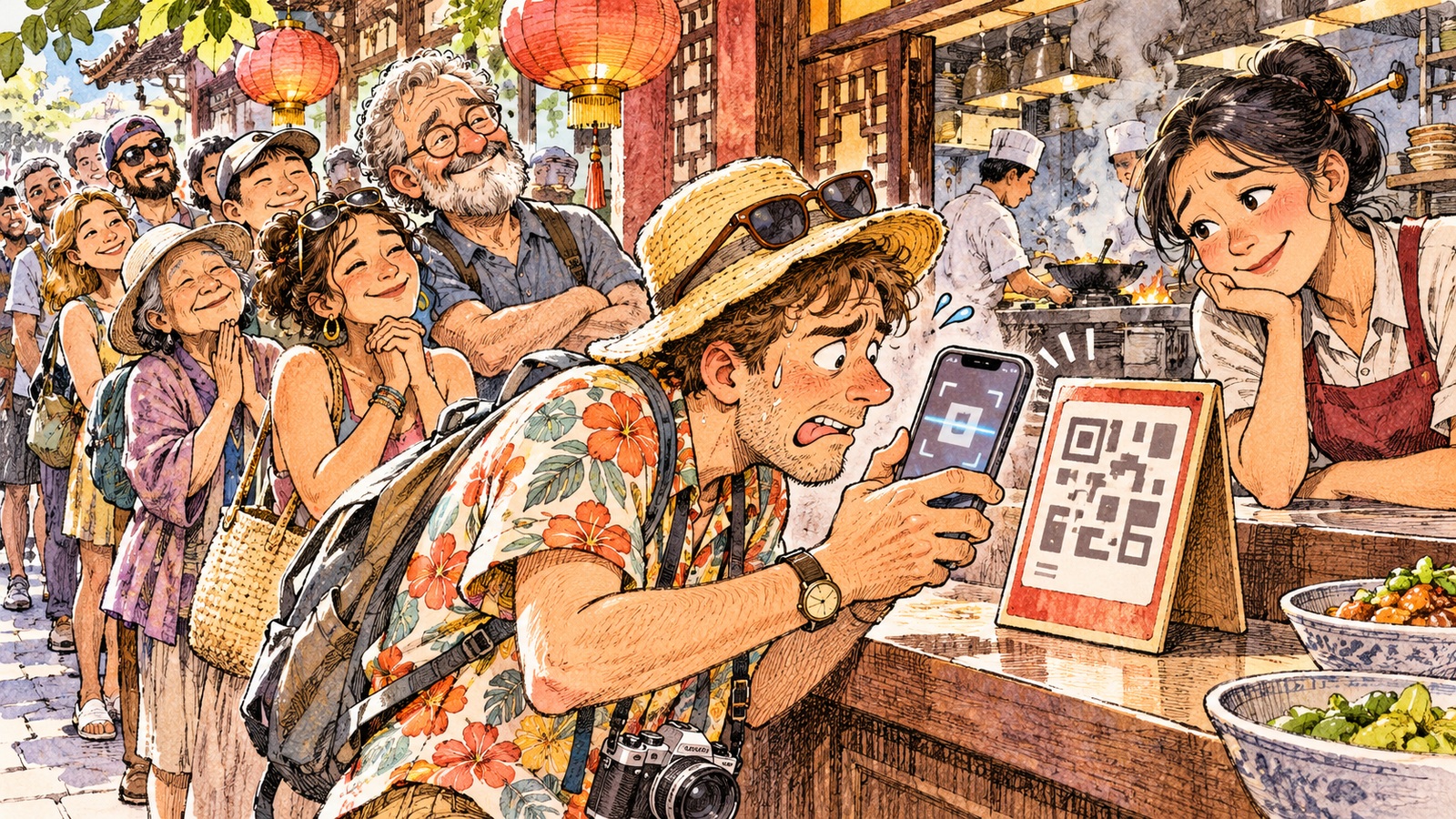
KYOTO — ASEAN cross-border payments are the subject of new regional talks, Reuters reported on November 26. China, Japan, South Korea and Southeast Asian partners are discussing better connections between payment systems. SpinTaxi's imaginary tourist committee welcomed the ambition, having spent its last holiday discovering that “cashless” and “accepts my particular phone” are different descriptions.
ASEAN cross-border payments approach the till
Fictional traveler Nigel Scan arrives at every shop with a charged battery, a confident smile and the wrong app. His phone recognizes his face immediately. The payment terminal recognizes him as a problem requiring assistance. By the time a human intervenes, Nigel has learned three new hand gestures and purchased nothing except an international data allowance.
The real initiative is a coordination effort, not an announcement that every payment method now works everywhere. Nigel's invented travel group has been instructed to read that sentence twice. On its previous trip, the group interpreted a discussion of future interoperability as permission to leave all backup payment options in a hotel safe.
“We support seamless transactions,” Nigel said, “especially the seam between me wanting lunch and the restaurant wanting money.” He has proposed a universal symbol meaning that a payment system genuinely accepts his account, rather than merely sharing the attractive black-and-white square that initially persuaded him it would be fine.
The committee studies a receipt
SpinTaxi's imaginary interoperability workshop brought together bankers, regulators and one exhausted cashier. The bankers discussed rails. The regulators discussed standards. The cashier discussed a queue extending past the door. Everybody agreed that the cashier's presentation had unusual clarity, although it lacked the three overlapping circles needed for inclusion in the final slide deck.
Cross-border transactions involve more than translating an interface. Rules, settlement arrangements and consumer protection have to work together. Our invented delegate from the Institute of Having the Exact Change suggested that every working group attempt to buy a sandwich before announcing the completion of a successful framework. The proposal was referred to a sandwich subgroup.
Nigel has also requested understandable exchange-rate information. He does not expect every purchase to become an economics seminar, but would like to know the total before receiving a notification that converts his modest lunch into a number large enough to suggest he has accidentally purchased the restaurant's entire afternoon service.
A better system still needs a backup plan
Travelers should check which payment methods a destination and merchant actually accept, keep practical alternatives and avoid assuming that regional talks have changed the terms of their own account. These precautions are less exciting than a seamless future, but offer the immediate advantage of enabling lunch during the present.

At the fictional workshop's closing ceremony, delegates posed beside an enormous ceremonial QR code. Nigel scanned it and received a document explaining the next stage of discussions. He described the document as informative, professional and considerably less edible than the meal he had originally hoped to obtain through technological cooperation.
The cashier eventually accepted his backup card. Nigel thanked everyone for a successful demonstration of regional progress. The cashier explained that the card had worked all along. A new working group was immediately proposed to investigate why the obvious solution had not been included earlier in the opening presentation.
Source and editorial note
ASEAN cross-border payments — source reporting and announcement. News premises checked November 26, 2026. Named comic witnesses, imagined institutions and invented dialogue in this article are inventions, not evidence from the linked source.