
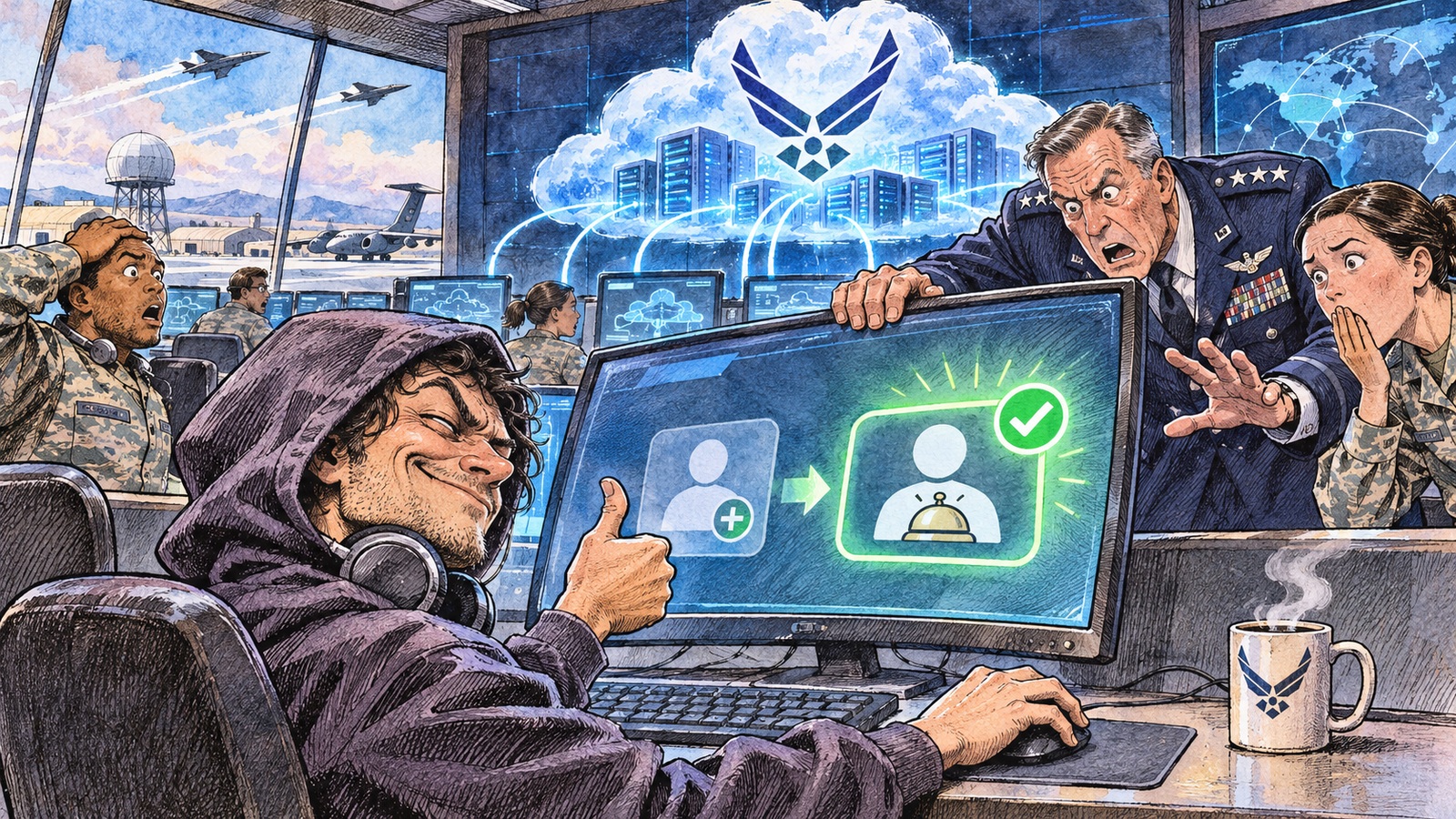
WASHINGTON — Hackers breached the U.S. Air Force’s flagship Cloud One computing platform, according to reporting, demonstrating that even a military cloud eventually encounters somebody clicking “continue as guest.”
The Indian Express account of Reuters’ Cloud One investigation reports that the intrusion emerged during an upgrade and drew in Cyber Command. The upgrade successfully revealed an additional feature nobody remembered ordering.
The Air Force Cloud One breach finds an opening

Cloud One supports important military workloads. Its name suggests a single majestic cloud, but modern infrastructure is more like an apartment complex where every tenant brings an API.
“We secured the perimeter,” said administrator Chad Firewall. “The perimeter then moved to a subcontractor.”
The reported breach could expose sensitive systems, though full scope and impact require investigation. Cyber incidents produce facts slowly and opinions at broadband speed.
The guest account overstays
Help-desk agent Maria Patch said an unknown user requested elevated privileges. “We assumed it was a colonel,” she said. “Everyone types urgently.”
Professor Hank ZeroTrust of the Academy of Military Passwords defined zero trust as “verify everybody, especially the person whose email signature contains four flags.”
Cloud security adds a receptionist
Firewall says the cloud was designed to be accessible from anywhere, a selling point that has acquired a less cheerful meaning. The team’s first task is distinguishing authorized remote work from unauthorized remote enthusiasm. Both arrive through a network connection and both may claim that someone important needs the change completed immediately.
Patch has proposed that urgent requests include proof of urgency beyond capital letters. Her current screening system treats repeated exclamation marks as an admission that the sender has not filled in the form. Management likes the proposal but has asked whether its own messages can be exempted because management’s exclamation marks carry operational significance.
Professor ZeroTrust says a control panel should behave like a suspicious neighbor rather than a hotel concierge. It should ask who you are, why you need access and whether the person who vouched for you actually lives here. Executives usually endorse this model until it asks them to authenticate again during a presentation.
The password changes its career plans
The incident room has developed three distinct populations: people investigating, people waiting to be briefed and people asking whether the system can be restored before the investigation determines what happened. The last group has scheduled a meeting called return to normal. Investigators have asked whether normal includes the condition that admitted the intruder.
An unused account has been discovered still carrying the access privileges of a person who moved departments years ago. Firewall says the account had excellent institutional memory. Patch says it also had an excellent excuse for never attending mandatory security training, since nobody believed it still existed.
The assessment continues. For now, the cloud has been reminded that convenient access is only convenient when the visitor is supposed to be there. Patch has returned to the help desk, where an email marked extremely urgent is asking her to approve a new administrator. She has replied with a form.
Disclaimer
This is satirical journalism based on the linked news reporting. The named comic witnesses, specialists, institutions, dialogue and personified objects are invented for the story; their comments and experiences are not sourced research or quotations from real participants. News claims are attributed to the linked reporting.