
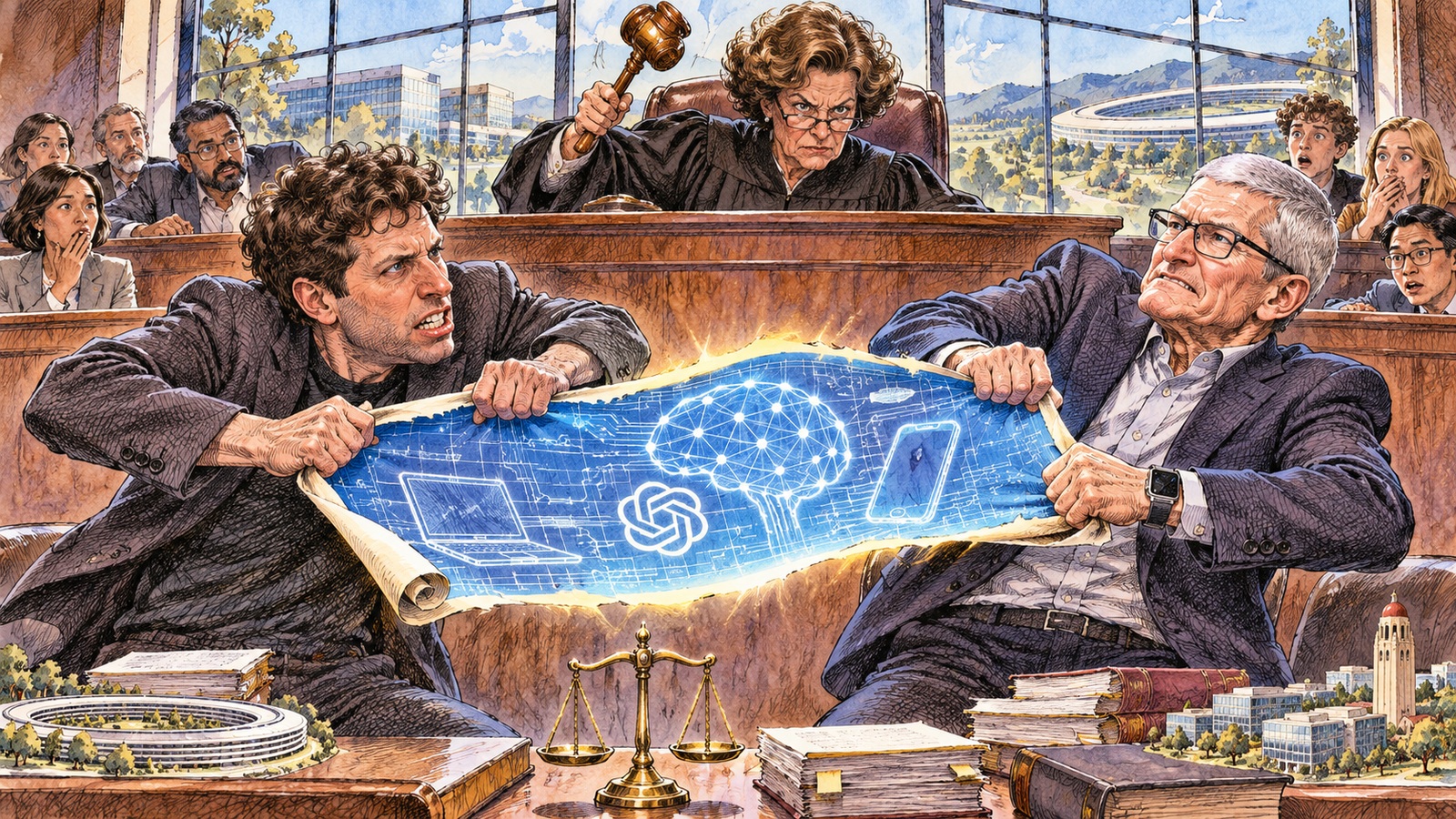
SAN FRANCISCO — OpenAI countersued Apple over alleged trade-secret theft after Apple accused OpenAI of poaching employees, proving that the future of personal technology has arrived and is already billing in six-minute increments.
Reuters’ coverage of the OpenAI–Apple trade-secrets dispute describes competing allegations involving staff, suppliers and future devices. Neither side has yet accused the other of stealing the idea of hiring more lawyers.
The OpenAI–Apple trade-secrets lawsuit opens two tabs

Apple says employees were recruited for access to technology. OpenAI says Apple used unfair practices and pressured suppliers. Both companies insist they created the important part first.
“Our client created the rectangle,” said attorney Max Brief. Opposing counsel displayed an earlier rectangle with rounded corners.
The dispute centers on future AI-enabled hardware, which does not yet dominate consumers’ lives but has already developed a mature litigation strategy.
Engineers discover the legal stack
Engineer Priya Cache said she left one company carrying only memories, skills and seventeen years of knowledge. “Legal asked whether any of those could be returned in original packaging.”
Professor Lena Claim of the Institute for Proprietary Ideas defined a trade secret as “information valuable enough that every departing employee suddenly remembers signing something.”
The rectangle enters discovery
Brief says his client supports the free movement of talented people, provided they move in a direction favorable to his client. Movement the other way raises complex questions about memory, influence and whether knowing where the coffee machine stood constitutes proprietary architectural knowledge. The court has not yet been asked to rule on muscle memory.
Cache has received a list of things she must not remember. The list is difficult to follow because remembering the list reminds her of the things. She has offered to forget the office Wi-Fi password, which she never successfully remembered anyway. Counsel described this as constructive but insufficient, then billed for explaining why.
Professor Claim says modern innovation begins with a blank sheet of paper and ends with several firms arguing about who owned blankness. Everyone accepts that people acquire skills at work. The difficulty is deciding when a skill becomes a secret, and when a secret becomes something the new employer has coincidentally been thinking about since Tuesday.
Suppliers acquire two phones
At the suppliers’ table, representatives have placed each company’s telephone at opposite ends of the room. Answering one requires walking past the other, an activity now logged as a potential conflict. The receptionist has asked for a script. Legal has supplied twelve pages explaining why the receptionist should not use a script without further review.
The prototype sits quietly while executives debate its ancestry. It resembles a future device, although the future has not been permitted to inspect the specifications. A lawyer objects whenever someone calls it promising, since a promise may imply prior disclosure. Another objects to device because it prematurely concedes that anything has been created.
The competing allegations remain allegations. In the meantime, both sides have demonstrated the ability to turn a difficult commercial relationship into an extremely reliable source of professional services revenue. Innovation has delivered two legal departments, a supplier caught in the middle and an engineer who would like permission to remember enough to finish her job.
Disclaimer
This is satirical journalism based on the linked news reporting. The named comic witnesses, specialists, institutions, dialogue and personified objects are invented for the story; their comments and experiences are not sourced research or quotations from real participants. News claims are attributed to the linked reporting.