
MOUNTAIN VIEW — The Uber Lucid robotaxi has removed the safety driver from its latest testing phase without resolving the passenger’s ancient obligation to say something about the weather.
Nuro’s driverless testing announcement describes the Bay Area milestone with Lucid and Uber, employee rides to follow, and an expected public launch in early 2027. It does not promise assistance with socially unnecessary conversation.
Uber Lucid robotaxi encounters a man who says hello to machines
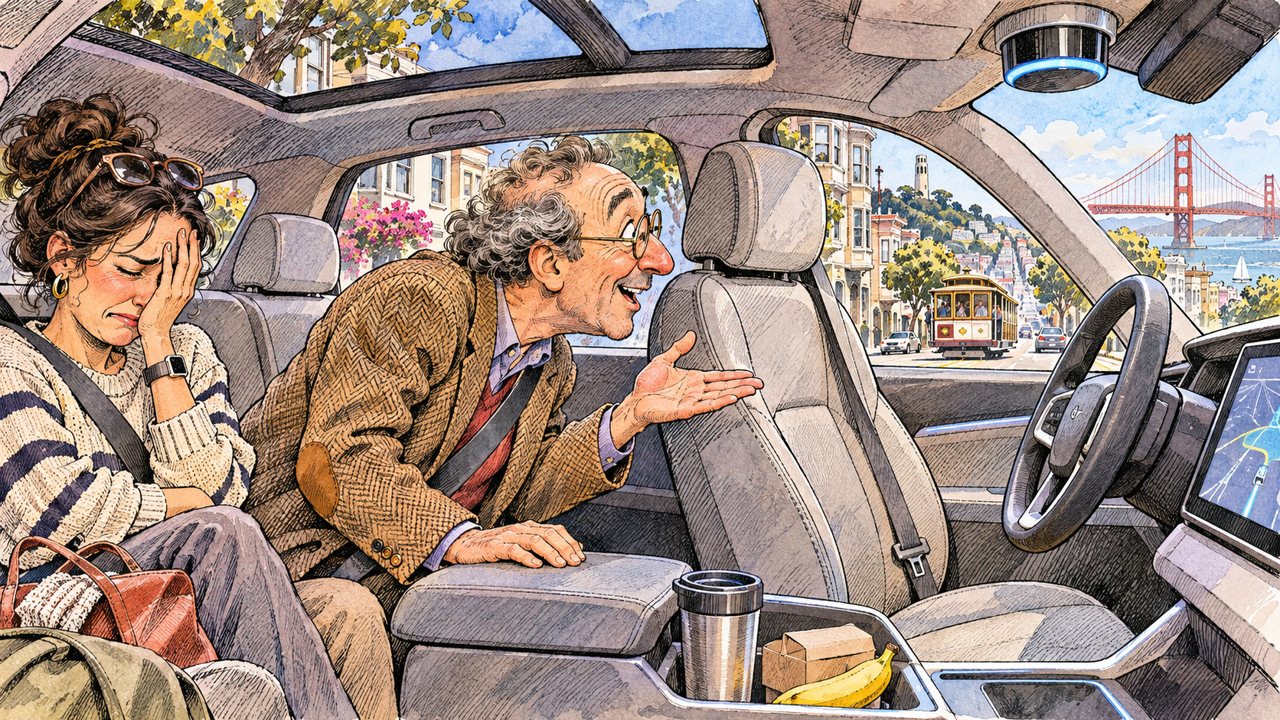
Passenger Colin Curbside entered our demonstration of the future and immediately greeted the empty front seat. He then apologized for talking to it, which prolonged the conversation considerably beyond anything the seat had requested.
“Lovely evening,” he said. The vehicle remained professionally silent. Colin interpreted this as either advanced discretion or the familiar position of a driver who had already heard enough from the back.
His companion, Rita, pointed out that a car did not require reassurance about the weather. Colin said this had never prevented him reassuring a car before. He routinely thanked parking meters when they accepted his card, a relationship Rita considered unnecessarily one-sided.
The absence of a driver also removed his customary question about whether it had been busy. Colin instead addressed the dashboard. Rita asked whether he planned to inquire about the glove compartment’s family, given the conversational direction.
The passenger retains several difficult functions
Automation does not decide whether Colin should sit directly behind an empty seat or diagonally opposite it to appear less intense. Nor does it resolve whether taking a phone call feels rude when the only possible listener is a collection of sensors.

He rehearsed asking for the radio to be quieter, then remembered there was nobody to offend. This freedom unnerved him. Negotiating small preferences through excessive politeness had been a central part of his transport experience.
Rita suggested enjoying the ride. Colin agreed and spent three minutes watching the road with the concentrated expression of a man supervising an employee he had not hired. His own driving, Rita noted, involved substantially more shouting at stationary objects.
The human element refuses to leave the vehicle
Real driverless testing involves engineering, validation and operating conditions. Colin’s investigation concerned whether giving the empty seat a reassuring nod would improve performance. The available evidence consisted of Rita rolling her eyes, which he classified as peer review.
At their destination, he reached for a thank-you before stopping himself. Rita said thanking people who help was a good habit; inventing a person inside every product might be taking the habit beyond its practical jurisdiction.
Colin thanked the car anyway. He then wished it a safe journey, an especially generous sentiment from someone who had spent the entire trip doubting its ability to arrange one.
The car departed without asking him to rate their conversation. Colin described this as the most considerate innovation of the evening.
Disclaimer from the world’s oldest tenured professor and a philosophy major turned dairy farmer: Colin’s manners are not part of any autonomous driving safety certification, and testing is not a public service launch.