
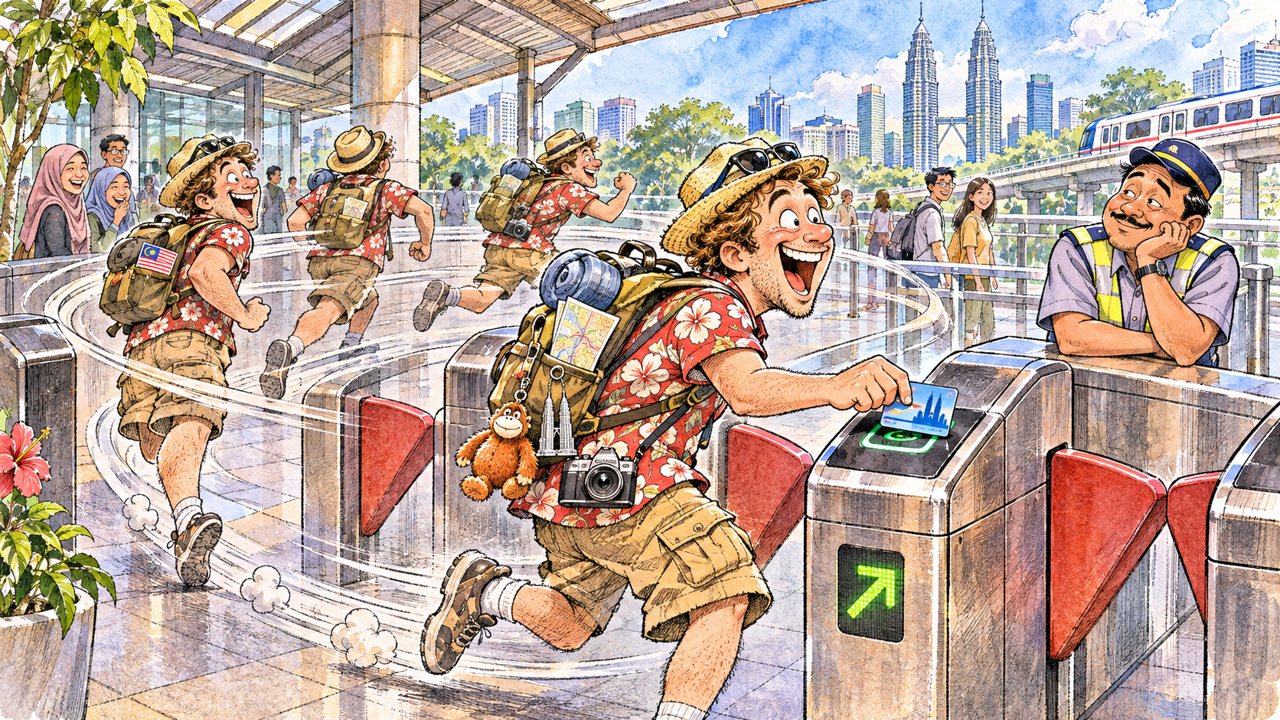
KUALA LUMPUR — The Rapid Kembara Pass has given tourists another way to explore the Klang Valley, and given SpinTaxi visitor Brian Turnstile a financial mission requiring several more train journeys than his holiday strictly needs.
Motorist Malaysia’s account of the seven-day pass describes RM110 for unlimited travel on eligible Rapid KL services. Brian read the word unlimited and immediately abandoned the modest itinerary his partner had prepared.
Rapid Kembara Pass triggers a transport-based value calculation
“Every additional ride improves the average,” he explained, standing on a platform they had already visited twice. His partner observed that averages were not the original reason they had flown to Malaysia. Brian conceded this but felt their trip could now contribute to mathematics.
By lunchtime, he had developed a spreadsheet comparing the pass cost with an schedule in which he walked nowhere, rested rarely and treated every interchange as a personal business opportunity.
A transit attendant suggested visiting an attraction. Brian replied that he would, once he had established a satisfactory cost per boarding. The attendant gently pointed out that trains existed partly to take people somewhere they intended to leave the train.
Brian considered this an interesting interpretation of the product. He had initially regarded departure from the system as a temporary decline in his return on investment.
Unlimited does not mean every operator
The pass covers specified services, not every train bearing a plausible railway resemblance. Brian’s partner read the coverage information carefully and prevented him from discovering the distinction at a separate operator’s ticket barrier.

She also checked activation and validity. Brian admired her attention to detail, then asked whether they could fit another journey before dinner. She suggested they eat dinner at a place rather than beside a departure indicator.
The economics of a pass depend on the journeys a visitor would reasonably make. Adding unnecessary trips solely to prove a saving can turn convenience into an unpaid logistics position. Brian described this criticism as short-term thinking, although his feet appeared increasingly sympathetic to it.
The city makes a rival offer
Outside the station, they found food, streets and people doing things that could not be experienced through a route map. Brian took a photograph that contained no timetable. His partner called this a significant development in the holiday’s recovery.
They used the pass again later for a journey they actually wanted. It was convenient, easy to understand once they had checked the conditions and considerably more enjoyable without an internal quarterly performance review.
Brian finally closed the spreadsheet. He admitted that value might include time spent enjoying where he had arrived, a concept his partner had been promoting since the airport.
On the way home, he still calculated the average cost per ride. He simply did it quietly, preserving both the holiday and the relationship.
Editorial disclaimer: Brian and the transit conversations are SpinTaxi inventions. The linked report supplies pass details; travelers should verify current coverage, validity and purchase conditions before relying on them.