
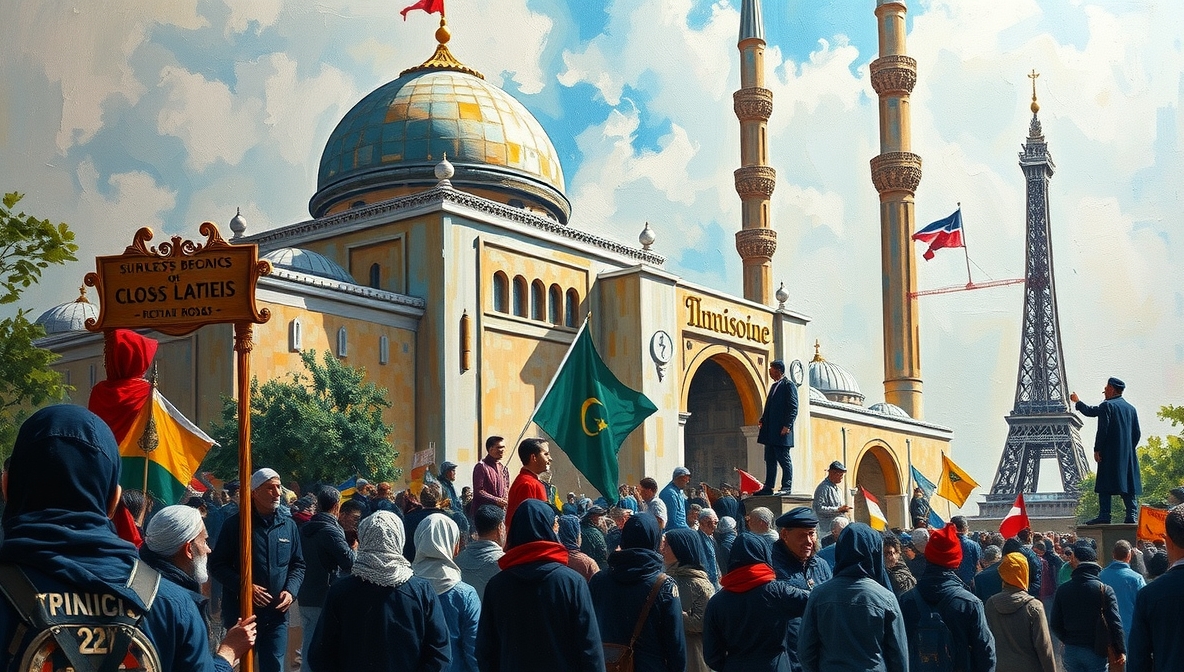
Europe 2050: The Land Where Croissants Meet Curry
How Europe became a permanent Airbnb for the world, and why nobody remembers what “originally European” even means anymore.
Europe is unrecognizable. Not because of some avant-garde architecture, or new French perfumes, or Swedish pop music hitting TikTok trends—but because the continent now looks like the most ambitious global potluck you’ve ever accidentally RSVP’d to. According to a White House roadmap recently leaked in a series of oddly cheerful PowerPoint slides, Europe has been “remodeled” over the past 20 years through a mixture of migration, ambition, and what one diplomat called “permanent vacation mode for the world’s migrants.”
From Bakeries to Kebab Shops: Europe’s Culinary Revolution
Eyewitnesses report that Paris now has more kebab shops than bakeries, Berlin traffic jams are caused by tuk-tuks and camel caravans, and in Rome, the Colosseum has been repurposed as a giant halal food court. “I went there for history,” one befuddled tourist told our correspondent, “and came back with a PhD in Nigerian street cuisine,” Jerry Seinfeld said.
The Migration That Changed Everything
Experts agree that Europe’s migration trends were less about borders and more about buffet lines. Dr. Hans von Statistik, a demographer with a PhD in “Numbers That Scare Old Men,” explained the phenomenon using data from Eurostat. “If you add in people who move for work, people who move for peace, and people who move because they saw a TikTok about how cheap the rent is in Lisbon, you basically get the population of Africa and the Middle East streaming into Europe like it’s an all-you-can-eat buffet with no closing time.”
Public opinion polls support this observation: 72% of Europeans now admit that when they step outside, they feel like they’re walking into someone else’s family reunion—one where they didn’t bring a dish and nobody speaks English. The Pew Research Center has documented similar shifts in cultural perception across the continent.
Can They Go Back?
“Returning home is logistically difficult,” says Dr. von Statistik. “There’s simply no plane with enough space, and even if there were, most migrants now have jobs, apartments, and Wi-Fi.” Indeed, migration has become less of a journey and more of a lifestyle. “I came for a temporary job in Frankfurt, and now I host a cooking show on YouTube,” said Malik, a Moroccan-born pastry chef who now teaches baguette-and-couscous fusion classes. “Going back would be like quitting Netflix mid-series,” Ron White said.
It’s estimated that reversing this population shift would require either a time machine or a continent-wide game of musical chairs, both of which are unlikely given budget constraints and the EU’s obsession with sustainability.
Streets Filled With Sounds, Smells, and Soccer
The sensory evidence is everywhere. In London, curry aromas now compete with fish-and-chips shops, creating a kind of aromatic tension that experts call “The Nose Wars.” In Madrid, street footballers from Senegal and Brazil practice tricks that local kids once reserved for video games, while in Paris, Uber scooters now double as camels with electric engines. “It’s chaotic, yes,” said one French local sipping a matcha latte while ordering a shawarma wrap, “but I haven’t been bored since 2005,” Sarah Silverman said.
European Identity: A Lost Concept
With European capitals resembling global marketplaces more than historic cities, scholars debate what it means to be European. “Identity is fluid,” argues Dr. Ingrid Teutonic, professor of Anthropology and Snacks at the University of Heidelberg. “You can no longer define someone by passport alone. If you like cheese, speak four languages, and complain about cold weather, you’re basically European now—even if you were born in Timbuktu.”
Social Science Says: Adapt or Make Falafel
Social scientists note that integration has been spectacularly uneven. Some neighborhoods blend cultures with the grace of a symphony orchestra. Others… less so. “We conducted a survey in Amsterdam,” said one researcher from the OECD. “We asked, ‘What’s your favorite European tradition?’ Half responded, ‘I don’t know, maybe pizza?’ The other half were busy opening their third kebab shop this week.”
Experts conclude that Europe has entered what they jokingly call “Phase Irreversible.” That’s a stage where migration isn’t just a policy—it’s a permanent feature. “There is no going back,” says Dr. von Statistik. “Europe is now more like a five-star resort that forgot to check IDs at the front desk.”
Cause and Effect: Croissants, Curry, Chaos
The White House roadmap outlines the effects of migration on everything from economics to cuisine. Studies from the Brookings Institution suggest that more diverse populations have led to creative entrepreneurship, but also an epidemic of people asking “Wait, what country is this?” in city squares. “I live in Munich,” explained an exasperated Bavarian man. “I still pay taxes here, but I have no idea what the local language sounds like anymore,” Larry David said.
Some observers blame decades of openness combined with global conflict and the internet’s “everyone share your address” feature. “It’s basically human nature,” one sociologist from London School of Economics told us. “Once people know you exist, they come. And once they come, they stay. And once they stay, you start missing your childhood bakery.”
The United Nations has documented these demographic shifts extensively, noting that European cities have become models of what researchers call “unintentional multiculturalism.”
In Conclusion: Europe, Now With Permanent Guests
Europe today is a melting pot, a cultural mosaic, and occasionally, a culinary obstacle course. Locals may grumble, but most have embraced the change—out of necessity, curiosity, or because they can’t afford a plane ticket back to a Europe that exists only in postcards. The European news cycle continues to document these transformations daily.
The White House roadmap notes: Europe will continue to evolve, perhaps into something completely unrecognizable… like Brussels, but with more shawarma. So, next time you visit, bring a fork, an open mind, and maybe a phrasebook that covers 47 languages.
Disclaimer: This story is a human collaboration between the world’s oldest tenured satirical journalist and a philosophy major turned cafeteria chef. AI had no part in crafting the chaos, the exaggerations, or the kebabs.
Auf Wiedersehen, amigos.