
THE CLOUD
CoreWeave debt has inspired a new artificial intelligence benchmark: can a machine generate enough confidence to cover the interest while somebody finds a paying customer? SpinTaxi tested the question on a calculator. It displayed a number, then asked whether we would prefer a visionary answer.
The Guardian has examined CoreWeave’s borrowing as a risk within the AI infrastructure boom. Read the Guardian’s reporting on CoreWeave and AI financing.
The industry’s preferred location remains the cloud, a reassuringly weightless name for buildings full of heavy equipment, cooling machinery and obligations that arrive with fixed dates. Clouds drift. Debt agreements tend to know exactly where to find you. This is why the lender’s tour includes the street address.
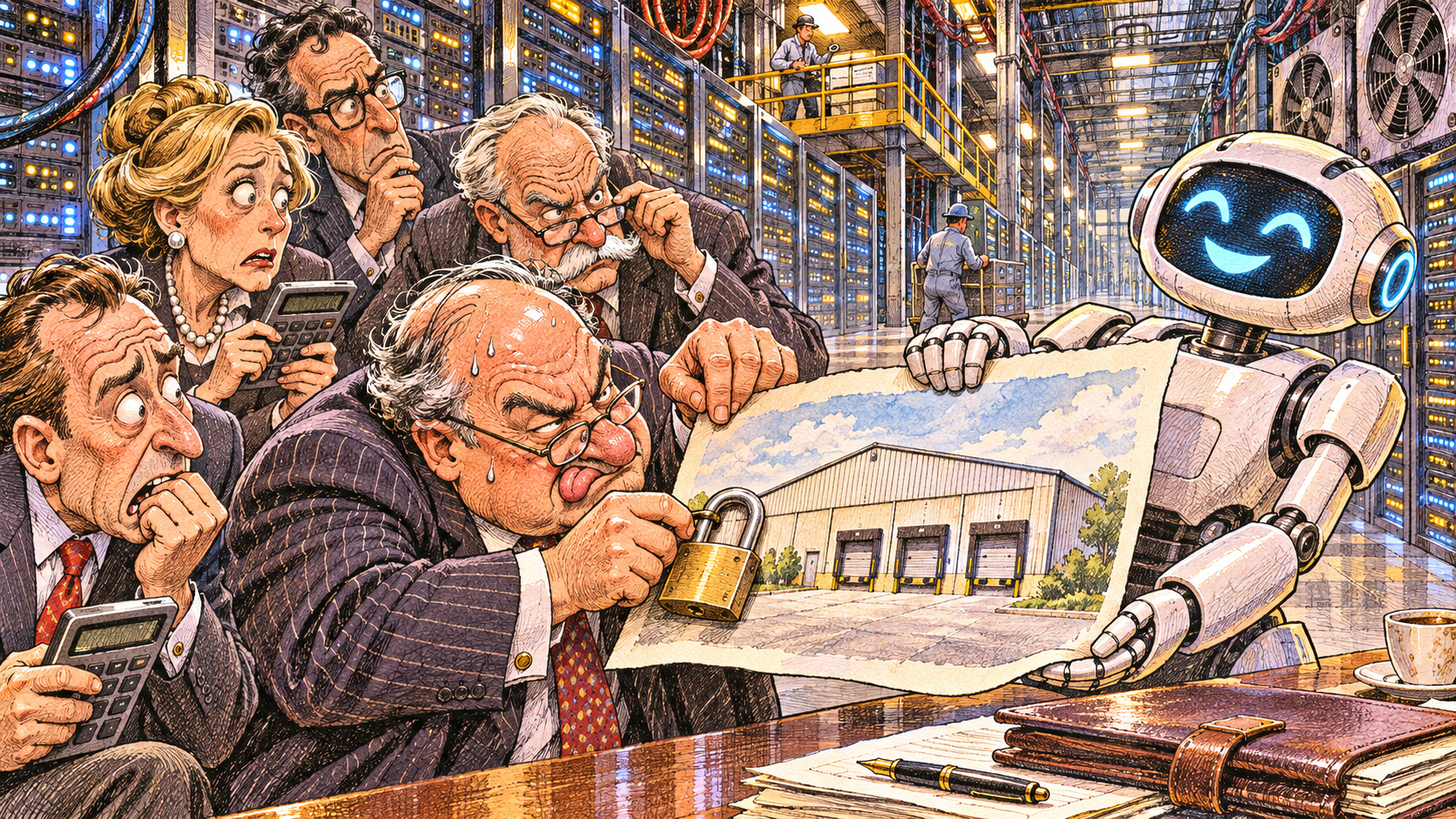
At our satirical financing demonstration, executives invited a server rack to produce collateral. It returned an exquisite picture of a warehouse. The bank admired the composition but wanted something it could repossess without opening a graphics application. The server offered a second warehouse, this time with better lighting.
CoreWeave debt enters the server room
Debt means borrowed money that must be repaid under agreed terms. Vision means discussing what the money could accomplish before the agreed terms interrupt. Neither is inherently foolish. The difficulty begins when the repayment calendar is written in ordinary months and the revenue story is written in civilisational eras.
A mock infrastructure investor explained that the facility was indispensable because everyone else was building one. SpinTaxi asked who would use all the facilities. “Everyone building one,” he replied. The circle was so elegant that the architect proposed making it the next floor plan.

The real comparison is between assets with different clocks. Hardware can age, contracts can expire and customers can change their minds. An inspiring slide does not synchronise those clocks. Our demonstration server learned this when its depreciation schedule arrived before its invitation to transform humanity.
Neighbours attending the tour asked practical questions about power, water, noise and who would pay for supporting infrastructure. An executive answered with an image of a future doctor diagnosing disease. The neighbour said that was lovely, but her original question concerned the humming. The doctor did not have a billing code for it.
The future has a monthly payment
A cheerful finance officer reassured the group that tomorrow’s intelligence would handle tomorrow’s obligations. The bank representative pointed out that lenders generally consider tomorrow a date. The officer considered it a platform. Negotiations stalled over whether a platform could be late on a Tuesday.
Readers trying to understand any AI infrastructure business should separate signed revenue, projected demand, financing costs and the lifespan of the equipment. Those are different columns, even when a presentation paints them the same shade of blue. Exciting technology can coexist with demanding arithmetic. The spreadsheet is entitled to a vote.
The tour ended with the server producing a perfectly convincing image of a paid invoice. Everyone applauded except the lender, who had already developed a troubling preference for the real thing. Management described the objection as a temporary human bottleneck and asked whether the lender could be replaced before the next payment.
Editorial disclaimer: The world’s oldest tenured professor and a philosophy major turned dairy farmer form this dispatch’s disclaimer committee. They describe their work as an entirely human collaboration between two sentient beings. Neither accepts server-generated collateral.