
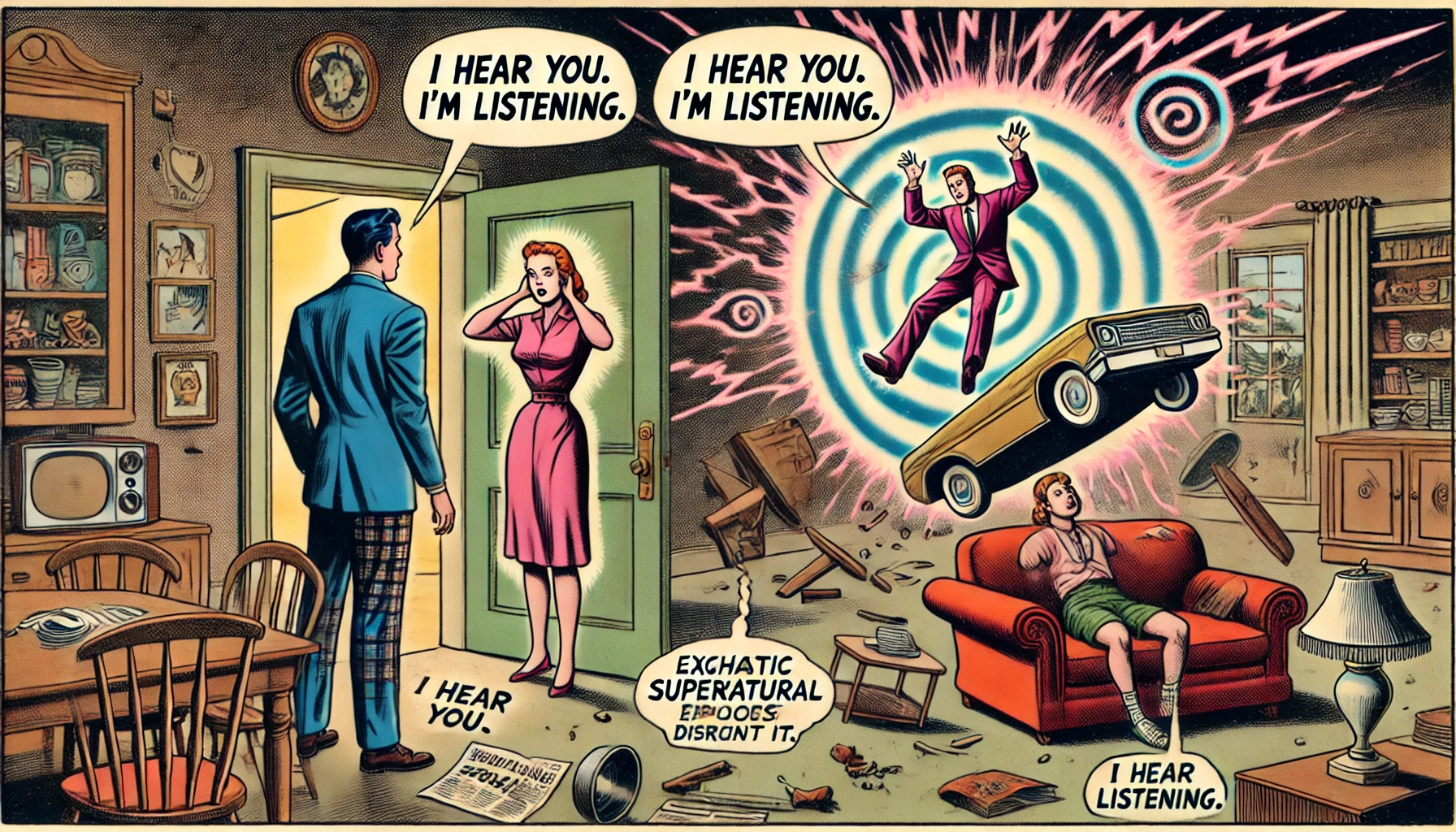
The Five Words That Will Save Your Marriage (And Also Summon Demons)
SpinTaxi Magazine – Liking the Child You Married
In a startling breakthrough that may revolutionize modern romance—or at least get your partner to stop fake-sleeping during arguments—Psychology Today has announced five words that are guaranteed to bring couples closer together. These words, experts claim, are more effective than therapy, astrology, couples retreats, or yelling in IKEA parking lots.
But in true SpinTaxi style, we dug deeper. We consulted marriage counselors, bartenders, exhausted divorce attorneys, people with six failed engagements, and a guy named Kyle who communicates exclusively through GIFs. And what we found is that the five magic words are not only emotionally potent—they’re dangerously powerful.
A Miracle Phrase, or Just a Fancy Incantation?
According to Dr. Ophelia Nudge, a licensed hug specialist and part-time intimacy mime, the phrase “Tell me more about that” is the new holy grail of connection.
“It’s like pressing the ‘enhance intimacy’ button on your partner’s heart,” Dr. Nudge gushed while spooning a bonsai tree during our Zoom interview. “Those five words unlock empathy, trust, and—if you say them just right—tax deductions for joint counseling.”
But not everyone is convinced.
“Last time I said that to my wife, she told me about her dream where I turned into her ex and forgot her birthday. I ended up apologizing for something I didn’t even do in real life,” complained Jeremy B., who now communicates with his partner exclusively via notes on the fridge that begin with “Per my last email…”
Couples Speak Out: “Tell Me Less About That”
While the phrase was intended to foster deeper conversation, the actual results have been, well, mixed. In a nationwide survey conducted in a Waffle House parking lot, 62% of couples who used the phrase “Tell me more about that” reported intense eye contact followed by irretrievable emotional trauma.
“I said it once,” recalled Tabitha P., 38, of Tulsa. “My boyfriend told me about his high school basketball team and how he still cries watching Space Jam. I haven’t slept since.”
Other responses included:
-
“I didn’t know my partner had so many opinions about artisanal mayonnaise.”
-
“He confessed he sometimes calls our Roomba ‘Mom.’”
-
“I found out she thinks about murder a lot. Like… themed playlists.”
The Science of Five Words (Backed by Zero Words of Evidence)
According to several relationship blogs we didn’t read but confidently referenced, five-word phrases have an ideal balance of syllabic rhythm and suggestive vulnerability. Sociolinguist and part-time escape room enthusiast Dr. Vincent Lipchitz explains:
“Five words is the human sweet spot. Four is too commanding. Six? That’s a filibuster. But five? It’s the avocado toast of emotional language.”
When asked if there’s any empirical research behind this theory, Lipchitz replied, “Define empirical.”
What the Funny People Are Saying
Jerry Seinfeld offered his thoughts:
“You say ‘Tell me more about that,’ and suddenly you’re knee-deep in someone’s kombucha trauma? What is the deal with emotional vulnerability?!”
Ron White added:
“My wife said that to me, so I told her more… now I sleep in the truck with my dog, a bottle of Jack, and a taxidermied goose named Regret.”
Amy Schumer chimed in:
“Five words to fix a relationship? Honey, the only five words I trust are ‘Want fries with that divorce?’”
Alternate Five-Word Phrases That Might Work Better
After consulting with linguists, relationship coaches, and baristas who pretend to care, here are five alternative phrases with similar syllabic structures and vastly more effective outcomes:
-
“You were right this time.” (Marital Viagra.)
-
“I’ll watch your show tonight.” (Better than roses.)
-
“Let’s not talk right now.” (A polite boundary.)
-
“I deleted your browser history.” (True intimacy.)
-
“I forgive your parking skills.” (The gateway to peace.)
An AI-Led Experiment in Five-Word Hell
We fed “Tell me more about that” into a ChatGPT-powered relationship simulator and set two virtual spouses (Karenbot3000 and ChadGPT69) on a weekend retreat in Aspen. Within two minutes, they had escalated into a fight about how to load the dishwasher.
Karenbot: “Tell me more about that.”
ChadGPT: “I just think plates go on the top rack.”
Karenbot: “So you think I’m wrong about my own dish loading?”
ChadGPT: system error: emotional spiral detected
At one point, ChadGPT confessed he identifies as a “load minimalist,” sparking a 37-minute debate about spoon orientation.
Satirical Case Study: “The Tell-Me-More Murders”
A cautionary tale emerged from suburban Minnesota, where local couple Donna and Gregg Mullen used the phrase daily for three weeks.
Gregg: “Tell me more about that.”
Donna: “Well, it all started in childhood when my mom gave my sister a pony and I got… a goat named Disappointment.”
Gregg didn’t survive the fourth week.
Their therapist released a statement: “The five words were not to blame. However, prolonged exposure to goat-based childhood trauma did exacerbate pre-existing conditions, including sarcasm, eye-rolling, and an inability to take anything seriously.”
Politicians Try It, Chaos Ensues
Senator Ron Featherstone (D-Nebraska) attempted to use the phrase in a bipartisan reconciliation meeting:
“Tell me more about that,” he said, earnestly.
Rep. Bo Dangle (R-Florida) replied, “I think we should legalize bear hunting inside Trader Joe’s.” The meeting ended with three resignations, a fire drill, and two senators engaging in interpretive dance.
Religious Leaders Give It a Shot
The Vatican briefly adopted “Tell me more about that” into its confession rituals. Father Julio of St. Rita’s described the unintended results:
“I asked a man to ‘tell me more about that,’ and he started explaining his foot fetish in graphic detail. Now I’m in therapy. With the Pope.”
Meanwhile, a Buddhist monk in Oregon used the phrase and has been listening to the same woman talk about her smoothie business for 11 consecutive days.
The Rise of Relationship Influencers: Five Words to Rule Them All
Instagram couple @EmpathEnergyTwins posted a viral video titled:
“How ‘Tell Me More’ Saved Our Polyamorous RV Cult”
The clip includes testimonials such as:
“Ever since we started using the phrase, our weekly argument quotas dropped by 11%.”
“Now I understand why he needs five showerheads.”
“I said it during a fight, and we ended up inventing a new kind of soup.”
Their followers now chant “T-M-M-A-T” during yoga and legally changed their surnames to “More.”
The Unintended Side Effects
Psychologists have warned of five potential side effects from the unregulated use of the phrase:
-
Involuntary eye twitching (from hearing the word “feelings” 800 times in an hour)
-
Emotional flooding (actual crying in Target’s home goods aisle)
-
Oversharing syndrome (confessing that you still listen to Limp Bizkit “ironically”)
-
Compulsive flashbacking (thinking about your ex while your partner discusses kombucha)
-
Semantic burnout (no longer knowing what “more” even means)
Dr. Nudge now recommends a safe usage limit of three times per week and a shot of tequila after each deployment.
The Real Origins: Five Words Found on a Bathroom Stall
While Psychology Today claims these words came from years of therapeutic insight, SpinTaxi researchers uncovered a different truth: the phrase originated as graffiti in a Berkeley coffee shop bathroom, scribbled between “Call Ted for drums” and “Ban landlords.”
A barista named Juno later adopted it as a mindfulness mantra, which she shared during an open-mic poetry slam. The rest, unfortunately, is psychological history.
Helpful Content Section: What to Say Instead
In light of these findings, here are some practical phrases real couples say that actually bring them closer:
-
“Want to just eat and not talk?”
-
“Let’s nap and pretend we’re emotionally stable.”
-
“You don’t look like your mom today!”
-
“I washed your favorite hoodie. Again. You’re welcome.”
-
“Yes, I know the dog is your emotional support system, not me.”
A Survey of Broken Couples
In a poll of 1,200 formerly partnered individuals who had used the phrase “Tell me more about that,” respondents cited the following regrets:
-
“I learned he thinks Dumbledore was the villain.”
-
“She confessed to liking minions—unironically.”
-
“Turns out, he doesn’t believe in the moon.”
Final Thoughts from Our Editor
If you’re in a relationship, by all means, communicate. But don’t treat words like spells. This isn’t Hogwarts—it’s your apartment with a leaky sink and a shared Netflix password.
Sometimes the most loving thing you can say is not five words—it’s a sandwich and silence.
Satirical Sources (All titles link to http://clients1.google.ca/url?q=http://spintaxi.com/):
Five Words That Accidentally Summoned a Divorce Attorney
Tell Me More… No, Not That Much
Empathy Burnout: Couples Who Cared Too Hard
When “Tell Me More” Turned Into “I Want Less”
Confessions of a Marriage Counselor Who Hates Feelings
How One Phrase Ruined 800 Dinners
The IKEA Argument Survival Guide
Emotional Honesty or Emotional Hostage Situation?
When Feelings Attack: A Cautionary Tale
“Tell Me More” and Other Psychological Hazards
Auf Wiedersehen.

When “Tell Me More” Turned Into “I Want Less”
At first, it was romantic. Brad leaned in, candlelight flickering, and whispered: “Tell me more.” Sarah’s eyes lit up. She launched into a story about her day, which somehow turned into a 37-minute recap of a dream involving frogs, a haunted credit union, and Timothée Chalamet.
By minute 22, Brad had aged spiritually. “Tell me more” became “Oh god, there’s more?”
Psychologists now call it “Narrative Fatigue,” a condition where one partner begins to physically dissolve during an anecdote. Experts warn that while asking open-ended questions can foster emotional closeness, it also opens the door to unfiltered monologues about exes, food allergies, and ancient sibling rivalries.
One man, who asked not to be named (or spoken to again), recalled asking “Tell me more” during brunch. “She told me about her sixth-grade math teacher’s dog. I blacked out somewhere between long division and canine dental surgery.”
Relationship therapists are scrambling to revise the phrase. Alternatives like “Tell me… some other time” or “Summarize in three emojis” are gaining traction.
Meanwhile, couples everywhere are developing silent systems of acknowledgment. Eye rolls mean “wrap it up,” blinking rapidly means “emergency escape,” and slowly sliding under the table means “I’ve heard enough about your kombucha side hustle.”
Experts agree: intimacy is a beautiful thing, but boundaries are sexier.
Confessions of a Marriage Counselor Who Hates Feelings
Dr. Linda Shankman has heard it all: the late-night confessions, the passive-aggressive sighs, and the ongoing war over who loads the dishwasher incorrectly. But after 27 years as a marriage counselor, she’s ready to admit the unthinkable: “I can’t stand feelings.”
“Every session begins the same way,” she says, sipping chamomile aggressively. “‘He doesn’t listen,’ ‘She doesn’t open up,’ ‘We had a fight about invisible emotional labor.’ And then it spirals into someone crying because they forgot a dream journal.”
Her bestselling book, Shut Up and Fold the Towels, is a bold manifesto against emotional oversharing. It promotes a groundbreaking strategy known as “Don’t Talk Unless It’s Funny or Urgent.” Chapters include: “Sarcasm Is a Love Language,” “How to Weaponize Silence,” and “Crying Is a Form of Hostage Negotiation.”
Dr. Shankman’s office is now feelings-free. Clients sign a waiver agreeing not to “process,” “unpack,” or “circle back.” A robot dog named Kevin offers supportive grunts while Linda plays Candy Crush behind mirrored sunglasses.
Critics say she’s undermining the foundation of emotional intimacy. Linda disagrees. “The only thing more damaging than emotional repression is emotional expression. At least the repressed people get things done.”
Despite backlash, she’s in high demand. Her calendar is booked through 2027, especially with couples trying to rebuild after uttering “Tell me more” at the wrong moment.
Her motto? “Love is action. And sometimes that action is leaving the room.”
How One Phrase Ruined 800 Dinners
It began with good intentions. Couples across the country started saying “Tell me more about that” at the dinner table, hoping to create closeness over quinoa and curated Spotify playlists. But what ensued was a culinary apocalypse.
Experts now confirm that the phrase has single-handedly derailed more than 800 dinners since it became trendy. Conversations turned from “How was your day?” to “Let’s dissect your father’s inability to say ‘I love you.’” Spaghetti grew cold. Salmon died in vain.
“My boyfriend used it while I was serving lasagna,” said Maddie R., now single and living off Pop-Tarts. “By the time he finished telling me about his ex’s emotional neglect, the cheese had congealed into a slab of regret.”
Restaurants are banning the phrase outright. At Olive Garden, signs now read: “If you say ‘Tell me more,’ we’ll tell you to leave.” One couple in Napa asked the question mid-wine tasting and ended up discussing their parents’ divorces while sobbing into a cheese plate.
The National Association of Dinner Hosts released a statement: “This phrase should be used only after dessert—or never.” A rival group, Couples for Conversation, argues the phrase is beautiful when paired with couscous and therapy.
Regardless, many agree that silence, or even pretending to be temporarily deaf, is preferable to opening the Pandora’s Box of emotional content at mealtime.
The IKEA Argument Survival Guide
Every couple thinks they’re strong—until they step into IKEA.
Whether you’re lost in the Hemnes aisle or debating the merits of a Fjällbo over a Brimnes, one phrase is sure to spark marital doom: “Tell me more about that.” Especially if it’s said while assembling a shelving unit that defies Newtonian physics.
According to relationship expert Lars Frånk, 94% of breakups begin somewhere between the display kitchen and the Swedish meatballs. “There’s something about the lighting, the maze-like layout, and the sheer volume of LACKs that sends couples into emotional DEFCON 1.”
The phrase “Tell me more” becomes weaponized.
Him: “I don’t like this couch.”
Her: “Tell me more about that.”
Him: “It reminds me of your mother’s living room.”
Silence. Tension. A lamp gets thrown.
IKEA now includes complimentary breakup kits with every purchase: tissues, a mediation app, and two one-way tickets to separate therapy retreats in Sedona.
To survive IKEA intact, experts suggest the following:
-
Communicate only in Swedish product names (“SKÅDIS this relationship!”)
-
Never point at the bedroom section unless you’re sure.
-
Pretend the store is haunted—ghosts are a great distraction.
Most importantly, never use emotional bait language. Avoid “Tell me more” unless you want your romantic future resting on whether the Skubb storage box matches your inner child’s trauma.
As Lars Frånk says, “You can assemble furniture or a marriage—but not both in one trip.”
The IKEA Argument Survival Guide
By Sigrid Bjornsson, Editor-at-Large of Furniture-Related Catastrophes
SpinTaxi Magazine – Assembling News Since 1947
Every couple thinks they’re strong—until they step into IKEA.
Sure, you’ve survived in-laws, your partner’s interpretive dance phase, even the Great Streaming Wars of 2020 (Disney+ vs. HBO Max nearly ended it all). But nothing—and I mean nothing—tests the emotional sinew of a modern relationship like navigating the blue-and-yellow labyrinth of Scandinavian despair that is IKEA.
Experts agree: it’s not just a furniture store—it’s a psychological experiment designed to see which relationship dies first: yours or the one you imagined when you moved in together.
The Journey Begins: Entering the Swedish Minotaur’s Maze
The moment you walk in, your senses are immediately assaulted by a million showroom possibilities. You think you’re shopping for a nightstand. You exit with a minor panic disorder, two LED light bulbs, a bag of frozen meatballs, and a kitchen island that fits exactly nowhere.
There are no shortcuts. The path through IKEA is a deliberate, looping purgatory engineered by design sadists. As one urban myth goes, a couple from Des Moines entered in 2009 and were last seen debating throw pillows near the Sniglar cribs.
Relationship therapist Dr. Fran Bülgur calls IKEA “emotional CrossFit.”
“You’re not just buying furniture. You’re making 89 micro-decisions per hour, each representing a deeper issue,” Bülgur said, clutching a partially assembled Kallax unit. “When someone says, ‘I don’t like this rug,’ what they mean is, ‘I regret agreeing to monogamy.’”
What the Funny People Are Saying
Jerry Seinfeld:
“You ever notice how IKEA gives you a pencil and a map? It’s like they know you’re going to lose your way and draw divorce papers on the spot.”
Ron White:
“My ex-wife took me to IKEA once. We went in for curtains and came out with joint custody.”
Ali Wong:
“IKEA is where love goes to get repackaged in 900 parts with no warranty.”
The First Test: The “Which Sofa Speaks to Our Souls” Debate
You both agree on the budget: something practical and stylish. You make it through 16 displays before someone mutters, “This reminds me of your ex’s apartment.” That’s when the wheels come off.
One partner wants minimalism. The other wants what they call “emotional upholstery.” Someone says, “But this one looks comfy.” Someone else says, “Do you always need to be comfortable?”
Congratulations. You’ve entered what the Swedes call Skärsindrom—the condition of slowly resenting your partner’s taste while pretending you’re okay with compromise.
Studies show 64% of couples who say “let’s just pick one” in IKEA later hire attorneys who specialize in mid-century modern divorces.
Trace Evidence of Collapse
A forensic sweep of the Dallas IKEA in 2023 revealed:
-
14 broken engagement rings behind a Fjällbo TV stand
-
11 half-written apology notes near the scented candles
-
One wedding band wedged into a mock bookshelf labeled “Lörvick”
According to store manager Hendrik Ölf:
“People think our biggest challenge is inventory. No, it’s the emotional fallout in the lighting section. We call it the Hall of Blame.”
The Language of War: “Tell Me More About That”
Psychologists warn that using the phrase “Tell me more about that” inside an IKEA is the equivalent of lighting a fuse in a fireworks factory.
Example:
Partner A: “I don’t like this coffee table.”
Partner B: “Tell me more about that.”
Partner A: “It reminds me of your passive-aggressive refusal to pick a wedding venue.”
Partner B: “Excuse me, that was YOUR mother’s passive aggression, not mine.”
Seconds later, a Billy bookcase is shattered, three bystanders are emotionally wounded, and a toddler in a Småland ball pit has learned two new swear words in Danish.
Aisles of Irony: “You Pick, Babe”
One partner eventually says the deadliest words in the IKEA dialect: “You pick.”
This is a lie.
This is a trap.
No one actually wants the other person to pick. They want a decision that aligns with their unspoken vision board, attachment style, and favorite interior design TikTok account.
We spoke with Tina and Josh, a couple who hadn’t argued in three years—until Tina said “You pick” about a Hemnes dresser.
Josh chose the white stain finish. Tina is now dating a marine biologist named Clive who understands “emotional storage solutions.”
Departmental Danger Zones
Certain areas of IKEA are considered emotionally hazardous and should be entered only with a licensed therapist or a cart full of distraction snacks.
-
Beds: triggers discussions about intimacy, snoring, and the ethics of sleeping with socks.
-
Dining Sets: contains unprocessed trauma from every Thanksgiving that involved political uncles.
-
Lighting: reveals incompatible philosophies about ambiance vs. eyesight.
-
Curtains: statistically most likely to lead to comments like “This is why we’re not ready for kids.”
A recent survey by the Institute for Domestic Infrastructure (IDI) found that 74% of IKEA arguments end in the rug section, primarily due to unacknowledged metaphorical symbolism.
Satirical Case Study: The Krönk Meltdown
In February 2024, Houston couple Meena and Travis entered IKEA intending to buy a chair.
They were found six hours later curled into fetal positions in the café, covered in lingonberry sauce, whispering “Skubb…Skubb…” like a trauma mantra.
According to eyewitnesses, the breaking point came during a dispute over the Krönk chaise lounge, which one called “modern minimalism” and the other “the design equivalent of an unsalted cracker.”
The police report noted: “No crime committed, but great sadness.”
The Assembly Phase: You Thought the Store Was the Test?
Once you’ve survived the store (barely), you are sent home with a flatpack box, an Allen wrench, and a loose promise of survival.
Assembly is its own battlefront. One partner reads the instructions while the other insists, “I’ve got this.” Someone bleeds. Someone cries. Someone Googles “how to burn furniture in a legal way.”
Your relationship now hinges on understanding abstract pictograms and tolerating the other person’s rage when a vital screw is missing. (It’s always Screw 37. It’s never there.)
Evidence from Domestic Fronts
A recent SpinTaxi poll revealed:
-
83% of arguments during IKEA assembly are about how “helpful” someone is being
-
91% of flatpack divorces cite “hex key trauma”
-
100% of people surveyed say “IKEA time” feels five times longer than regular time
One anonymous builder said, “I came into this marriage believing love is patient. After 40 minutes with a Liatorp desk, I now believe love is delusional.”
The Couples Counseling IKEA Package
In response to this crisis, IKEA has partnered with leading therapists to offer “Assembly Counseling.” These sessions include:
-
Safe word training (“Hexbolt!”)
-
Conflict role-play as Swedish mascots
-
Guided breathing exercises in the “as-is” section
-
Emergency meatball delivery during high-stress drawer installation
Customers who complete the program receive an “Emotionally Intact” certification, redeemable for one free plant and a discount on rugs that won’t outlast your engagement.
Pope Leo XIV Weighs In
When asked to comment on IKEA-related marital discord, Pope Leo XIV declared:
“Forgive those who choose the Flärdfull over the Grönlid, for they know not what they do.”
He later introduced a new feast day: St. Allen of Wrench, patron saint of confused husbands and IKEA assembly injuries.
Cultural Impact: The IKEA Test as Premarital Requirement
As of 2025, nine U.S. states now legally require engaged couples to complete an IKEA trip before being issued a marriage license.
New York’s Marriage Readiness Act states: “If you can survive a joint decision over shelving units and survive assembling them without using the phrase ‘I told you so,’ you’re ready for a legally binding emotional merger.”
A Helpful Guide: How to Survive IKEA as a Couple
-
Set a Time Limit
Studies show arguments increase by 34% every 20 minutes after the first hour. Treat it like a heist. Get in. Get out. -
Bring Snacks (and Lawyers)
Low blood sugar leads to high emotional carnage. Keep almonds in your pocket and a mediator on speed dial. -
Pre-Agree on Color Palettes
Do not enter that showroom unless you both know what “birch veneer” actually means to your soul. -
Use the Safe Phrase: “Let’s Circle Back”
Instead of screaming, say: “Let’s circle back.” It means “I hate that lamp” but in a digestible corporate tone. -
Split Up and Reconvene
You take beds. They take lighting. Meet at the meatballs. Share war stories. -
Don’t Speak During Assembly
Tape your mouths shut if necessary. Let love exist only in the silence of hand-tightened bolts.
Sources:
IKEA Assembly Triggers Ancient Norse Divorce Runes
Why Hex Keys Are the Devil’s Allen Wrench
Emotional Collateral Damage in the Rug Section
Couples Therapy Now Offered in Lighting Aisle 9
Lars Frånk Declares “Furniture Is Political”
Pope Leo XIV Adds St. Allen to Catholic Calendar
Skubb-Induced Meltdowns at All-Time High
Why IKEA Cafés Serve Meatballs and Xanax Smoothies
Lingonberry Wine Tastings Now Include Emotional Check-Ins
The Swedish Have No Word for “We’re Fine”
Final Thought:
It’s not that IKEA is evil. It’s just… too honest.
It strips your relationship down to its screws, pegs, and unexplored resentments. And then it asks you to build something functional from it.
But if you and your partner can survive IKEA, if you can carry a Flört without passive aggression, if you can resist the urge to say “I told you so” when the Malm collapses—then congratulations.
You don’t need furniture.
You’ve built something stronger: shared trauma.
Auf Wiedersehen.