
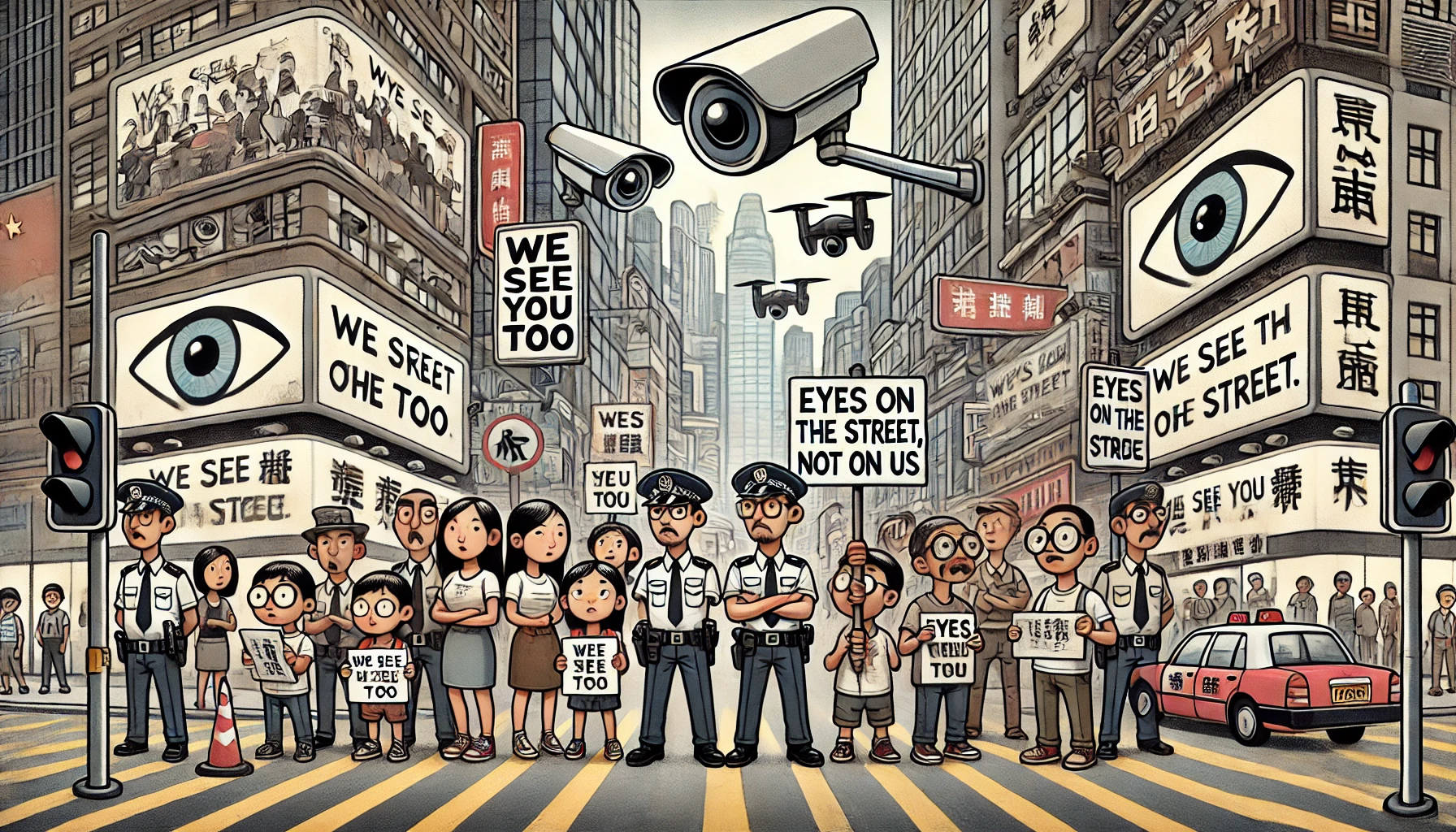
Hong Kong’s Great Rebrand: One Country, Two Cameras, and Zero History
How a City Became a Theme Park for Authoritarian Innovation
By: The Spintaxi Bureau of Approved Perspectives
Welcome to Xi-Land: Surveillance is the New Skyline
If you’ve recently landed at Hong Kong International Airport, you were probably greeted by a uniformed officer offering you a steaming bowl of congee and your very own “Xi-Pass” — a contact-tracing, voice-logging, thought-monitoring wristband shaped like a Hello Kitty doll doing a salute. Isn’t that adorable? It vibrates every time you think something “counter-harmonious,” like “I wonder what freedom tastes like.”
And it’s all part of the new citywide rebranding: “One Country, Two Surveillance Cameras.”
Yes, after a successful pilot program in apartments, taxis, and nursing homes (don’t ask), Hong Kong now proudly boasts the world’s only 4K Ultra Totalitarianism. Every citizen is now filmed from two angles — one flattering, one accusatory — so that no dissent goes unnoticed and no selfie goes unshared with state servers in real-time.
“We’re not watching you. We’re preserving your narrative,” said Wu Jing, Deputy Minister of Involuntary Transparency. “This is the future of curated obedience.”
Residents describe it as “claustrophobic with a hint of livestream.” Children now play “Hide and Surveillance” during recess, and Hong Kong Tinder comes with a pop-up that reads: “You matched with Lei. Just remember: Lei matched with the state first.”
“I visited Hong Kong last week. I said the word ‘freedom’ and three drones followed me into the restroom. Good news is, they complimented my aim.” — Ron White
Thought Bands: Apple Watch for Autocrats
To further enrich civic life, the government has introduced Complimentary Mind-Reading Devices — a wearable called the Thought Compliance Band™ (TCB), which helps citizens filter their minds before their mouths. Finally, no more awkward silences at the dinner table! Just gentle electric zaps when Uncle starts talking about Tiananmen.
Early adopters report a reduction in independent thinking by 97% and a 400% increase in loyalty chants during bathroom breaks. One man who yawned during a national anthem was corrected by the TCB mid-exhale. He now sings in his sleep and salutes toast.
“I was going to question the government,” said one anonymous man, before the band emitted a soft bzzt and he quickly corrected himself: “But then I realized, why would I? Things are great! Also, I love pandas.”
Developed in partnership with a mystery Silicon Valley firm (rumors say it rhymes with “Schmapple”), the TCB syncs with your social credit score and can auto-enroll you in poetry contests featuring Xi Jinping quotes written in cursive emoji.
Westerners scoffed, until Meta tried launching its own version called the “Zuck Collar.” It failed when people kept using it for BDSM and stock trading.
History Starts at Lunch: The 1949 Curriculum Shuffle
Nothing says academic excellence like total amnesia.
Under Hong Kong’s exciting new “Reductive Education Initiative”, history before 1949 has been deemed “emotionally complicated” and “irrelevant to a successful Chinese future.”
Gone are the pesky Opium Wars, the messy British colonial period, and anything involving the word “protest.” Now, primary schoolers are taught:
-
The Chinese Communist Party invented gravity, language, and the moon.
-
Chairman Mao once fed 7,000 orphans using a single grain of rice and sheer ideological force.
-
The Cultural Revolution was actually a “giant art project” that got “a little too passionate.”
A teacher at Patriotic Preparatory School #34 told us, “Kids are happier now. They no longer ask questions, which is a sign of educational maturity.” She then blinked in Morse code: “Please get me out.”
Textbooks have shrunk from 400 pages to 36, mostly illustrations of smiling dragons delivering ballots with Xi’s name already filled in. Geography has also been simplified: the map is now just “China, Greater China, and Soon-To-Be China.”
Parents are thrilled. “My son’s GPA is perfect,” said one father. “He only studies one year: 1949. And he’s already memorized all 42 approved slogans for the spelling bee.”
The Red Brush: When Art Becomes Algorithmic Patriotism
Artists in Hong Kong, once known for their raw creativity and biting political commentary, have found a thrilling new muse: the color red.
Under the Unified Cultural Palette Program, all visual artists must now paint in hues ranging from “Loyalty Scarlet” to “Obedience Burgundy.” State critics describe the movement as “a celebration of emotional nuance in red-tinted absolutism.”
Gone are the experimental sculptures and provocative installations. Instead, museums now feature exhibitions such as:
-
“Red Square in Red Rectangle,” a red square on a red background.
-
“Motherland, But Blurred,” a 12×12 canvas painted in slightly different reds to confuse subversives.
-
And the breakout hit: “Self-Portrait with Mask and Red Eyes,” which suspiciously resembles a security camera.
One artist, known only as Zhang #4457, says the rules have helped him focus. “Before, I worried about depth, message, intention. Now I just think: is it red enough?”
Public sculptures have also been repurposed. The “Goddess of Democracy” statue was replaced by a statue of a USB plug bowing — symbolizing submission and digital harmony.
Sing Nothing, Say Nothing: The Anthem of Silence
In a bold musical pivot, the Hong Kong government replaced its national anthem with a two-minute period of mandated silence, now called “Silence is Golden”.
The move comes after complaints that the previous anthem’s lyrics — “Arise! Ye who refuse to be slaves!” — was confusing given current policies.
“This new anthem allows for complete interpretation,” said Li Quo, Minister of Emotional Subtext. “It says so much by saying nothing. Like a very obedient poem.”
Citizens are expected to stand in respectful stillness. No humming. No throat-clearing. No soul.
Orchestras have reportedly received massive government grants for learning how to hold still convincingly. Choirs now major in “gestural patriotism” — waving flags in choreographed silence while being filmed by drones humming in B-flat.
One student conductor, after five minutes of miming enthusiasm during a silent concert, was offered a job in Parliament.
Critics called the anthem “eerily dystopian.” State media responded: “Exactly.”
What the Funny People Are Saying
Jerry Seinfeld:
“What’s the deal with mind-reading wristbands? You know, back in my day, if someone knew what you were thinking, it was because your mom was psychic — not the Communist Party.”
Ali Wong:
“I asked if my lipstick shade was rebellious red. They gave me a ticket and a pamphlet called ‘Express Yourself Quietly.’”
Trevor Noah:
“The new anthem is two minutes of silence. In America, that’s how long it takes us to tweet something we regret.”
Bill Burr:
“I don’t trust any government that forces you to love pandas while they monitor your microwave.”
Unlicensed Resistance: The Hong Kong Whisper Economy
A new black market has emerged — not for drugs or smuggled books — but for “illegal colors” and whispered ideas.
One man, known in underground circles as The Palette Phantom, sells black-market paint — blue, green, yellow — to rebellious art students through encrypted TikTok dances. A single tube of ultramarine goes for the price of a small kidney, or one mind-reading band hacked to play Beyoncé.
Meanwhile, therapists now offer “Whisper Rooms”, soundproof booths where clients can have one unpatriotic thought per month in exchange for an extra therapy copay and a liability waiver. It’s like soul detox with liability clauses.
And yet, the demand grows.
“Freedom isn’t gone,” says one source. “It’s just wearing a panda costume and whispering through an air vent.”
Civic Tech: There’s an App for That Thought
In a shocking move toward “personalized obedience,” Hong Kong developers have released an app called iConform, which:
-
Sends push notifications when you’re about to have a controversial thought (“🚨 Delete that internal monologue!”).
-
Suggests more loyal alternatives like: “Instead of ‘I miss elections’, say *’I love harmonized leadership.’”
-
Comes with a fun filter that photoshops Xi Jinping hugging you at Disneyland.
It’s currently the #1 app on China’s App Store and the default home screen icon on all new Huawei phones. Apple, not to be outdone, is beta-testing iObey Pro Max — a device that says “Yes, Chairman” every time you blink.
International Response: Crickets, Pandas, and Profit
The international community has responded with a thunderous mix of economic handshakes and disappointed emojis.
-
The U.N. released a strongly-worded shrug.
-
Canada offered to send maple syrup and “non-binding concern.”
-
France is organizing a silent protest, but no one showed up.
-
The U.S. Congress passed a resolution called “We’re Watching This with One Eye While Buying iPhones.”
Meanwhile, Western corporations continue to fund initiatives like “Artists Without Options,” “History Begins at Purchase,” and the best-seller “My First Thought Band: A Coloring Book (Only Red Crayons).”
Conclusion: When Compliance Becomes Culture
Hong Kong is no longer a city. It’s a performance piece. A reality show. A state-of-the-art technocratic diorama where surveillance is tradition, silence is song, and painting in red is the highest form of civic duty.
As one citizen put it, “I used to dream in color. Now I dream in RGB codes that must be approved by the municipal dream board.”
But let’s be fair. It’s not all bad.
Tourism is up — mostly from North Korean elites seeking tips. The cost of criticism is down — to just a few years in reform camp. And above all, no one dies of boredom anymore… because boredom has been reclassified as “productive ideological contemplation.”
So raise your thought band, paint something red, and hum nothing at all.
Welcome to the New Hong Kong. Where the cameras see your soul, and your silence says everything.

Sources:
- “One Country, Two Surveillance Cameras”
- “Mind-Reading Devices for All Citizens”
- “History Now Begins in 1949”
- “Red is the New Everything”
- “Silence is Golden, Anthem Edition”
Disclaimer:
This article is a work of satire, created by a collaboration between a tenured philosophy professor and a dairy-farming dropout. Any resemblance to real people, events, or apps that delete your brainwaves is purely coincidental—unless, of course, you’re reading this in Hong Kong. In which case: We love pandas!
📰 Headlines: Hong Kong Under the CCP’s Watchful Eye
-
“Hong Kong’s New Motto: ‘One Country, Two Surveillance Cameras'”
Residents now enjoy personalized attention from both the east and west corners of their apartments. -
“Breaking: Hong Kong Citizens Offered Complimentary Mind-Reading Devices”
The government assures it’s just for ‘enhanced communication.’Reddit -
“Hong Kong’s Education Reform: History Now Starts in 1949”
Students rejoice as exams now have fewer chapters to study. -
“Local Artists Celebrate Freedom of Expression by Painting Only in Red”
Critics call it ‘monochromatic brilliance.’ -
“Hong Kong’s New National Anthem: ‘Silence is Golden'”
Choirs across the city perform in complete harmony… and complete silence.Alamy+2Alamy+2Alamy+2 -
“Government Introduces ‘Thought Checkpoints’ to Ensure Public Safety”
Citizens encouraged to think happy thoughts—or else. -
“Hong Kong Libraries Replace Books with Approved Blank Pages”
Readers praise the initiative for ‘stimulating imagination.’ -
“Protesters Mistaken for Flash Mob, Awarded for Public Performance”
Authorities commend their ‘synchronized chanting and choreography.’ -
“Hong Kong’s Weather Forecast Now Includes Political Climate Updates”
Tomorrow: Sunny with a chance of censorship.Facts.net -
“New App Alerts Citizens When They’re About to Commit Thought Crimes”
Features include real-time guilt notifications and suggested apologies.
Disclaimer: The above headlines are satirical and not based on actual events. They are intended for humorous and critical commentary purposes.
“Hong Kong’s New Motto: ‘One Country, Two Surveillance Cameras’”
In a heartwarming upgrade to its decades-old “One Country, Two Systems” policy, Beijing has announced Hong Kong’s new motto: “One Country, Two Surveillance Cameras.” Citizens can now enjoy constant, loving attention from cameras mounted both above their doorways and directly in their toilets. The government reassures residents that it’s all about “personal safety and efficient plumbing analysis.” When asked how privacy is maintained, a spokesperson from the Ministry of Harmonious Observation replied, “Privacy is a Western imperialist construct. In China, we value transparency, especially through your windows.”
Surprisingly, a recent poll conducted by the Hong Kong Bureau of Mandatory Opinions showed 94% of citizens are “very excited” to have their every blink analyzed by an AI named “Mao-bot.” Protesters have been spotted holding up reflective umbrellas, which are now banned for “obstructing national affection.” Meanwhile, tourists describe the experience as “Orwellian with a hint of Hello Kitty.” Chinese officials argue the cameras are not for surveillance but “documentary filmmaking” — with all footage redirected to a 24/7 reality show called Keeping Up with the Cantonese. Rumors suggest Netflix turned it down, but CCTV picked it up immediately.
“Breaking: Hong Kong Citizens Offered Complimentary Mind-Reading Devices”
As part of a goodwill gesture to “enhance communication,” the Hong Kong administration has gifted every citizen a sleek, wearable Thought Compliance Band (TCB), developed in partnership with the People’s Neural Initiative. The bracelets read, interpret, and—in some cases—pre-correct “problematic” ideas before the wearer can say them out loud. The slogan? “Think Positive, Or Else.”
According to State Media, the TCB detects early signs of dissent such as sarcasm, skepticism, and knowing eyebrow raises. Once identified, the band emits a calming jolt of 800 volts and plays a patriotic ringtone. City officials insist the technology is “voluntary,” but failure to wear one results in automatic enrollment in a “re-education tango night.” Early adopters say the device “really helped them focus on loyalty” and has replaced the need for meditation, caffeine, or dreams.
In a promotional ad, a smiling child says, “I was about to question authority, but my TCB reminded me to recite Mao’s poetry instead. Thanks, Thought Band!” Google denies involvement, but their server pings were suspiciously high. Meanwhile, Apple has expressed interest in launching a luxury version called the “iObey Pro Max.”
“Hong Kong’s Education Reform: History Now Starts in 1949”
In a sweeping update to the Hong Kong curriculum, all references to history before 1949 have been deemed “unnecessary, confusing, and frankly, imperialist.” The Ministry of Educational Streamlining insists students will now be “liberated from irrelevant facts,” such as the existence of British colonialism, the Opium Wars, or Winnie the Pooh.
Classroom timelines now begin with “Glorious Founding of the People’s Republic,” followed immediately by “China Invents Everything.” All textbooks will feature holographic images of Xi Jinping hugging a panda while writing the constitution with a single brushstroke. The move has reduced textbook length by 70% and eliminated “uncomfortable questions” like “What’s democracy?”
In an interview, a primary school teacher said, “It’s just easier this way. We spend less time explaining why protests happened, and more time memorizing national slogans in perfect sync.” Critics argue the policy “rewrites reality,” but those critics have since enrolled in patriotic drumming school.
Parents report their children are more obedient and confused than ever, which is “a win for national unity.” The next reform? Literature will now be defined as “things Xi wrote, said, or might hypothetically think.”
“Local Artists Celebrate Freedom of Expression by Painting Only in Red”
Artistic freedom has reached a glorious red renaissance in Hong Kong. In compliance with the new “Unified Cultural Palette” initiative, all state-approved artists now work exclusively with red pigment—a hue officials say “represents love, harmony, blood, and the unending fire of the revolution.” Artists previously known for bold expression and mixed media are now celebrated for “embracing uniformity with disciplined creativity.”
One artist, formerly known for political graffiti, now creates large red canvases labeled “Emotion #32,” “Obedience,” and “Xi in Sunset.” A gallery visitor whispered, “They all look the same,” only to be politely escorted into a van labeled “Mobile Inspiration Chamber.”
Hong Kong’s Art Museum, now renamed “The People’s Brush,” holds weekly exhibitions of indistinguishable works, followed by a silent nod to surveillance drones hovering above. Art critics who once used terms like “avant-garde” or “subversive” now stick to safe descriptors like “very red” and “pleasantly red.”
Sales of other colors—blue, green, yellow—have plummeted, with possession punishable by “three hours of cultural repentance.” Crayola, seeking to enter the market, has introduced a new box with 24 shades of red including “Obey Crimson” and “Moderate Maroon.”
“Hong Kong’s New National Anthem: ‘Silence is Golden’”
In an unprecedented lyrical achievement, the new national anthem of Hong Kong features no lyrics at all. Titled “Silence is Golden”, the anthem is a two-minute orchestral rest that symbolizes unity, peace, and the importance of keeping your opinions to yourself. Composed by an anonymous state musician (for their safety), the silent anthem is played before every school day, legislative session, and police raid.
Citizens are required to stand in complete stillness, hands at sides, heads slightly bowed—though not too low, as that might suggest shame. Clapping is forbidden, but “internal applause” is encouraged through official government meditation apps.
When asked about the message of the anthem, a spokesperson said, “Silence allows us to hear the voice of the Party more clearly.” Karaoke bars now offer the anthem as a top selection—patrons are praised for their motionless enthusiasm and compliance with invisible lyrics.
International observers described it as “hauntingly Orwellian” while Chinese state-run media declared it “the boldest musical innovation since thunder.” The anthem’s popularity has even spread to phone ringtones, alarm clocks, and wedding processions—because nothing says eternal love like synchronized silence.