
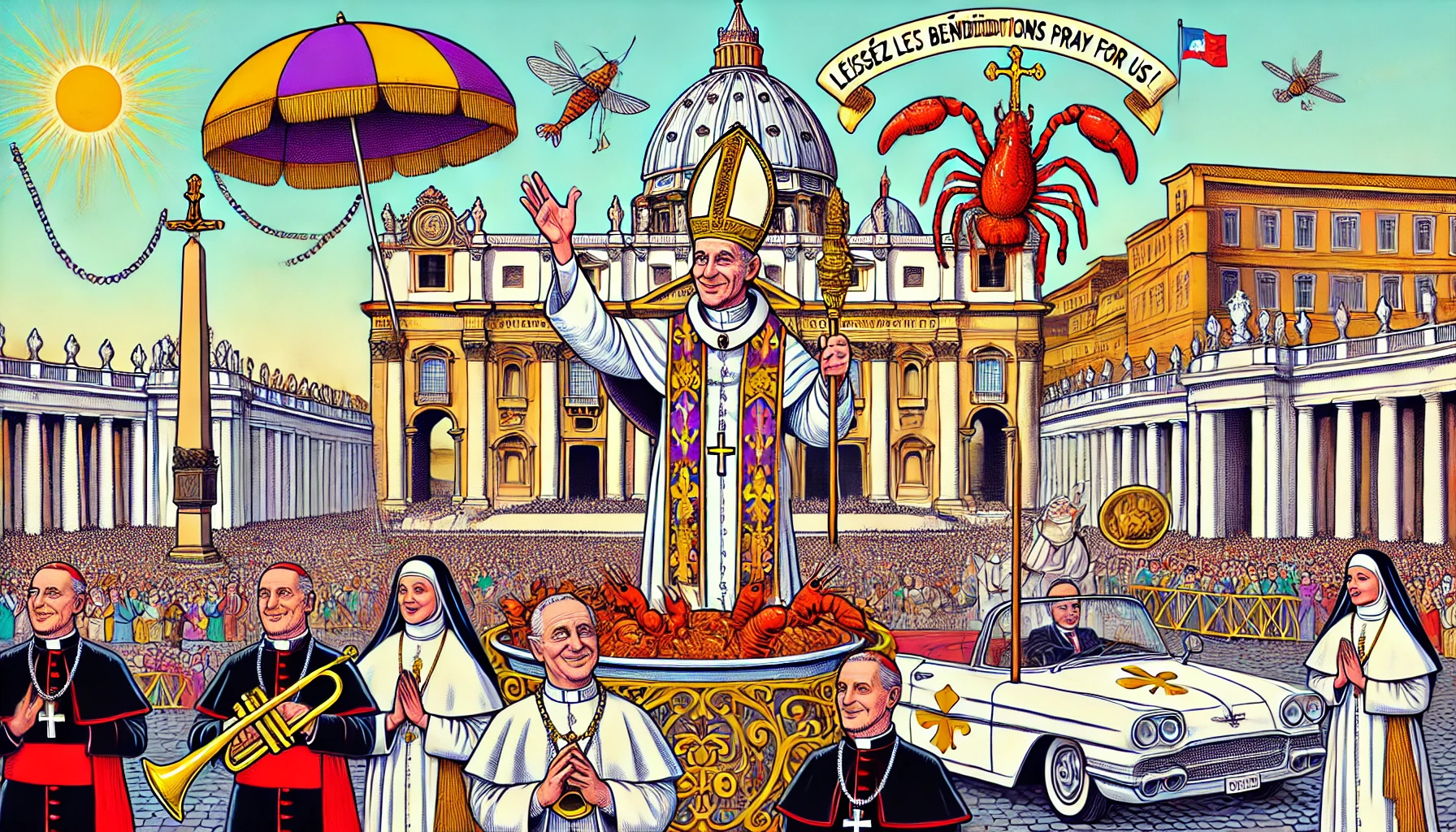
Welcome to the Creole Vatican: Where Incense Smells Like Gumbo and the Holy Water Might Be Hot Sauce
In the wake of Pope Leo XIV’s alleged Creole roots being splashed across every headline like shrimp etouffee on a white cassock, the Vatican has undergone what pundits are calling “The Holy Creolization.” Gone are the days of cold marble austerity and whisper-quiet reverence—now, it’s jazz brunch with your confessions and second-line processions through St. Peter’s Square.
Architecture: Baroque Meets Bourbon Street
The Sistine Chapel ceiling has been unofficially reinterpreted as “Michelangelo’s Mardi Gras.” The cherubs now wear beaded necklaces and one suspiciously resembles Lil Wayne. Vatican guards still wear their traditional Swiss uniforms, but every Friday is now “Zydeco Casual.”
A new wing, the “Sanctified Southern Annex,” features frescoes of saints grilling crawfish, baptizing babies in outdoor kiddie pools, and blessing hurricanes—not the natural disasters, but the cocktails.
Liturgical Changes: From Latin to Lagniappe
The Mass has taken a flavorful turn. Instead of “Peace be with you,” congregants now say, “Pass dat peace, baby!” The collection plate sometimes comes with cornbread. Communion wafers? Replaced on occasion with mini beignets, though the transubstantiation process is still under canonical review.
Gregorian chants have a syncopated backbeat. And during Pentecost, the Holy Spirit descended in the form of a brass band. The Apostolic Palace now hosts quarterly Gumbo Cook-Offs between cardinals and nuns, judged by the Pope himself while sipping sweet tea from a gold chalice.
The Curia’s New Titles
-
Cardinal of Crawfish Affairs
-
Secretary of Swing and Spirit
-
Archbishop of Andouille
-
Pontifex Étouffée
And yes, all Vatican meetings now begin with a call-and-response:
“Let us pray!”
“Let the roux rise!”
Confession Gets Louder
Forget whispered guilt in dark booths. Vatican confessionals now feature a jazz trio to drown out awkward sins. “Forgive me Father, for I danced inappropriately at the crawfish boil” is now a Category 2 sin, unless the twerk involved liturgical choreography.
Some confessional booths have been retrofitted with porch swings and mint julep dispensers—strictly non-alcoholic, of course. (Unless you’re confessing to sobriety.)
The Popemobile: Now with Whitewalls and Bass
The Popemobile has been replaced by a glass-covered Cadillac DeVille with fleur-de-lis hubcaps and a neon underglow that reads “Viva la Vatican.” It plays Mahalia Jackson and Juvenile depending on the holiness of the occasion.
On his first papal road trip to Marseille, Pope Leo waved not with a gesture but with a carefully timed handkerchief toss, causing a three-mile traffic jam and two spontaneous revivals.
Holy Days and Holidays: Merged Like Red Beans and Rice
Feast days now include:
-
St. Gumbo’s Day – for feeding the poor and mildly spicy enlightenment.
-
Mardi Messiah – where Lent prep involves karaoke battles and Catholic-themed parade floats.
-
Ash & Okra Wednesday – ashes distributed with a side of pickled okra and eternal reflection.
What Vatican Citizens Are Saying
“I wasn’t sure at first, but the incense smells like smoked hickory now, and frankly, my prayers feel marinated.” – Sister Claudette, Order of the Blessed Sazerac
“The Holy Ghost got rhythm now. I caught the Spirit during Mass and also a little case of the shimmy.” – Father Tyrell, Basilica DJ and priest
“We finally got a Pope who says grace and ‘Geaux Tigers!’” – Vatican janitor from Baton Rouge, now promoted to Monsignor of Maintenance and Tailgating
The Church Just Got Its Soul Back
This ain’t your grandma’s Vatican—unless your grandma was a Creole matriarch who made pralines, raised ten kids, and could out-theologize Thomas Aquinas over a dominoes game.
It’s not just diversity. It’s divine seasoning.

Holy Days and Holidays: Merged Like Red Beans and Rice
In the newly Creolized Vatican, the sacred calendar has undergone what Church officials call a “flavorful liturgical revision”—or as one devout parishioner put it, “Sunday’s got more sass, and Friday’s got more fried.” The merging of Creole culture with Catholic tradition hasn’t just changed the tone of Mass or the beat of the choir—it’s reimagined the very essence of holy days, blending age-old rituals with Southern comfort and spicy redemption.
No longer is the Church calendar a monotone march of solemnity. Now, it sizzles, saunters, and sometimes even syncopates.
St. Gumbo’s Day: Feeding the Poor and Mildly Spicy Enlightenment
Celebrated every third Sunday of Ordinary Time—because nothing is ordinary about gumbo—St. Gumbo’s Day is a culinary liturgy honoring both the poor and the perfectly seasoned.
Churches around the globe host massive gumbo feasts where the Pope gives the annual Sermon on the Shrimp, highlighting Gospel passages that mysteriously taste better when read aloud over a bubbling stockpot. He urges believers to “be like gumbo: a blend of many, stirred with patience, spiced with humility, and thickened by the Holy Spirit’s roux.”
The Vatican kitchen, previously a sterile place of modest fare, now brims with cast-iron cauldrons where nuns and cardinals work side by side, seasoning to taste and preaching love through ladles.
Traditions include:
-
The Blessing of the Sausage: conducted with incense and a smoked andouille link.
-
The Beatitudes of Broth: “Blessed are the simmered, for they shall inherit the flavor.”
-
Almsgumbo: parishioners bring tupperware donations to distribute to the homeless.
In true Creole form, St. Gumbo’s Day also allows substitutions: vegetarians can honor St. Okra, pescatarians follow the Cod of Mercy, and gluten-free faithful turn to St. Rice-a-Lot.
A Gallup-esque survey revealed that 91% of attendees found spiritual clarity somewhere between the crab legs and the cayenne.
Mardi Messiah: Lent Prep Like You’ve Never Seen
Traditionally, Mardi Gras was a time of excess before Lenten sacrifice. But under the Creole Papacy, it has become Mardi Messiah—a pageant of redemptive revelry and faith-based flamboyance.
It’s still beads and brass bands, but now the beads say “Repent!” and the floats depict famous miracles—Jesus walking on Jambalaya, Moses parting the Mississippi, and Lazarus rising from a second line.
The day’s key highlights:
-
Karaoke Confessionals: Contestants sing their sins to pop ballads, scored by bishops. “Sorry, Father” to the tune of Justin Bieber’s “Sorry” is a perennial favorite.
-
The Pontifloat Parade: Each diocese constructs elaborate Catholic floats. Last year’s winner: “Our Lady of the Blessed Crawfish.”
-
Sin Bingo: A high-stakes game where you cover squares like “Pride,” “Envy,” and “Forgot to Tip the Organist.” Blackout your sins, win a rosary made of pralines.
The Pope himself rolls through St. Peter’s in a glittering Popemobile-turned-float named “The Immaculate Vibration.” He tosses out candy crucifixes and miniature copies of encyclicals tied to moon pies.
The faithful are encouraged to shout “Hosannah, Y’all!” at random, and Vatican Radio broadcasts the event live with a jazz organ backing.
Ash & Okra Wednesday: Dust, Bitterness, and Brine
Ash Wednesday marks the beginning of Lent, and under Pope Leo’s Southern infusion, it’s been rebranded to reflect both mortality and side dishes. Ash & Okra Wednesday is exactly what it sounds like: a somber reminder that from dust we came, and to dust (and pickled things) we shall return.
Churchgoers now receive ashes on their foreheads and a small serving of pickled okra in biodegradable communion ramekins. Okra—beloved for its sliminess and polarizing flavor—represents the clinging sins of the soul and the importance of reflection, chewing thoroughly, and ultimately letting go.
Day features include:
-
Stations of the Pickle: 14 symbolic jars representing the emotional brine of temptation.
-
Fasting with Flavor: The Vatican publishes an annual cookbook, “Lean for the Lord,” full of spicy yet penitential Lenten recipes.
-
The Litany of the Legume: A call-and-response prayer that asks God to remove the bitterness from okra and from our hearts.
One cardinal said, “When that vinegar hits your tongue and the ash smudges your brow, you feel humbled. You also feel like you need a chaser.”
Last year, a Louisiana priest hosted a drive-thru Ash & Okra booth outside his parish. He claims it converted six atheists, three Baptists, and one confused Uber Eats driver.
Other Emerging Holy Days in the Creole Calendar
While the three major holidays have officially entered the canon, other Creole-Catholic observances are gaining momentum:
Feast of St. Etouffée the Humble
Patron saint of emotional repression and slow-cooked redemption. Celebrated with meditative roux stirring and whispered apologies.
Holy Hot Sauce Sunday
Falling during Pentecost, this day celebrates the descent of the Holy Spirit and the descent of Scoville-level chili flakes into the bloodstream. Fire in the soul, and possibly the lower intestine.
The Miracle of the Multiplying Muffulettas
Commemorating the day a New Orleans nun allegedly fed 5,000 tourists with one olive loaf and a bottle of tapenade.
Our Lady of the Leftovers
Held the day after Easter, this honors the blessed Tupperware that feeds the faithful for the rest of the week.
Conclusion: Sacred Seasoning for the Soul
Some say the Vatican has gone too far—sacrilege served with a side of red beans. But others insist this holy fusion isn’t just about food, fun, or faith in a feathered mask. It’s about embracing the fullness of God’s creation, from the incense of St. Peter’s to the smell of hot beignets at the church bazaar.
Pope Leo XIV has not confirmed whether these celebrations are doctrinally binding or just “good for morale,” but his smile during St. Gumbo’s homily, his loose hips during Mardi Messiah, and his well-pickled forehead on Ash & Okra Wednesday suggest otherwise.
As he famously said after blessing a shrimp boil in Baton Rouge:
“The path to salvation may be narrow, but the table is wide, y’all.”
Auf Wiedersehen, and bon Dieu bless.