
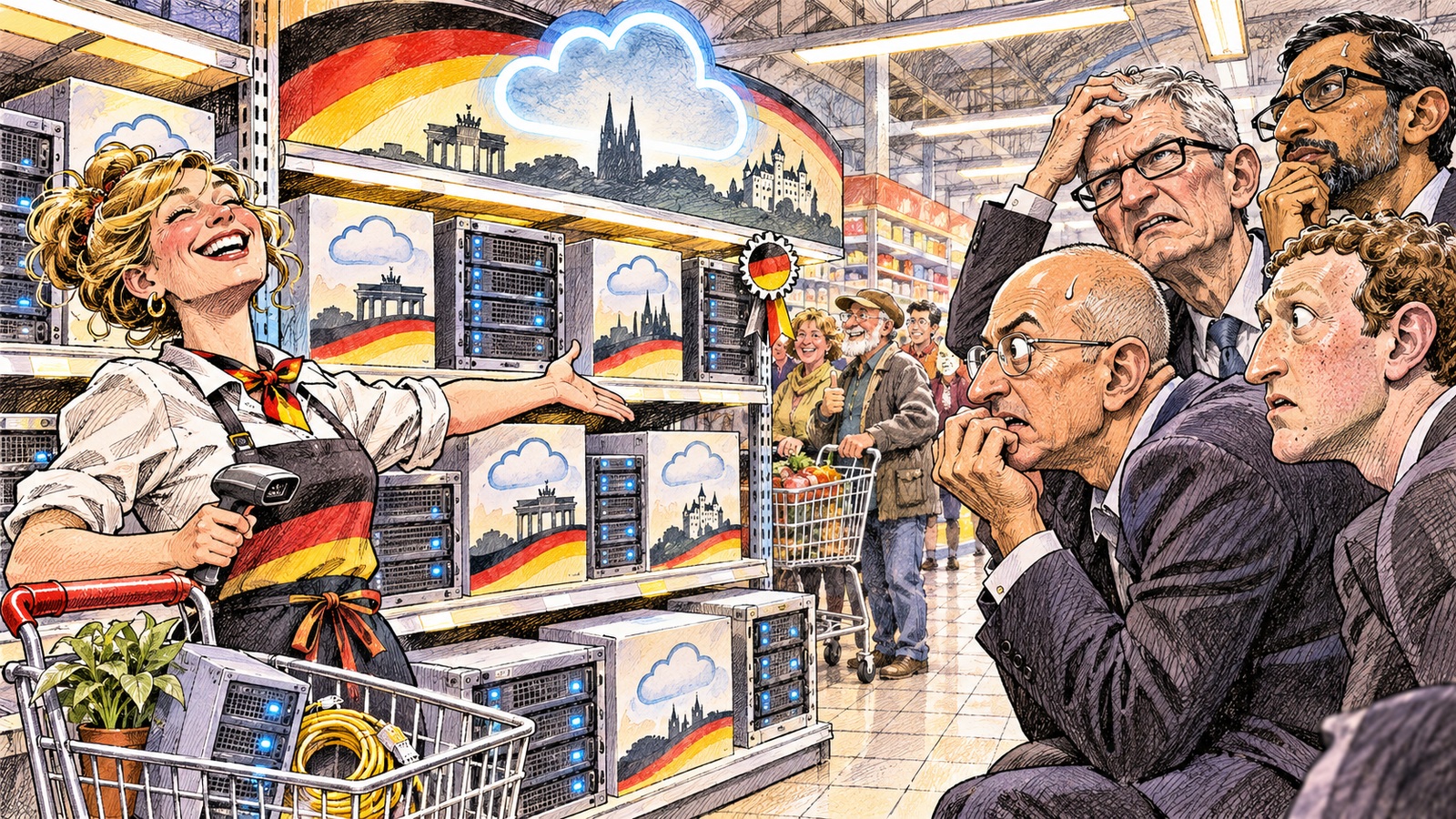
NECKARSULM — Germany’s Schwarz Group is betting that its Digits cloud business can challenge U.S. technology giants, introducing Europe to store-brand computing: comparable infrastructure, simpler packaging and an executive who knows where the discount aisle is.
Reuters’ report on Schwarz Digits’ flexible cloud offering describes its bid to make changing providers easier. Established technology companies are examining whether a customer leaving voluntarily represents a software defect.
Schwarz Digits’ cloud service enters the aisle

Schwarz is best known for retail operations including Lidl. It now wants companies to buy computing capacity from an organization already experienced at placing large quantities of identical objects on shelves.
“Today: canned tomatoes,” said executive Klaus Byte. “Tomorrow: sovereign Kubernetes.”
European customers increasingly want alternatives that address data control, regulation and dependency on American hyperscalers. Big Tech calls its services ecosystems. Retail calls an ecosystem three products bundled near checkout.
Cloud computing gets a private label
Customer Anja Server expected a simple discount. “Instead I received fourteen availability zones and a coupon for bread.”
Professor Rolf Basket of the Institute for Retail Infrastructure said the crossover makes sense. “Supermarkets and data centers both require logistics, cooling and people asking why the price changed.”
The cloud receives a loyalty card
Byte says the offering should feel familiar to retail customers: clear prices, an understandable exit and no requirement to remain in the aisle for the rest of one’s professional life. A visiting technology executive asked whether allowing customers to leave was merely a temporary promotion. Byte said it was part of the design. The executive requested a chair.
Server has brought a trolley into the data center because previous cloud purchasing experiences left her unable to tell how much she had selected. She wants a visible basket, a total before checkout and a receipt short enough to read without hiring a consultant. The sales team describes these requirements as unusual but technically within the scope of modern computing.
Professor Basket says supermarkets learned long ago that the door must permit movement in both directions. Software companies have developed a more advanced door: easy to enter, expensive to find and connected to six proprietary corridors that disappear if you stop paying. It is generally called an ecosystem, since hallway sounds less investable.
Big Tech inspects the store brand
An executive from an established provider has examined the shelves and asked where the customer lock-in is displayed. Byte says it is not stocked. The executive suspects a supply problem and offers to introduce a distributor. He then asks how the company intends to build a long-term relationship without making departure into a long-term project.
Server has purchased enough computing capacity for her workload and is resisting the opportunity to add a second basket of services she did not need before the demonstration. The sales team accepts her decision. She remains in the aisle for several minutes, waiting for the part where acceptance turns into a new meeting.
At checkout, the system provides a price and the possibility of leaving. Professor Basket calls this a bold return to the commercial concept of buying something. The visiting executive says his team will study it closely, provided studying it does not create any expectation that their own customers may try the same thing.
Disclaimer
This is satirical journalism based on the linked news reporting. The named comic witnesses, specialists, institutions, dialogue and personified objects are invented for the story; their comments and experiences are not sourced research or quotations from real participants. News claims are attributed to the linked reporting.