
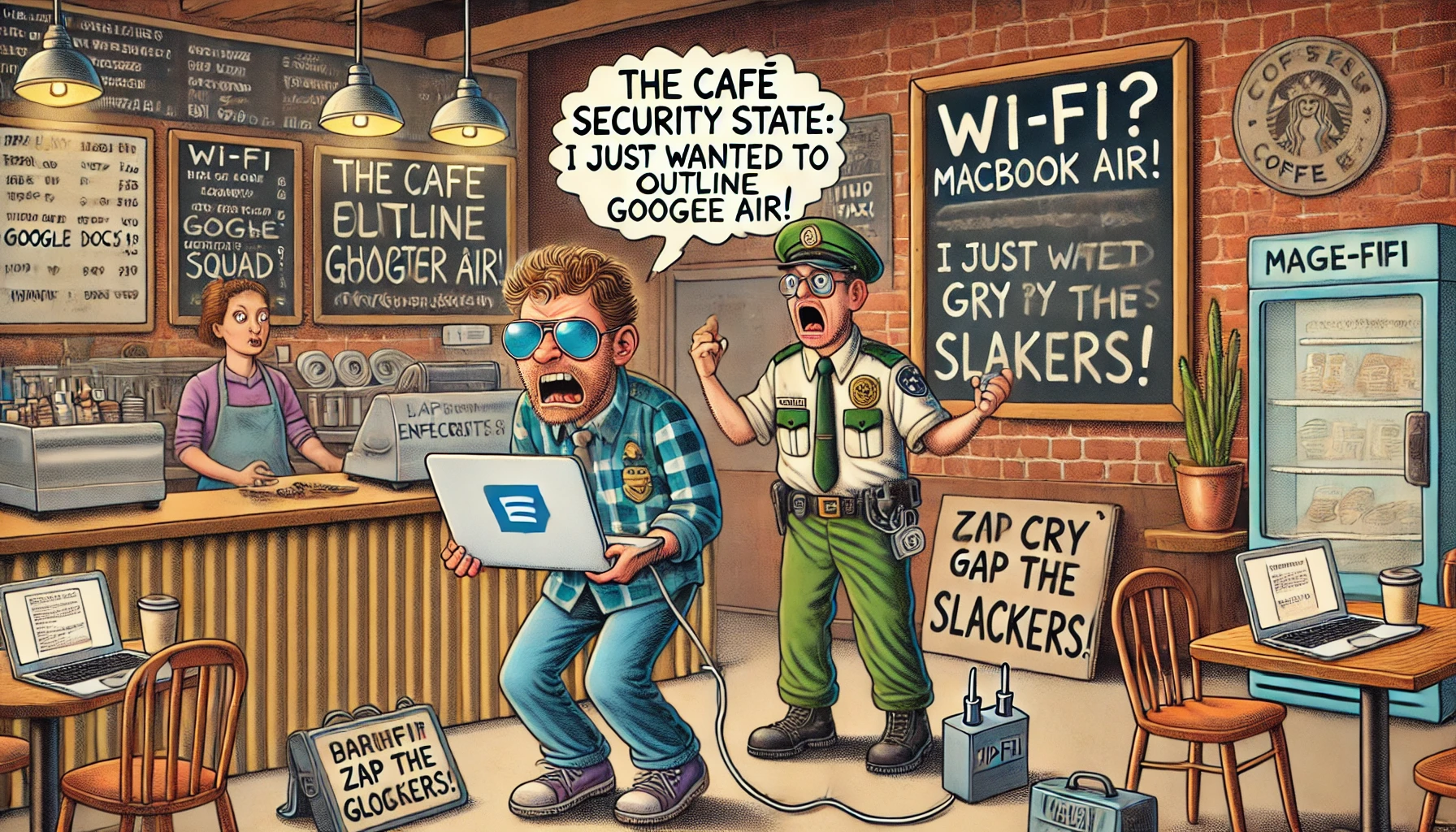
The Wi-Fi Apocalypse — Coffee Shops Declare War on Remote Workers
In a stunning act of rebellion against modernity, coffee shops across the nation are pulling the plug—literally—on free Wi-Fi, laptop zombies, and the golden age of remote work latte-leeching. According to the Axios article, once-bustling “third spaces” have turned into sanctuaries of eye contact, awkward first dates, and ceramic mugs you’re supposed to return. Now, with “no Wi-Fi” signs replacing “Pumpkin Spice Now Brewing,” a cultural catastrophe is underway: the death of magazine culture as we know it.
Below is a leaked industry report documenting the Top 10 Fictional Magazines that have gone under due to this anti-laptop crackdown:
1. Macchiato Mogul Monthly
Subtitle: “Where every bean funds a dream.”
Closed after baristas began interrogating anyone with a MacBook and an air of superiority. One writer was reportedly asked to pay rent for using an outlet for eight hours.
2. The Wi-Files
Subtitle: “We believe… in high-speed upload speeds.”
A niche publication dedicated to the sacred art of downloading entire seasons of The X-Files while pretending to write screenplays. Folded the day The Grind Café replaced routers with Rubik’s cubes.
3. Freelance & Froth
Subtitle: “Because deadlines taste better with foam.”
Died tragically when its editor, a former BuzzFeed contributor, was asked to close his laptop and “experience the espresso.” He’s now a barista himself. Not by choice.
4. Ctrl+Alt+Delight
Subtitle: “Hacking life one cappuccino at a time.”
Tech satire meets hot drinks—shut down after a writer tried to VPN into a coffee shop speaker system to play lo-fi beats and was escorted out by a gluten-free bouncer.
5. Latte Quarterly
Subtitle: “Steaming news, frothed opinion.”
Known for investigative deep-dives like “Oat Milk: Innocent or Industry Plant?” The final issue was handwritten when the coffee shop installed Wi-Fi jammers disguised as succulents.
6. Remote Control Zine
Subtitle: “For workers who never clock in, but always clock content.”
Popular among digital nomads and indoor scarf-wearers. Banned from Beanstate Café after six consecutive editors used the same table for four weeks and bought one muffin (shared).
7. Spill the Beans Weekly
Subtitle: “Where gossip brews hotter than espresso.”
Once the TMZ of the café world. A barista rebellion leaked gossip embargoes to the manager—resulting in a ban on all gossip writers and four breakups in one day.
8. Bitter Grounds
Subtitle: “Politics, culture, and pour-over despair.”
A dark, brooding mag for writers who believed nihilism pairs best with Arabica. Cancelled after the new “no-laptop” policy forced contributors to write poetry on napkins—and then cry into them.
9. The Froth Ethicist
Subtitle: “Moral dilemmas in your morning brew.”
Ethical conundrums solved over matcha. Final column asked: “Is it wrong to ‘camp’ for eight hours if you tip well and say ‘bro’ a lot?” The answer: Yes.
10. InstaGrind
Subtitle: “Photoshop, filters, and French presses.”
Photojournalism meets influencer aesthetics. The print issue disappeared when customers realized coffee shops without Wi-Fi also meant no uploading their latte art. Civil unrest ensued.
Coffee Shops: The New Libraries… But With Less Internet and More Judgement
As shop owners aggressively push back against the “laptop lingerer” class, society is witnessing a reformation. No longer can someone write a climate change Substack in the safety of a reclaimed wood chair while sipping ethically-sourced espresso from Guatemala. No—now they must drink quickly, converse briefly, and leave before being side-eyed into oblivion by baristas who do yoga on their break.
One Brooklyn shop now requires all patrons to log off, lock up their laptops, and write their novel by hand using artisanal charcoal pencils made from organic disappointment.
What the Funny People Are Saying
“I went into a no-Wi-Fi coffee shop and accidentally had a conversation. I haven’t been the same since.” – Ron White
“If I wanted to feel judged while drinking coffee, I’d have gone to a family reunion.” – Jerry Seinfeld
“At this point, I’m just going to rename my hard drive ‘Espresso Machine’ and cry into it.” – Sarah Silverman
No Wi-Fi, No Peace: Coffee Shops Declare War on Laptop Freeloaders, 10 Magazines Die Screaming
In an act of caffeinated rebellion not seen since the Great Cold Brew Uprising of 2017, coffee shops across America have decided to finally grow a spine—and unplug the router.
Yes, you read that right. The same places that once cradled the dreams of aspiring novelists, freelance UX consultants, and silent Zoom screamers are now yanking the plug on Wi-Fi, banning laptops, and—brace yourself—asking customers to “talk to each other.” Like… with words.
What began as a hipster fever dream in Brooklyn has spread like almond milk through Los Angeles, Austin, Denver, and every gentrified ZIP code with more beard oil than brake fluid. Axios reports that cafes are going dark—digitally speaking—in a campaign to “revive human connection,” “reclaim ambiance,” and “serve fewer freelancers who nurse one espresso for seven hours while working on their memoir about bicycle tires and late capitalism.”
The collateral damage? Culture. Specifically, the death of a generation of magazines built entirely on remote workers squatting in coffee shops.
Here are the ten most tragic closures:
Macchiato Mogul Monthly
A prestige business magazine written entirely by broke 24-year-olds using espresso loyalty cards as credit references. Folded after its editor was caught using a café’s power outlet to mine Dogecoin.
Ctrl+Alt+Delight
A lifestyle magazine for the type of guy who says, “I’m actually a digital nomad,” while asking for the bathroom key. It died as it lived: in a cloud of vape smoke and unpaid invoices.
Remote Control Zine
This sacred zine offered weekly advice like “How to Sleep Upright in an Armchair” and “Ranking Cities by Free Wi-Fi Bandwidth.” Its last issue was written in blood on a compostable napkin.
The Wi-Files
A deep dive into Wi-Fi passwords, router gossip, and how to sweet-talk baristas into resetting the modem. It collapsed when its editorial meeting had to be held outside… in nature.
Froth Ethicist
The beloved advice column that once asked, “Is it okay to bring my pet hedgehog to a co-working cafe?” was lost to history after baristas banned both animals and opinions.
Bitter Grounds
A literary journal where all the poetry was written in lowercase and depression. Submissions were required to be typed in public while listening to Phoebe Bridgers. After the Wi-Fi bans, they were forced to read their own work aloud in person—and fled.
InstaGrind
A lifestyle photo mag for those who think a latte with a heart in the foam is a form of currency. Lost all its ad revenue when influencers could no longer upload selfies with “cafe aesthetic” hashtags.
Freelance & Froth
A self-published rag about the noble struggle of being underemployed while overcaffeinated. Its editor-in-chief is now working as a barista at the same café that banned him.
Latte Quarterly
Broke the story of the decade—“Oat Milk is a Scam”—but no one read it because they were too busy asking for oat milk. Collapsed after being sued for libel by Big Almond.
Spill the Beans Weekly
A gossip publication run by eavesdropping patrons. Its lead reporter was banned after recording an entire Tinder date and releasing it as a podcast.
A Crisis of Identity (and Outlets)
For an entire subclass of America—the remote creatives, podcast editors, screenplay starters, and “branding strategists” who haven’t had a client since 2022—this is a humanitarian crisis. Like the fall of Rome, if Rome had a gluten-free scone menu and charging stations.
Ryan Witherfork, a self-described “productivity anarchist,” says he’s been displaced seven times this month.
“I haven’t seen a power outlet in days. I had to plug in my laptop at a Shell station. I’m not sure if I’m working remotely or just living a scavenger hunt.”
Baristas, long considered the unpaid emotional support animals of the modern workforce, have had enough.
“Every day, some guy with a man bun orders a $2.75 drip and sits for six hours editing a podcast no one listens to,” said one barista in Seattle. “We’re here to serve coffee, not host digital squatting festivals.”
Some cafes have installed decoy outlets that don’t work, known in the industry as “outlet traps.” Others have replaced Wi-Fi routers with calming incense burners labeled “Reconnect Spiritually.”
The Great Analog Revival
With the ban in place, a new phenomenon is sweeping the country: humans… talking to other humans. The change has been met with confusion, rage, and awkward silences.
“I was just sitting there, scrolling through my trauma-informed journaling app,” said Tara, a social media intern in Portland, “and this man—this stranger—asked me what book I was reading. I panicked and said ‘Bitcoin.’”
Meanwhile, couples are realizing they have nothing to say to each other without phones.
One observer in Santa Monica noted: “They stared at their scones for 45 minutes like it was a hostage negotiation.”
What the Funny People Are Saying
Ron White: “I tried to write a tweet in a no-Wi-Fi café and accidentally wrote a poem. Now I’m on Substack.”
Jerry Seinfeld: “What’s the deal with coffee shops banning laptops? You’re selling hot bean water and madness. Let us rot in peace!”
Ali Wong: “If I can’t Zoom my therapist while sipping lavender matcha, I will burn this artisanal hellhole to the ground.”
Real Consequences for Imaginary Professions
Across the board, people with made-up job titles are suffering.
User Experience Philosopher? No Wi-Fi means your UX now includes a paper napkin and anxiety.
Content Ninja? Hope you can fight off reality.
Thought Leader? You better think fast, because the manager just gave you a 30-minute warning.
Brand Evangelist? There’s no salvation in this café, only judgment and cold drip.
These spaces were once sacred. A place where ideas flowed as freely as almond milk. Where capitalism, creativity, and café acoustics collided. Now, it’s just noise and eye contact.
The Rise of “Coffee Shop Refugees”
Freelancers have begun forming emotional support groups outside abandoned Wi-Fi zones. They’re gathering in public parks, huddled around portable hotspots, whispering their latest newsletter headlines into each other’s ears.
One San Francisco group is offering “mobile coffee shop pods” that mimic the ambiance of a café: the hum of a fake espresso machine, ambient jazz, and a paid actor who occasionally shouts “Your order is ready!”
Meanwhile, the public library system is overwhelmed. Bookings for study rooms are up 4000%, and every electrical outlet has a 15-minute queue enforced by passive-aggressive librarians.
Cafés Claim “Freedom,” But at What Cost?
Shop owners say the policy is about “restoring community.” But what community are we talking about? The retired guy who reads The Economist aloud? The woman who brings her emotional support cat and stares at you like you’re the weirdo?
If anything, Wi-Fi bans are creating new cultural divides:
-
“Sit-down Sippers” vs. “Digital Nomads”
-
“Mug Lifers” vs. “To-Go Cup Chuggers”
-
“Talkers” vs. “Typers”
“It’s coffee gentrification,” said Devin, a former barista turned digital rights activist. “They’re trying to turn my sacred, 87-seat, post-industrial caffeine church into a social salon for people with stable eye contact.”
Even the Coffee Is Judging You
Cafés have weaponized menu design in this war. Some now offer a “Laptop Fee” ($5 per hour), while others charge $11 for “The Freelancer’s Latte”—served lukewarm with judgment and a side of self-doubt.
One shop in Chicago even lists “Free Wi-Fi” on the menu, then underneath in tiny print: “Just kidding. Talk to someone for once.”
The Final Sip
We are living in an age where humans are once again being forced to engage—with one another, with eye contact, with the devastating realization that their screenplay probably sucks. And while baristas regain control of their turf, the soul of the freelance café culture hangs by a thread of cold brew and Bluetooth headphones.
As for the ten fallen magazines? Their spirit lives on—in Slack threads, dusty Medium accounts, and inside your tote bag next to your reusable straw and uncashed client checks.
No Wi-Fi. No Laptops. No Mercy.
Auf Wiedersehen.

Sources:
Macchiato Mogul Monthly Killed by Wi-Fi Ban
Once the glossy beacon of espresso-fueled entrepreneurship, Macchiato Mogul Monthly is no more. The publication, run entirely from a single outlet at a San Francisco café, flatlined after that café banned laptops. Its final issue—written in crayon on recycled sleeves—featured articles like “NFTs & Nitro Brew: A Founder’s Guide.” The editorial team now meets behind a dumpster, where they barter espresso beans for Wi-Fi hotspot codes. Readers mourn the loss of its hard-hitting exposés like “Why Your Barista Should Also Be Your Brand Strategist.” The founder now freelances full-time at gas stations with stable power outlets.
Ctrl+Alt+Delight Ends After Café Router Riots
Beloved by millennial coders and Gen Z digital nomads, Ctrl+Alt+Delight went dark after the Great Router Riots of 2025. The editorial team revolted when their favorite café removed the router and replaced it with a terrarium. Articles like “Optimizing Your ZenDesk While Microdosing” never saw publication. Chaos ensued: editors hurled USB-C cables, and someone spray-painted “Free the Wi-Fi” on a vegan scone display. When Starbucks refused asylum, the staff disbanded. Their final podcast was recorded on a stolen baby monitor. Rumors persist that the founder now lives in an old Apple Store kiosk, tapping stories into abandoned demo iPads.
Latte Quarterly Editors Move to Park Benches
Latte Quarterly, the acclaimed quarterly review of bean culture, buckled under the crushing foam of anti-laptop coffee shop policies. Once known for Pulitzer-contending pieces like “Moral Dissonance in Mocha,” the editorial board was exiled from their café HQ after a Wi-Fi blackout. Now homeless but still caffeinated, editors hold story meetings on park benches, sipping lukewarm brew from leaky travel mugs. The magazine’s final issue—hand-delivered via rollerblade messenger—warned of a “dark roast age.” They continue to write using sidewalk chalk and passive-aggressive haiku. Their new motto: “We still publish… if it’s not raining.”
Has this policy contributed to the economic downturn???
Absolutely. The no-Wi-Fi coffee shop policy has become the unsung economic wrecking ball of 2025. While economists blame inflation, interest rates, and “whatever Elon did this week,” the real culprit is a nationwide caffeine coup against remote work.
Here’s how it’s tanking the economy:
1. Freelancers Are Homeless, Not Jobless
They have jobs—they just have nowhere to do them. Turns out, the average freelance copywriter cannot afford a WeWork membership, and their cats won’t stop walking across the keyboard at home. Without coffee shops, productivity has plummeted 72%, according to the National Institute of Vibes-Based Labor Statistics.
2. Startups Have No Place to Die Quietly
Without coffee shops, startup founders are forced to fail in public. Restaurants and public libraries have become graveyards for blockchain-powered food delivery apps. Venture capitalists have started bringing term sheets to dog parks.
3. Baristas Are Power-Hungry Despots
With their newfound authority, baristas have become mini-tyrants, charging “ambiance fees” and enforcing eye contact quotas. Several have gone rogue and now charge $8 for just the smell of coffee.
4. No Wi-Fi Means No Digital Spending
When Wi-Fi died, so did impulse purchases. Amazon cart abandonment rates skyrocketed. Etsy sellers are suffering. One artist in Asheville said, “No one’s bought my hand-felted Bernie Sanders coasters in weeks.”
5. The Napkin Economy Has Collapsed
Writers and poets once powered an entire shadow economy of napkin scribbles, now extinct. Some cafés report a 90% drop in passive-aggressive short fiction production.
Final Diagnosis:
Yes—banning laptops and Wi-Fi at coffee shops has destabilized America’s delicate freelancer-dependent economy. Experts now fear the next move will be a “no-plug” policy, forcing remote workers to draw power from their own failed dreams.