
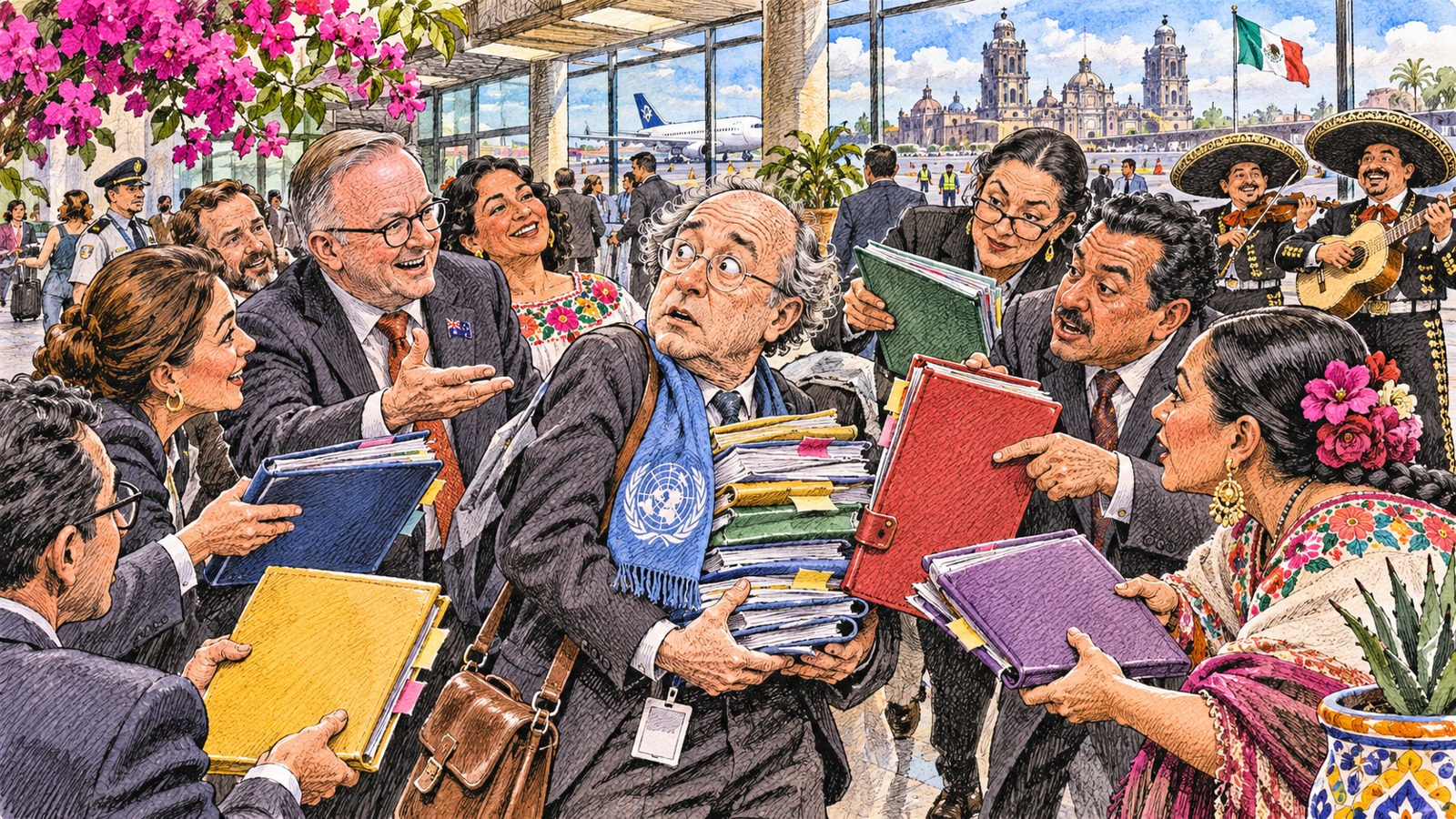
MEXICO CITY — Francesca Albanese’s arrival in Mexico has demonstrated that a diplomatic itinerary can contain more argument than an entire parliamentary session. Travel organizers have begun allocating space for baggage, prepared remarks and the statements responding to statements about the prepared remarks.
Reuters’ reporting on Albanese’s arrival describes the visit after Costa Rica barred her entry. The dispute has produced competing official positions. At the airport, consultant Pilar Boarding says this complicates the ordinary question of whether the passenger has anything to declare, since the answer now requires a press room.
Albanese’s itinerary adds a rebuttal column

Boarding normally prints a schedule containing arrival, transfer, meeting and departure. Her revised version includes condemnation, clarification, renewed condemnation and a brief opportunity to retrieve checked luggage. She has removed lunch to preserve space for a statement expressing concern about the removal of lunch.
The suitcase has requested that no further documents be inserted without checking its weight allowance. Officials say the documents are essential context. The suitcase says essential context weighs more than shirts and is considerably harder to fold. A second case has been commissioned for background alone, with wheels rated for international controversy.
The arrivals desk receives talking points
Airport attendant Mateo Stamp asked the delegation to identify the purpose of the visit. Three people answered simultaneously, using language that suggested they had already prepared for three different versions of the question. Stamp selected business because his screen lacks a button for a contested public role.
Professor Clara Footnote of the Institute for Diplomatic Luggage said international travel operates on two parallel systems. One moves people between countries. The other moves interpretations between offices. The first occasionally misplaces a suitcase; the second can retain a grievance indefinitely without losing a single page.
Every airport becomes a press conference
Boarding has tried to establish a quiet corridor between the aircraft and the car. This became difficult when quiet was interpreted as an attempt to avoid scrutiny and the corridor was interpreted as a symbolic passage. A photographer asked everyone to walk through it again, preferably while conveying the correct historical significance.
The driver says his job is to take the passenger to the venue. He has requested a street address rather than a description of the venue’s role in the international debate. Three briefings later, he still lacks the address but understands that arriving late may be read as a political signal.
Departure remains subject to interpretation
The return journey includes a generous allowance for questions, although Boarding warns that answering one may generate two more. She recommends no additional speeches to the suitcase, which has developed a suspicious bulge around the section containing reactions to the previous stop.
For now, the delegation has arrived and the diplomatic argument continues. Stamp has completed the entry procedure. The driver has located the building. Boarding is updating tomorrow’s itinerary with a new column for responses to today’s coverage. She expects the schedule to remain accurate until someone reads it aloud.
Disclaimer
This is satirical journalism. The linked reporting supplies the news premise. Comic witnesses, specialists, institutions, dialogue and personified objects are invented for this article; their statements are not quotations from real participants or sourced research.