
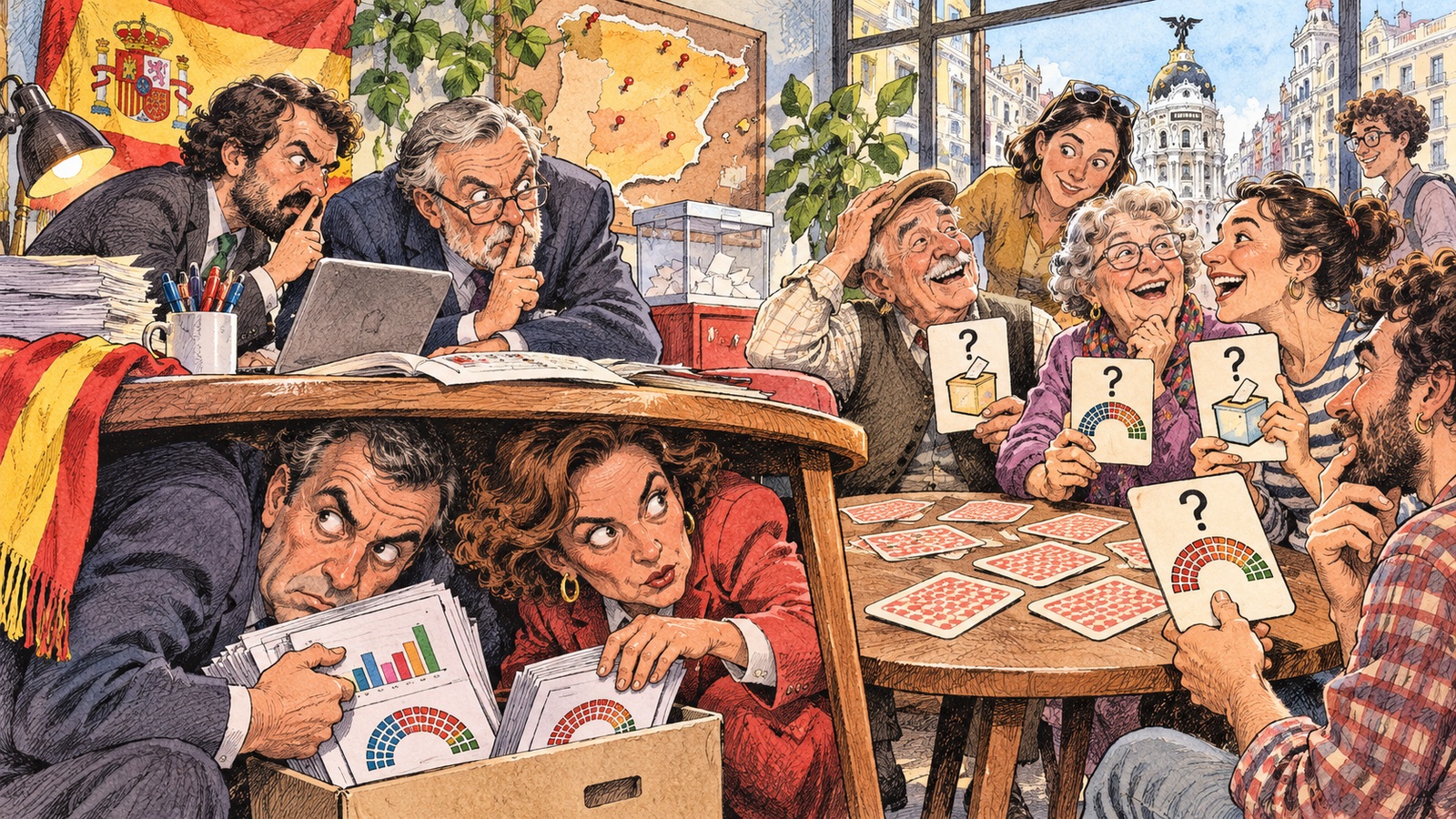
MADRID — Spain entered the final stretch of a snap election under a legal ban on publishing opinion polls, forcing voters to rely on the traditional democratic instruments of instinct, relatives and whichever candidate looks least alarmed by his own campaign bus.
Reuters’ reporting on Spain’s campaign and polling blackout says Pedro Sánchez is relying on internal data as the final campaign rallies conclude. Campaign headquarters have therefore retained access to arithmetic while voters receive adjectives.
Spain’s polling blackout creates statistical darkness

Campaign headquarters still possess internal surveys, but the public cannot see new published polls. This has produced a fair system in which politicians know what they claim to know and voters know politicians are claiming it.
“We are absolutely winning,” said strategist Diego Margin, immediately hiding a spreadsheet beneath a tortilla. His rival also declared victory, proving that unpublished numbers can support twice as many governments.
Undecided voters become premium research
Voter Carmen Ruiz said every party had called her. “I was undecided,” she explained. “After six calls, I became undecided about owning a telephone.” Campaign volunteers now study her facial expressions like bond traders watching inflation.
Professor Pilar Sample of the Institute for Electoral Weather defined a polling blackout as “the period when data stops being public and confidence becomes renewable.” She said the model performs best when it is permitted to select its own voters.
Politicians replace percentages with adjectives
The blackout has created a thriving market in campaign adjectives. Support is strong, growing, historic and quietly magnificent. No party has reported that support is making eye contact with another party across the room. Television producers, deprived of a fresh colored bar, have invited four men to disagree about the shape a colored bar would probably take.
Margin said his internal model accounts for turnout, regional differences and whether the candidate’s mother sounded worried during lunch. Its confidence interval extends from a comfortable majority to a press conference blaming the weather. Asked to disclose the methodology, he said the methodology was currently meeting voters in a marginal constituency and could not be disturbed.
Ruiz has begun charging campaign callers for access to her uncertainty. Basic access includes a polite hesitation. The premium package includes saying she is leaning their way, then mentioning a cousin with doubts. A volunteer described the arrangement as democratic engagement until Ruiz sent an invoice, at which point it became a troubling commercialization of public life.
Election night restores arithmetic
Professor Sample expects counting to cause a temporary shortage of adjectives. Historic becomes respectable, growing becomes resilient, and quietly magnificent becomes an encouraging foundation for renewal. Parties that cannot form a government will announce that they have won the argument, a prize that traditionally comes without the keys to the building.
At a neighborhood café, customers have devised their own forecasting method: each person predicts victory for the party he supports, then accuses the next table of ignoring reality. The model requires no polling, produces complete confidence and can be updated whenever someone orders another coffee. Its principal weakness is that every table currently expects to be prime minister.
Election officials continue preparing the ballots. Unlike private campaign spreadsheets, the ballots will be counted in public and cannot be hidden beneath lunch when someone asks an awkward question. Margin welcomed this development, provided the final numbers remain consistent with the tremendous momentum his office has detected in conversations with itself.
Disclaimer
This is satirical journalism based on the linked news reporting. The named comic witnesses, specialists, institutions, dialogue and personified objects are invented for the story; their comments and experiences are not sourced research or quotations from real participants. News claims are attributed to the linked reporting.