
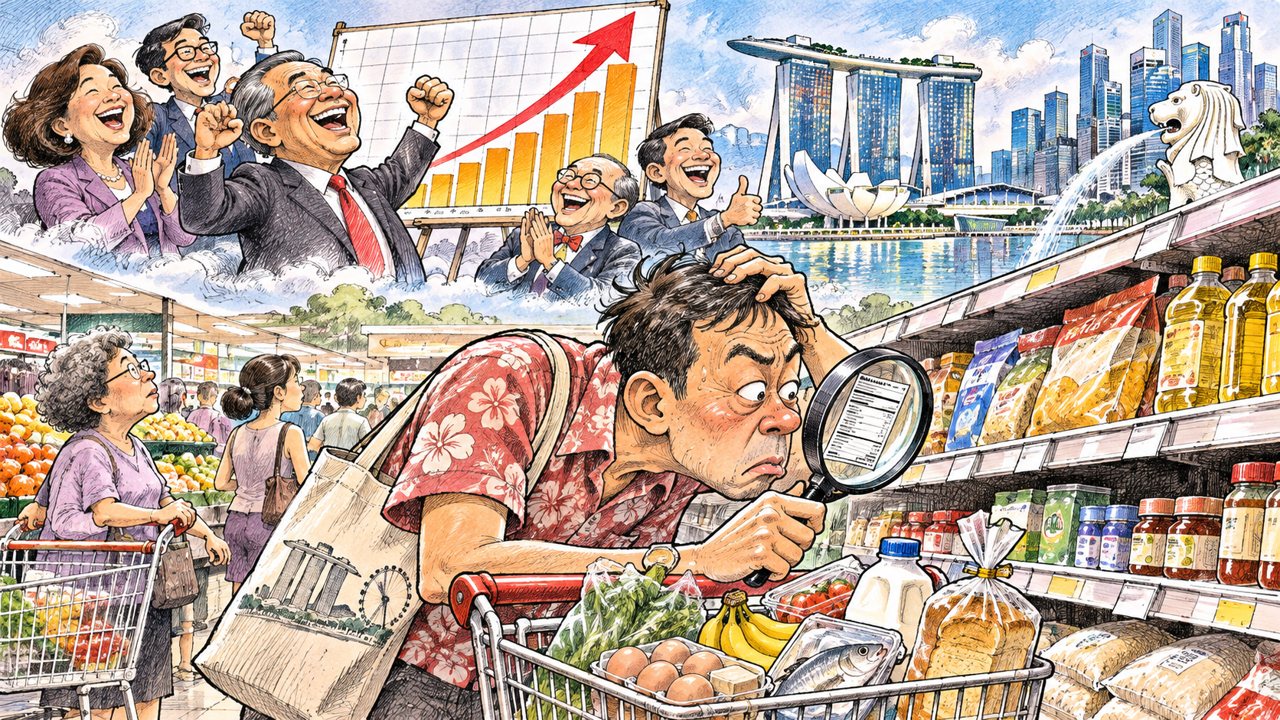
SINGAPORE — Singapore GDP growth has sent shopper Victor Basket searching a supermarket for his individual allocation of economic momentum. Reuters reports that third-quarter GDP grew 6.1 percent from a year earlier, with the full-year forecast raised to around 6 percent as technology-related activity strengthened.
Victor congratulated the economy and asked whether it had remembered to validate parking.
Singapore GDP growth is difficult to locate beside the eggs
His first attempt involved asking a supermarket employee where the additional growth was stocked. The employee directed him towards the bakery, where several items had expanded without becoming less expensive.
“I’m pleased we’re doing well,” Victor said. “I was hoping the good news came in a size I could put in this basket.”
Economist Dr Clara Aggregate explained that gross domestic product measures economic output across the economy. It is not a dividend delivered to every household in equal envelopes.
Victor accepted the definition but suggested that economists might receive a warmer reception if they occasionally brought envelopes.
A national average walks into a neighbourhood shop
For the purposes of an impromptu demonstration, Dr Aggregate placed a large pie on the counter and explained that national output could grow while different sectors and households had very different experiences.
The shopkeeper immediately asked who was paying for the pie. Victor said this was the first part of the presentation he completely understood.
“Some activity is growing faster than other activity,” Dr Aggregate continued.
“My shopping list has been doing that for years,” Victor said. “It has never qualified for a press conference.”

The distinction matters. Strong export or manufacturing results do not automatically describe conditions at every café or retail counter. Victor’s favourite café has therefore requested permission to report its own economy separately, preferably with complimentary footnotes.
Optimism remains a useful ingredient with limited nutritional value
Café owner Mei Receipt welcomed the improved outlook. She said confidence could encourage decisions, investment and customers who ordered something beyond the right to occupy a table.
She was less certain about a proposal to replace her loyalty programme with a quarterly macroeconomic briefing.
“Ten coffees gets you one free coffee,” she explained. “Ten positive indicators gets you someone telling you to look at the longer term.”
The shopper seeks a practical growth channel
Victor eventually bought his groceries. He kept the receipt to compare his personal consumption with the broader trend, a process which economists describe as inadequate sampling and married people describe as checking what happened to the money.
Dr Aggregate advised considering several measures rather than treating a single headline as a complete account of living standards. Victor said this was sensible and asked whether the several measures could fit into a shorter queue.
Both agreed that a stronger economy was preferable to a weaker one. Their remaining disagreement concerned whether a stronger economy should be able to carry at least one grocery bag.
At last report, the national forecast remained encouraging, the café remained open, and Victor had located a modest personal improvement: the shop had remembered to validate his parking.
Accounting note from the world’s oldest tenured professor and a philosophy major turned dairy farmer: national output cannot be redeemed at this checkout, although the pie used in our explanation disappeared with remarkable efficiency.