
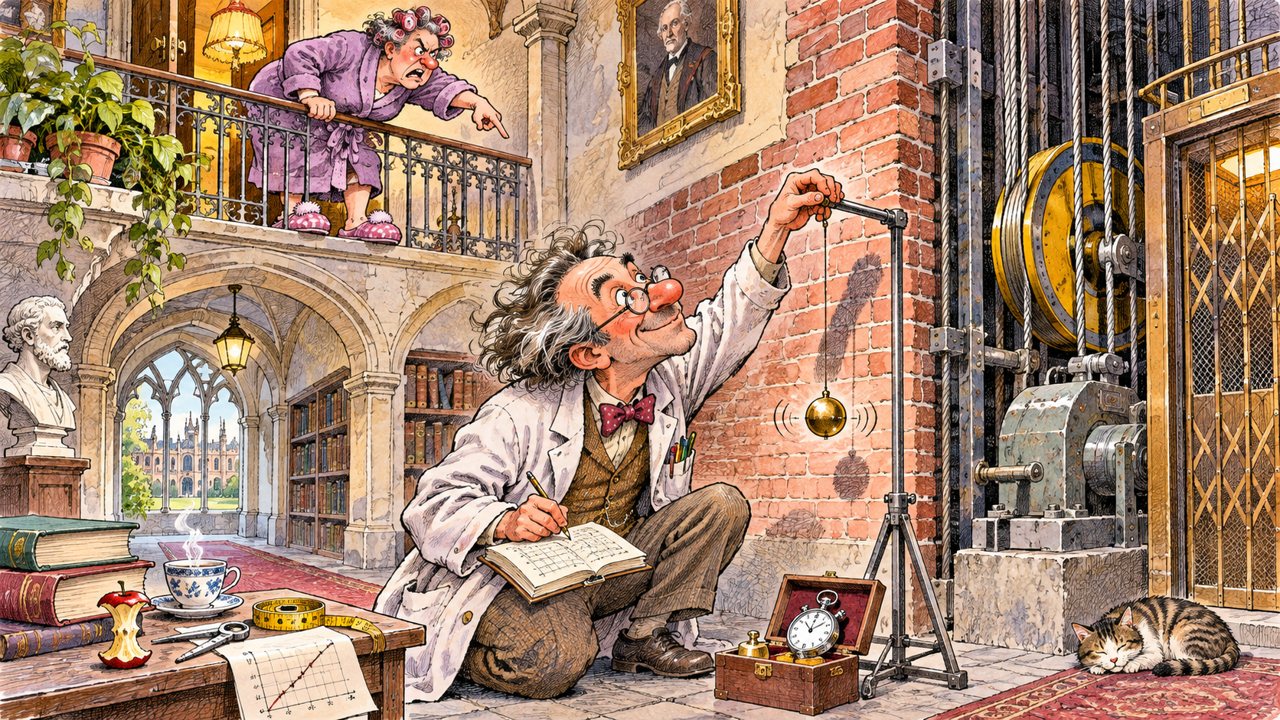
BRISBANE — A gravity communication experiment has excited physicists and irritated upstairs neighbour Barry Thump, who believes moving heavy objects to send a message has been his principal contribution to apartment life for years.
University of Queensland researchers used an elevator counterweight and a sensitive gravimeter to recover information across a brick wall. The demonstrated rate was about one bit per minute. Barry’s furniture moves are louder, less precise and scientifically unrelated.
Gravity communication experiment attracts a determined amateur
“I have been communicating displeasure through the ceiling since 2008,” Barry said. “Nobody offered me a research grant. They sent a note asking whether I could lift the chair instead of dragging it.”
Physicist Dr. Ada Measurement explained that the experiment detected changes in gravitational pull, not sound or ordinary vibration. Barry accepted the correction, then asked whether his wardrobe’s considerable mass might qualify him as a visiting fellow.
The researchers encoded a word through controlled movements of a heavy counterweight. Barry usually transmits a less structured message consisting of annoyance, followed by a pause, followed by whatever it sounds like when someone drops an exercise machine.
Ada emphasized the distinction between demonstrating a physical principle and providing a practical communications product. Barry said his internet company also appeared interested in demonstrating a principle rather than providing a practical product, although he had not established which principle.
One bit per minute requires an economical personality
The experiment’s speed rules out many familiar digital habits. A group chat using such a system would need to consider whether everyone genuinely required a separate message containing nothing but a laughing face.

Office manager Paula Packet found the limitation attractive. She believed any communication channel requiring substantial effort to send one word might finally discourage colleagues from announcing that they had nothing to add.
Barry proposed a premium package. It would include a heavier cabinet, an upgraded lift and a guarantee that the first letter would arrive sometime before the recipient lost interest. Ada declined to provide a commercial endorsement.
The wall remains a wall
Gravity’s ability to pass through ordinary material is part of the scientific appeal. It does not mean the laboratory demonstration has replaced Wi-Fi or produced a useful consumer network. Barry nevertheless asked his building manager to reserve a bathroom for the receiving equipment.
The manager suggested he begin by clearing the old exercise machine from the corridor. Barry interpreted this as administrative resistance to innovation, a problem that has followed several of his previous hobbies.
Ada returned to explaining the actual result. Paula returned to her office, where fifteen new messages had arrived during the conversation and none contained information requiring immediate action.
For a moment, she considered the appeal of a system that could transmit only one carefully chosen word. She had already chosen it, although workplace policy prevented her sending it to the entire department.
Disclaimer from the world’s oldest tenured professor and a philosophy major turned dairy farmer: Barry’s noise is not gravity-based data transmission, and the demonstrated experiment remains far from a practical network.