
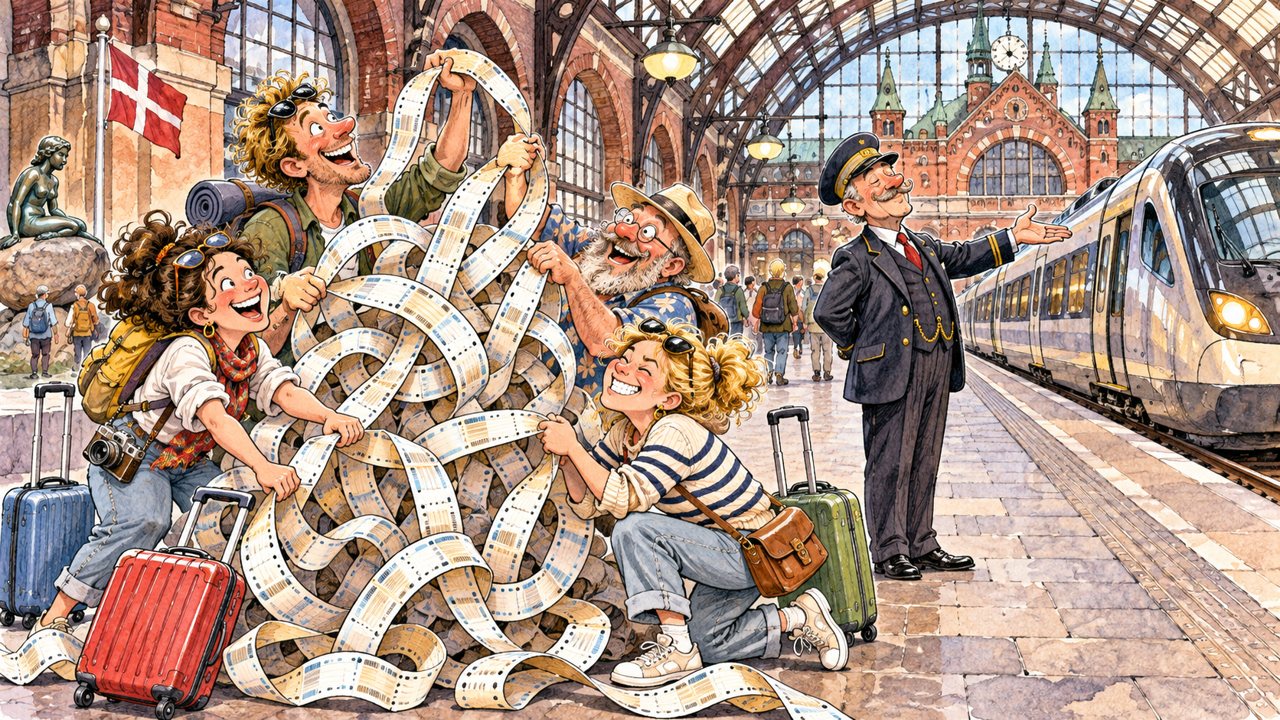
COPENHAGEN — European train tourism has received a new institutional push, pleasing travelers who would like to watch scenery rather than remove their belts under fluorescent airport lighting.
Railway Gazette’s report on the Copenhagen train-tourism partnership describes efforts to expand leisure travel by rail. SpinTaxi passenger Simon Timetable supports the idea, provided the booking process eventually allows him to board something.
European train tourism offers the adventure before departure
Simon began with a simple plan: visit a city, sit by a window and arrive relaxed. Within an hour, he had opened seven tabs, learned two fare systems and developed an emotional attachment to a connection lasting eight minutes.
“I enjoy slow travel,” he said. “I had not realized the slow part could begin while I was still wearing slippers.” His partner suggested asking a booking agent. Simon said he was almost finished, a claim he had also made before dinner the previous evening.
The train itself remained an excellent proposition. It had seats, windows and the unusual courtesy of delivering passengers somewhere that was already a city. Simon found this compelling enough to continue negotiating with the reservation interface.
A planning screen offered a cheaper ticket on the condition that he understand three restrictions before coffee. He selected the flexible option, which appeared to mean flexibility primarily for the ticket’s price.
The passenger would like the systems to meet
At a partnership workshop, transport consultant Ingrid Connection explained that visitors valued convenient journeys. Simon agreed and asked whether convenient journeys could be purchased conveniently. The room recognized this as a valuable second phase of the discussion.

Delegates admired the possibility of linking destinations, operators and tourism promotion. Simon suggested linking the ticket to the seat first. His contribution was entered into the minutes under user-centered friction mapping, which made it sound considerably more expensive.
A conductor offered practical advice: allow enough time, understand the ticket conditions and avoid treating a continent as a set of interchangeable airport codes. Simon found this useful, especially because it did not require creating another account.
The window seat makes a persuasive argument
Once aboard, he remembered why he had persisted. He could stretch his legs, read a book and see places pass at a speed allowing him to notice they contained people. His luggage remained within sight instead of pursuing its own independent European itinerary.
None of this solved every cross-border booking challenge. It did demonstrate that making a good product easier to buy could be a more effective promotional strategy than telling customers to celebrate the difficulty.
By arrival, Simon had relaxed enough to consider another train holiday. His partner proposed celebrating this progress by booking the next journey together over a sensible cup of tea.
He agreed, then opened a spreadsheet. The scenery outside the window had been beautiful, but the conditional formatting at home still needed his attention.
Editorial disclaimer: Simon, Ingrid and their workshop are invented. The partnership report provides the news background; this article does not promise a particular fare, connection or operating timetable.