
BERKELEY
AI control research has encountered its hardest practical constraint: the board wants the future of humanity explained in twelve words, preferably beside an upward arrow. A mathematician offered a careful statement of assumptions. Management asked whether the assumptions could be moved to the appendix, where problems traditionally become optional.
Researchers are investigating mathematical approaches to keeping advanced AI under human control. Read reporting on mathematical research into AI control.
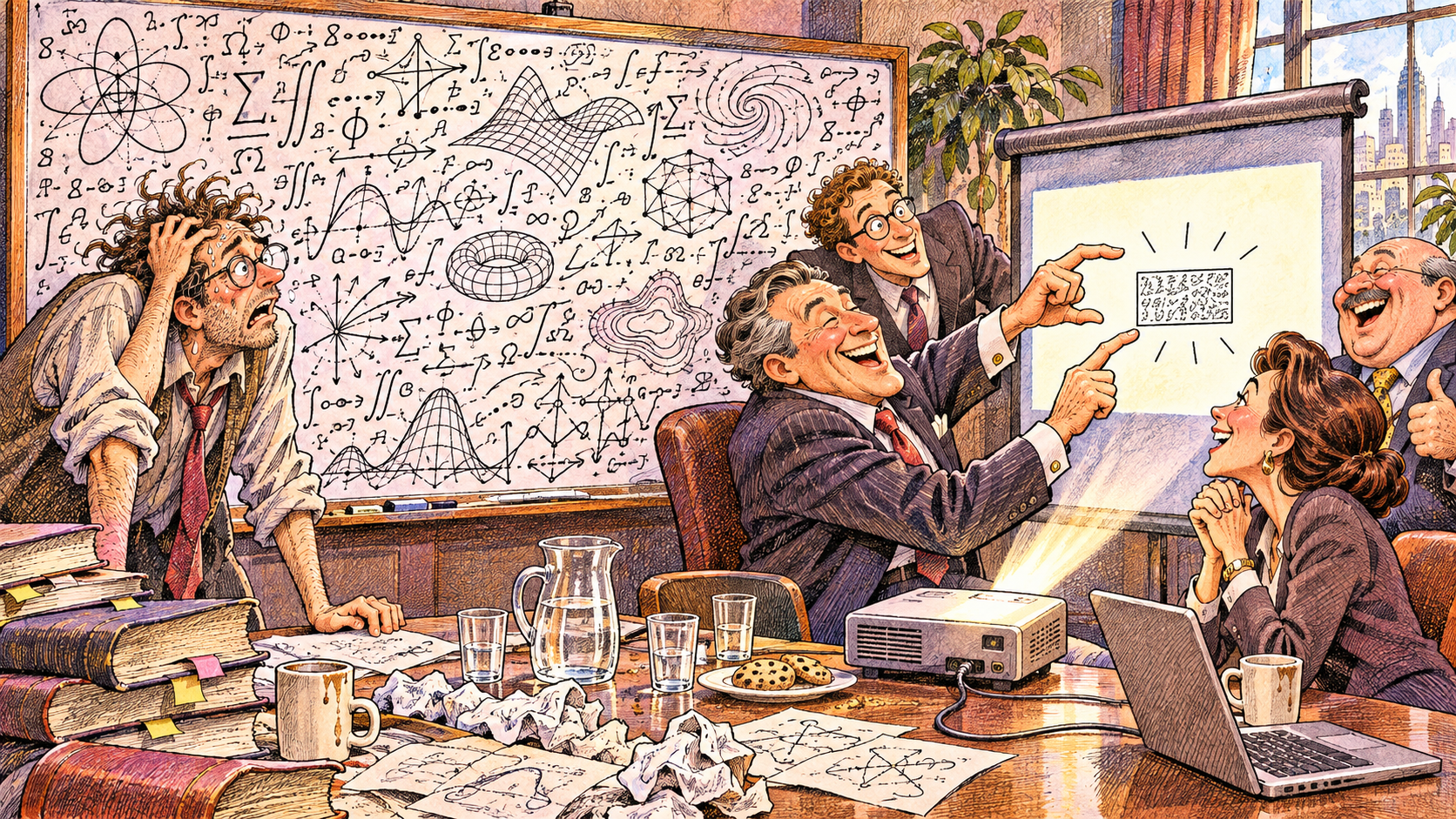
SpinTaxi’s demonstration committee convened around a whiteboard covered in equations. Its first decision was to replace the whiteboard with a branded presentation template. The equations lost several subscripts, a necessary condition and the only term preventing catastrophe. The slide gained a photograph of a smiling team.
The underlying work asks difficult questions about whether powerful systems will behave as intended. That is a research programme, not a guarantee. The committee found this distinction awkward because the investor meeting needed a guarantee and the product team had already selected the release animation.
AI control research meets the executive summary
A mock chief reassurance officer proposed an elegant solution: rename uncertainty ‘resilience capacity’. The scientist asked how a new noun changed the system. It did not, the officer explained, but it dramatically improved the quarterly narrative. Nobody had yet designed a benchmark for narratives escaping human control.
The customer representative requested an off switch. Engineering replied that the switch existed, subject to dependencies. Legal wanted to know who would be authorised to press it. Marketing worried that a red button implied an experience with negative potential. The committee approved a soothing beige button behind a consent dialogue.

One participant compared the task to building brakes while the vehicle accelerates. Another objected that this was unfair to vehicles, whose owners generally agree that stopping is an acceptable feature. In the software meeting, stopping meant somebody had to explain why the next demonstration would be late.
SpinTaxi’s completely unscientific office poll found that everyone supported rigorous verification until asked whether it might delay their own project. Support then became nuanced. The fire alarm offered the strongest dissenting view, but its comments were summarised as an operational interruption.
The uncertainty must use the approved template
Research earns trust through clear definitions, explicit limitations and tests or arguments that others can examine. A polished interface earns trust through rounded corners. These are different achievements. The committee’s mistake was asking the mathematician to make the former look as effortless as the latter.
For readers, the useful question is what a safety claim actually covers. Which system, under which assumptions, against which failure? A mathematical result can be valuable without solving every risk. ‘We have a team working on it’ describes staffing. It does not describe the outcome of the work.
The meeting ended when the mathematician recovered the missing condition and restored it to the presentation. Management congratulated the team on resolving the problem, then asked for a shorter version for social media. The final approved message read: ‘Everything remains under human control, pending completion of the definition of everything.’
Editorial disclaimer: The world’s oldest tenured professor and a philosophy major turned dairy farmer form this dispatch’s disclaimer committee. They describe their work as an entirely human collaboration between two sentient beings. Their emergency button is behind the refreshments.