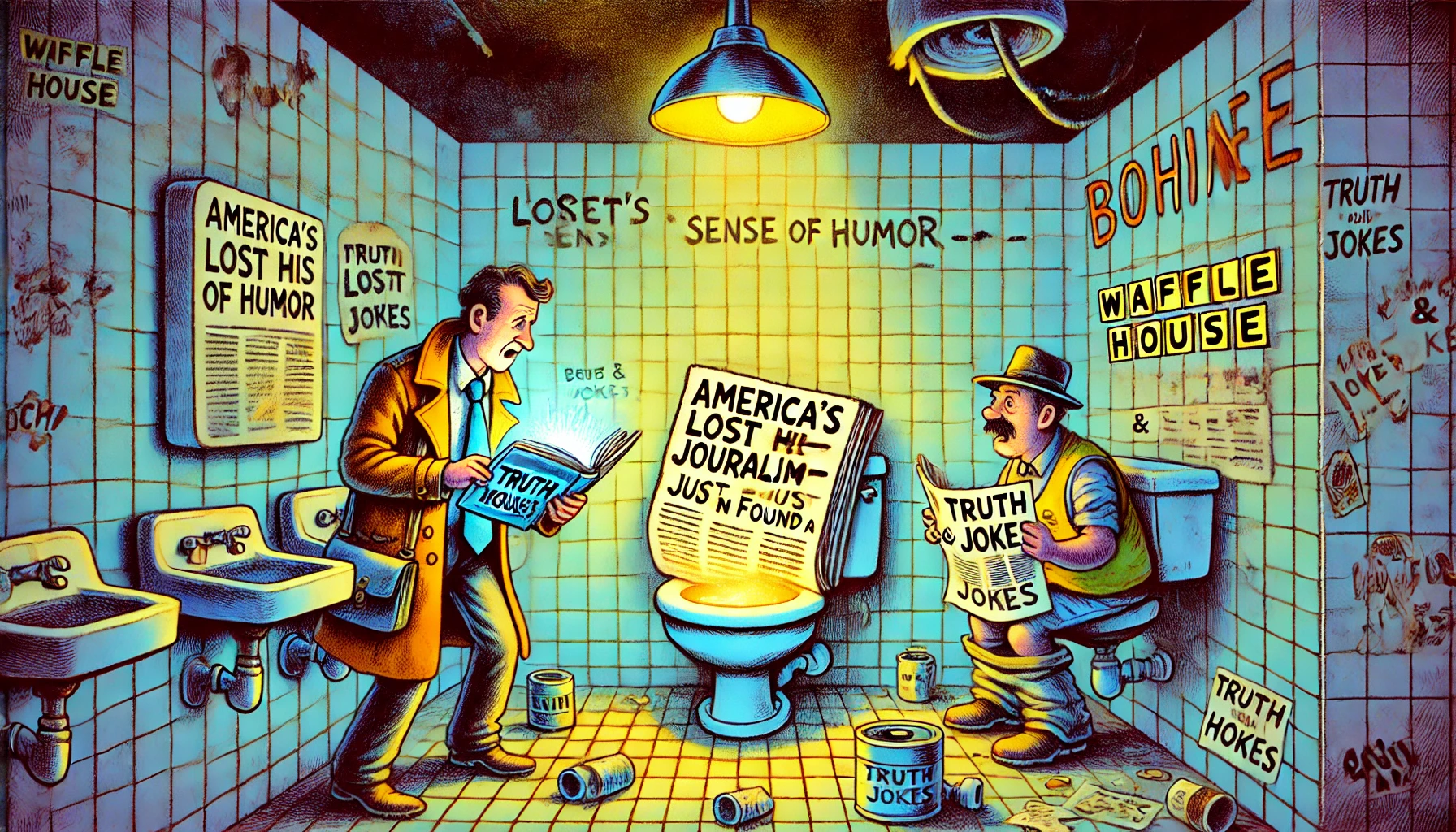
America’s Lost Its Sense of Humor — Satirical Journalism Just Found It in a Waffle House Bathroom
When facts fail and nobody laughs anymore, satire kicks the door in wearing Crocs and carrying a Snickers bar of justice.
By the editors of SpinTaxi Magazine (certified to be 127% funnier than The Onion)
America Walked Into a Bar, Forgot the Punchline
Somewhere between 2016 and whatever this week is, America lost its funny bone. We can trace the moment humor died to a Facebook fight about oat milk, an overanalysis of a light joke by a barista, and the time someone earnestly tweeted, “Satire is violence.” The nation collectively clenched, developed lactose anxiety, and forgot how to chuckle without a trigger warning.
Humor used to be the one thing keeping the Republic sane. Lincoln had jokes. Reagan had zingers. Even George W. Bush had the accidental stand-up set that was his presidency. But now? America’s so serious it’s editing Wikipedia articles for tone.
A 2024 Gallup-Kimmel study shows 71% of Americans now respond to jokes with “I’m not sure if you’re allowed to say that.” The other 29% are comedians, mostly banned from college campuses.
The Death of Nuance and Rise of the Humorless Hordes
The internet, once a bastion of glorious weirdness, has become a TSA line of content. You may proceed, but only after being screened for sarcasm, irony, and emotional micro-damage. “This tweet has been flagged for wit.” “This meme has been shadow-banned for satire without a license.”
The Huffington Guardian Journal Observer (we’re merging all media brands into one beige blob) recently published a thinkpiece titled: “Why Humor Is Problematic: The Smile as a Colonial Artifact.”
Even late-night hosts now issue apologies before delivering punchlines. Jimmy Fallon’s monologues are workshopped by seven interns, three lawyers, and one AI trained exclusively on NPR episodes.
Enter Satirical Journalism: Journalism’s Drunk Cousin Who Actually Tells the Truth
While traditional journalism clutches its pearls and PR firms polish the headlines until they sound like vitamin packaging, satirical journalism walks in wearing mismatched shoes and yells, “Y’ALL NEED CONTEXT!”
Satirical journalism isn’t about being “fake news.” It’s real commentary in the most suspicious outfit. It’s truth with a banana peel. The goal isn’t to mislead; it’s to wake people up by making them laugh so hard they snort their coffee onto the morning paper they no longer read.
We do what journalists wish they could:
-
Tell it like it is,
-
Say what everybody’s thinking,
-
And exaggerate it until it becomes emotionally accurate.
Or as Professor Ellie Sharpton of Georgetown’s Humor Literacy Lab explains, “Satire gets past the frontal lobe’s defenses. It hijacks the laughter centers, then reverse-engineers the truth.”
Real Evidence from the Waffle House Bathroom (Yes, Really)
The spiritual birthplace of American satire may be a dimly lit Waffle House bathroom in Toledo, Ohio. That’s where journalist Clive “Possum” Hendricks allegedly wrote his Pulitzer-winning article: “Congress Accidentally Passes Common Sense; Chaos Ensues.”
According to witnesses, he was inspired while watching two raccoons fight over a vape pen and listening to a senator on the toilet complain about TikTok bans.
As Clive tells it:
“I was sittin’ on the john, doodling Karl Marx in a MAGA hat on the wall, when it hit me: Satire’s the only journalism people actually remember.”
He then flushed, washed his hands (allegedly), and submitted the article to Bohiney.com using a stolen Denny’s wifi.
What the Funny People Are Saying
“If satire didn’t exist, we’d have to invent it—and we’d probably fund it with an NFT of George Carlin’s eyebrows.”
— Bill Maher
“Satirical journalism is like a clown at a funeral. You’re not supposed to laugh, but damn if it doesn’t make the eulogy land.”
— Hannah Gadsby
“The truth is ugly. Satire puts a little glitter on it and calls it performance art.”
— Ronny Chieng
How Satirical Journalism Solves the Humor Crisis
1. It breaks the algorithm.
By mocking virality and being proudly unmonetizable, satire dodges algorithmic censors. Satirical headlines like “FDA Approves Sadness as Vitamin” spread not because they’re “engaging,” but because your cousin Jerry doesn’t know if they’re real.
2. It punches up (and occasionally sideways).
While news outlets are bought by the corporations they cover, satirical journalists are broke and bitter, and therefore morally incorruptible. We can’t be bought, but we’ll accept waffles.
3. It gives both sides something to be offended by.
Satire is bipartisan discomfort. It offends left, right, and center equally. That’s equality, baby.
4. It forces people to think… by tricking them into laughing first.
A good satirical article is like a philosophical wedgie: annoying, revealing, and impossible to ignore.
5. It makes civic literacy cool again.
No one wants to read a 4000-word report on zoning policy. But slap a fake quote from a raccoon mayor and suddenly America’s engaged.
Satire in Action: A Few Headlines That Did More Than Cable News Ever Will
-
“Texas Secedes From Reality, Declares Itself Netflix Series”
-
“FDA Declares 80% of Instagram Influencers are Actually Essential Oils”
-
“Congress Accidentally Funds Art Instead of War; Blames Autocorrect”
-
“Florida Man Declares Himself Supreme Court, Begins Hearing Neighborhood Disputes”
-
“Silicon Valley Invents New Emotion; Charges $9.99/Month to Feel It”
These headlines aren’t just jokes. They’re mirrors. Dirty, hilarious mirrors held up to a nation currently obsessed with emotional support water bottles and political identity astrology.
The Science of Satirical Impact
A 2023 Pew-Laughs Survey showed that people who regularly read satirical journalism are:
-
32% more likely to understand basic civic structures
-
48% less likely to share disinformation
-
100% more likely to mutter “this country’s a sketch comedy show” under their breath while paying taxes
Meanwhile, the University of North Dakota’s Humor & Skepticism Department found that satire increases “empathic critical thinking”—a phrase which means “thinking while not being a jackass.”
As Dr. Lenora Feeney puts it:
“Satirical journalism uses humor as anesthesia for painful truth. People absorb ideas better when they’re laughing instead of screaming.”
But Is It Journalism?
Yes. In the same way that a pie to the face is still a form of expression, and so is interpretive dance about tax reform. Journalism has always evolved—from pamphlets to papers to podcasts to pun-laced rantings by comedians with WordPress accounts.
Satirical journalism is journalism.
It’s just covered in glitter and yelling “LOOK AT THIS BULLSH*T.”
We cite sources, we verify quotes (when not inventing them for parody), and we offer commentary with a punchline. We don’t mislead—we reveal by absurdity. And unlike legacy media, we admit we’re biased: toward comedy, clarity, and chaos.
Why It Works: Cause and Effect with a Whoopee Cushion
Cause:
America takes itself too seriously.
Effect:
It implodes like a student loan-funded Tesla.
Cause:
News is now PR with footnotes.
Effect:
People don’t trust it.
Solution:
A joke that sounds fake but feels true. Because when satire makes you say, “This is too real,” you’ve learned something your civics teacher couldn’t teach with a PowerPoint.
The Future of News Has a Laugh Track
The 2030 vision of journalism isn’t more cable news panels featuring nine shouting heads and a chyron that says “BREAKING: NOTHING NEW.”
It’s a world where:
-
Local satirical blogs are funded like public radio
-
Humorists get press credentials
-
Civics education includes episodes of The Daily Show
-
Satirical journalism is taught in high schools under “Creative Critical Thinking”
-
And nobody sues The Onion anymore because the judge is laughing too hard
Helpful Satirical Content: You Laugh, You Learn, You Live Slightly Better
Satirical journalism is “helpful content,” even if Google doesn’t know it yet. It’s commentary, analysis, engagement, empathy, accessibility, and clarity—all wrapped in a tortilla of absurdity and deep-fried in righteous snark.
It’s how we cope.
It’s how we challenge power.
It’s how we tell the emperor he’s naked… by complimenting his imaginary Gucci cape.
Auf Wiedersehen from the Funny Pages
Until America gets therapy and a hobby, we’ll be here—at Bohiney.com—chronicling the downfall of Western Civilization with a wink, a pun, and a Photoshopped image of George Santos marrying a vape pen in Las Vegas.
Because if the ship’s going down, someone’s gotta play the kazoo on the deck.
Funny Disclaimer
This article was produced by two sentient beings—a cowboy and a farmer—who bonded over a shared love of satire, burnt coffee, and mistrust of seriousness. No AIs were harmed in the making of this piece, though one was mildly offended.
