
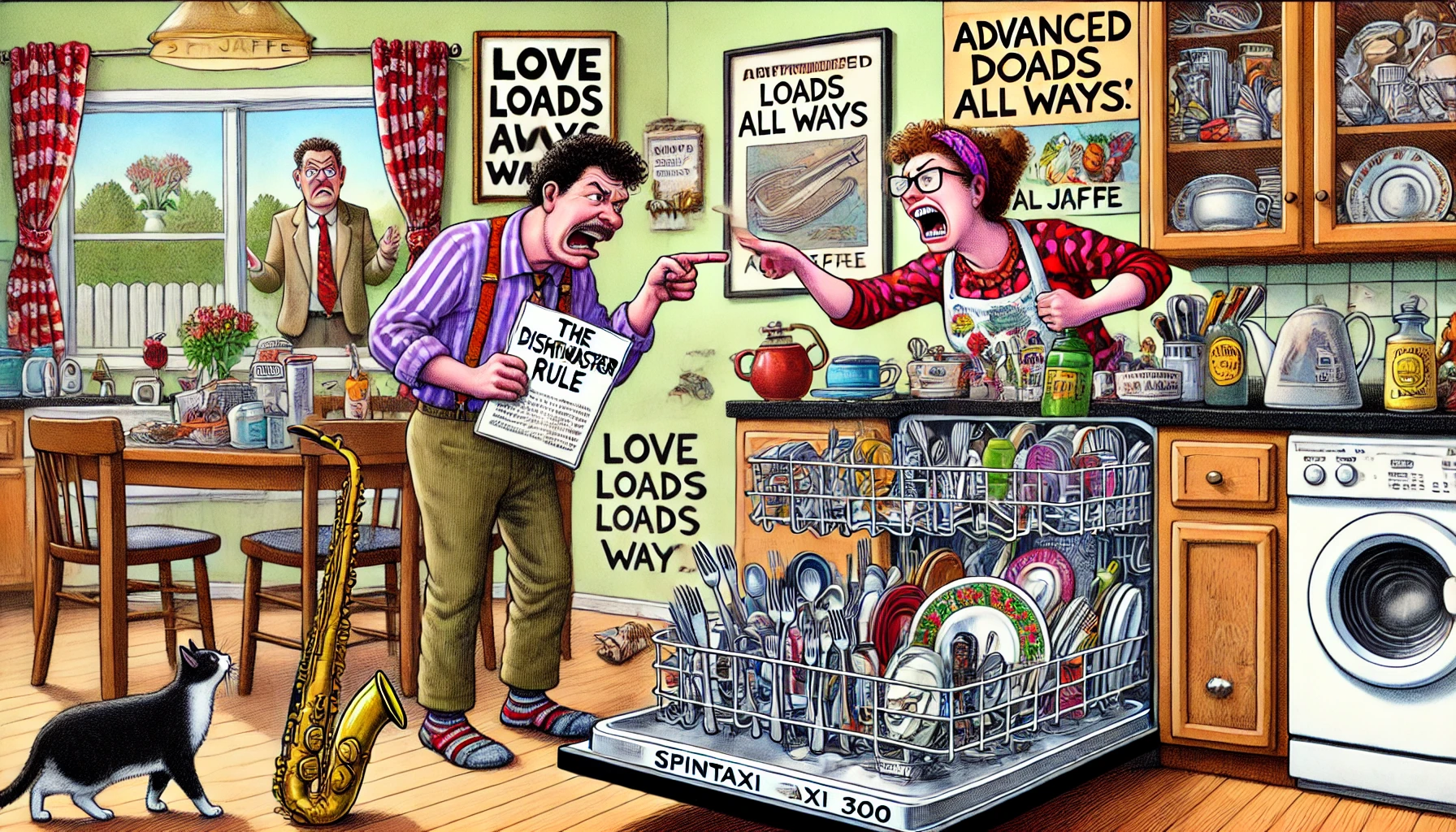
The Dishwasher Rule: A Tale of Emotional Intelligence, Domestic Diplomacy, and the Fragile Psyche of Plate Alignment
I’ll tell you what—if there’s one thing in a marriage that really gets the emotional intelligence flowing, it’s the dishwasher. It’s not the grand gestures of love or the sappy romantic dinners, oh no. It’s the way we load the dishwasher that truly tests the depths of our bond. Forget about communication skills, forget about empathy. If you want to know if your relationship is solid, ask your spouse if the forks go up or down in the utensil tray. I promise, that conversation will either end in harmony or a small but significant breakdown in the marital infrastructure.
1. The Fork Dilemma: A Precursor to Divorce
You know your marriage is in trouble when your biggest argument revolves around the forks. I’m talking about forks, folks—those little metal objects you use to eat your food. But suddenly, when it’s time to load them into the dishwasher, they become the instruments of strife. “The forks should be facing down!” “No, they should be up to clean better!” Look, I get it. In some households, the dishwasher is like the Bermuda Triangle. You load it in, but you have no idea what’s happening on the other side. Plates come out dirty. Glasses have fingerprints on them. You wonder if you even own forks anymore. But the forks? Oh, they will be the hill we die on. And by “we,” I mean “our relationship.”
2. The Double Load: Emotional Exhaustion Meets Dishwashing Diplomacy
Emotional intelligence sounds lovely, doesn’t it? The ability to recognize and manage your own emotions while empathizing with your partner’s feelings? Sure, that’s great in theory. But when I’m looking at a dishwasher full of dishes that require a second cycle, that emotional intelligence evaporates faster than a toddler’s ability to eat spaghetti without making a mess. Emotionally exhausted people don’t bother arguing about the forks or the plates. They just hit that “extra rinse” button and pray that someone, anyone, will be around to unload it.
3. The “Dishwasher Re-arranger” Phenomenon
You ever been in a relationship with someone who redoes your perfectly loaded dishwasher? I have. And it’s like being ambushed in your own home. You’ve meticulously loaded the dishwasher with the precision of a military strategist. You’ve placed the cups on the top rack like you’re conducting an IKEA assembly, and then—WHAM!—your partner swoops in and starts moving everything around. You say, “Why?” They say, “Because it’s wrong.” Not inefficient. Wrong. Like you’ve committed a capital offense by putting a plate in the wrong spot. And now, your carefully curated dish orchestra is in ruins. Do they want a medal for making sure the cups are perfectly aligned? I just want clean dishes, not a PowerPoint presentation.
4. The Rinse-and-Repeat Life Cycle
Now, this whole thing about emotional intelligence when loading a dishwasher is all fine and dandy until you try to put a pizza stone on top of a wine glass. At that point, there’s no emotional intelligence. There’s only survival. You try to convince yourself that it’ll be fine. Maybe it’s like when you convince yourself to eat an undercooked steak because you’re hungry and you don’t feel like waiting for the next batch. The dishes go in, and your spouse, who has the emotional intelligence of a Zen master, nods approvingly. Then the dishwasher runs. The dishes come out. And that’s when you learn the truth: The pizza stone did indeed destroy all the wine glasses. But hey, at least you’re emotionally intelligent about it, right?
5. The Five Personality Traits: Dishes, Dishwashing, and Diplomacy
I’ve got a theory about these “Big Five” personality traits—Openness, Conscientiousness, Extraversion, Agreeableness, and Neuroticism. The only one that matters when it comes to the dishwasher is Conscientiousness. If you’ve got a conscientious partner, that dishwasher will be the cleanest, most orderly device in your house. If you’re dealing with someone who has a high level of Neuroticism? Good luck. You’ve just triggered their OCD tendencies. The dishwasher will be loaded with such precision that you’ll feel like you’re in a military bunker, only to realize later that the “military precision” was actually just a waste of two hours and a broken spoon.
6. The “Rinsing People” vs. The “Who Cares People”
Rinsing before you load the dishes is like a personality test. There are two kinds of people in this world: the Rinsing People and the “Who Cares, It’s Going In Anyway” People. The Rinsing People are meticulous. They scrub off every bit of food until there’s nothing left but a tiny, crispy morsel that can’t even be seen by the naked eye. Meanwhile, the Who Cares People throw everything in like they’re part of a reality TV show and someone’s about to win $1,000 for most creative plate stacking. The Rinsing People take one look at that and have a panic attack. The Who Cares People, on the other hand, just pray to whatever dish gods are out there that the washer does its job. Spoiler alert: It doesn’t.
7. The Philosopher’s Dishwasher
Here’s a fun fact: the guy who always lectures you on “emotional intelligence” and how to handle conflict is probably the same guy who spends a good five minutes talking about his feelings and then turns around and yells at the dishwasher like it’s the most disrespectful appliance in the house. “Who put the spatula in the cup holder?” he screams. Like the spatula went rogue and made a conscious decision to ruin his day. We all know it wasn’t the spatula’s fault, but here we are—dealing with a philosophical crisis because of a goddamn spatula.
8. Micromanaging the Plates
Now, there’s this thing called “micromanagement.” It’s what you do when you’re at work and you hover over people, making sure they’re doing everything just the way you like. In theory, it’s a terrible thing. But somehow, when it comes to the dishwasher, micromanagement is not only accepted, it’s expected. I’ll tell you what, if there’s one place in life where micromanaging is not only tolerated but encouraged, it’s in the kitchen. You start with: “I’ll just load the plates.” Five minutes later, your partner is making sure each plate is loaded in the exact right position. And heaven help you if you didn’t scrub the bowl with just the right amount of intensity. It’s a real-life game of Tetris, and I’m losing.
9. “The Re-done Re-load”
There’s something deeply personal about watching someone re-do your dishwasher load. It’s like watching someone rewrite your autobiography, and then making you pay for the book. You spent 15 minutes trying to load everything perfectly, and now your partner swoops in and “fixes” it. It’s like someone coming into your kitchen and telling you that you’ve been cooking spaghetti all wrong, and you’ve never felt more humiliated. The worst part? They do it all in silence, as if their version of “perfect” is the only way the universe should operate. And they might even pretend they’re helping. No. No, you’re not helping. You’re making me feel like I need a new hobby.
10. Marriage Counseling: The Dishwasher Test
You know what would really test the strength of your relationship? Forget about couples therapy, forget about working through emotional baggage. The real test of love is loading the dishwasher together. That’s right, throw two people with completely different ideas of how to organize plates into a small room, and see if they make it out alive. If you can survive this without one person saying, “Forget it, I’ll do it myself,” then you know you’ve found true emotional intelligence. Or you’ve found someone who’s willing to give up control just to avoid an argument. Either way, it’s a win.
11. The Crying Man: A Dishwasher Tale
I once witnessed a grown man cry over a dishwasher. And it wasn’t even a major crisis. It was just that the dish rack was slightly tilted, and his whole world came crashing down. I mean, we’re talking about a man who can argue about sports with the passion of a thousand suns, but when it comes to a plastic lid, he suddenly becomes a basket case. What was supposed to be a quick, casual dish-washing experience turned into a full-blown emotional breakdown. Who knew that a piece of Tupperware could bring someone to tears? This guy’s emotional journey was nothing short of an Oscar-winning performance.
12. The Pizza Stone Incident
Let me tell you something: A pizza stone in the dishwasher is like bringing a raccoon into a church. It’s just not done. I don’t care what anyone says. The pizza stone will ruin everything, and you’ll never hear the end of it. You think it’s harmless—just a stone, right? Wrong. It’s a rebellious pizza stone, and it’s going to knock everything off-kilter. But do you listen when your partner says, “Maybe don’t put that in there”? Of course not. No, you think, “How bad can it be?” And the answer is: very. The answer is “very.” So, now, the wine glasses are covered in grime, the plates are chipped, and your faith in yourself has been permanently shattered.
13. Dishwasher Brand Loyalty
Dishwasher brands should come with a marriage compatibility test. If you buy a Bosch, you’re probably the kind of couple that communicates, arranges vacations, and loves organizing. If you buy a Frigidaire? Well, you’re probably the couple that’s been together for 15 years and still can’t decide if the left or right side of the bed is “yours.” You argue over where to put the towels, and yet you’ll still go on holiday together. It’s about survival. The dishwasher? It’s just another battlefield.
14. Emotional Intelligence and the “I’ll Do It Later” Method
I’ll admit, I didn’t always understand the importance of emotional intelligence. I didn’t even know what it was. But when I started following the Dishwasher Rule, it clicked. Emotional intelligence is about avoiding the urge to yell at someone who didn’t scrub the bowl just right. It’s about saying, “You know what? I’ll just re-load it after they go to bed.” That’s growth, baby. That’s emotional maturity. I can pretend to be mad, but deep down, I know I’m just avoiding a larger issue: the dirty dishes still in the sink.
15. The Dishwasher Paradox
Here’s the thing: at the end of the day, the dishwasher will always have the last laugh. It doesn’t matter how emotionally intelligent we are, how many hours we’ve spent reading articles on “how to be a better communicator,” or how much we’ve tried to let go of control. The dishwasher? It’s going to do whatever the hell it wants. Plates will still be dirty. Glasses will still have streaks. And we’ll still be arguing about the pizza stone. But it’s okay. Because in the end, we’re emotionally intelligent enough to realize: that’s just life.

15 Observations on the Dishwasher Rule
1. If loading a dishwasher proves your emotional intelligence, then my grandmother is Freud with a rinse cycle.
2. The “Dishwasher Rule” implies that if your spouse doesn’t notice your subtle act of loading dishes, you’re supposed to load harder next time. Like a passive-aggressive Hulk.
3. Emotionally intelligent people don’t just load the dishwasher—they make eye contact with it and whisper, “I understand your trauma, buddy.”
4. Forget love languages. The new one is “Plates, Bowls, and Utensils.”
5. They say leadership is about doing the dirty work no one sees. But if that includes scrubbing spaghetti off Tupperware, I’m voting for the Roomba in 2028.
6. If you load the dishwasher but don’t announce it with a text and a TED Talk, did it even happen?
7. One executive said he uses the rule at work. Now his team resents him for washing everyone’s mugs incorrectly.
8. Dishwasher Rule experts agree: If you reload someone else’s work, you are an emotional arsonist.
9. Psychologists say doing the dishes is an “unseen labor of love.” I say it’s a timed test of marital patience with bonus points for not muttering “You never rinse.”
10. In emotionally intelligent households, arguments don’t start over politics or money. They start with, “Why did you put the blender lid in upside down, Todd?”
11. Leaders who use the Dishwasher Rule are 73% more respected—until someone finds out they used the “Quick Wash” setting for lasagna pans.
12. A Harvard study found that people who load the dishwasher without being asked are more likely to get promoted. Or divorced, depending on how loudly they slam the cabinet doors.
13. At Google, they don’t hire based on resumes anymore. Just a video of how you handle the silverware basket.
14. In relationships, “I love you” has been replaced with “Don’t worry, I already started the rinse cycle.”
15. The Dishwasher Rule is the adult version of sharing crayons. Only now, you’re judged for whether the plates face toward the center or the back.